

- BGG-Rang
- BGG #7.195
- BGG-Bewertung
- 6,8
Cobra: Game of the Normandy Breakout
- 2 Spieler
- 120–480 Min.
- Komplexität 2,8/5
- 1977
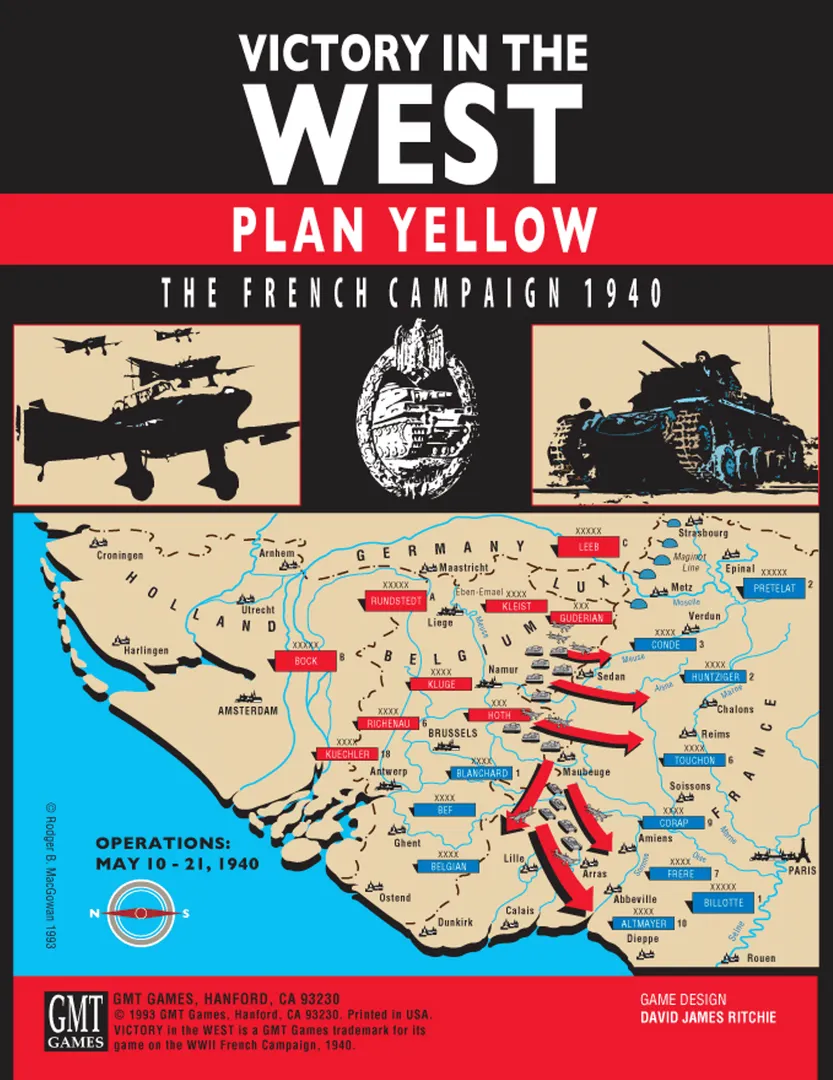
1993
Regelhilfe für Victory in the West: Plan Yellow, The French Campaign 1940
Verständliche Erklärungen zu Spielzügen, Karteneffekten und strittigen Situationen mit Verweisen auf offizielle Quellen und gespeichertem Fragenverlauf.
Für 2 Personen
Was möchtest du wissen?
Antworten stammen aus dem offiziellen Regelheft, mit Seitenangabe zum Nachprüfen.
Victory in the West: Plan Yellow, The French Campaign 1940 ist ein Brettspiel aus dem Jahr 1993 für 2 Personen, mit 360 Minuten pro Partie und ab 14 Jahren. Entwickelt wurde es von David James Ritchie; die wichtigsten Mechaniken sind Dice Rolling, Variable Set-up und Hexagon Grid.






Auf Englisch
Victory in the West: Plan Yellow, The French Campaign 1940, is a realistic two-player game that accurately recreates the 1940 campaign in all its aspects except one: the outcome is totally up to you. The game's centerpiece is an options system that lets the Allied player trade Victory Points for changes to his armies and policies that might (or might not) have changed history. Can you, as the Allied commander, repel the Germans with the forces on hand in 1940? How about if you train them better? Or give them a better command structure? Or provide them with more and better anti-aircraft an anti-tank guns? What do you think is the key to victory in the west? Can you, as the German commander, still beat the Allies if the French Army is motorized like the BEF? And how does your strategy change if the French don't build their Maginot Line, but do build a bigger and better air force? Do you still try to sneak through the Ardennes forest with your Panzers? Or do you ignore Allied bombers and wheel across the open plains of northern Belgium in a repeat of the 1914 Schlieffen Plan? Or do you do the unexpected and land a left hook through the Alsace? Your commanders await your orders. The future of Europe is in your hands. 10 May, 1940 ... The German Wehrmacht opened its long-awaited campaign in the West by smashing across the frontiers of Belgium and Holland. For the German High Command, it was seen as a daring move. Hitler's fledgling legions faced the combined armies of France, Britain, Belgium and the Netherlands. These Allied forces had more and better weapons of almost every type, and at least two of the opposing armies, those of France and Britain, were considered to be the best in the world. The Germans had the element of surprise and the new Blitzkrieg tactics of mobile warfare. Six weeks later, it was all over. The British Expeditionary Force (BEF) had been driven from the continent and the French, Belgians, and Dutch had all capitulated. Hitler had achieved a victory in the west, and the world would never be the same. But, what if? It didn't have to happen that way ... Bad generalship and correctable flaws in their armies hastened the Allied defeat. What if the High Command had bothered to stay in radio contact with its armies on the frontier? And had then reacted promptly to the developing situation? What if the Maginot Line had been extended to cover the Meuse crossings at Sedan where Guderian's Panzers broke into the Allied rear? What if the BEF had included a strong British mobile corps that could have fought Rommel's Panzers on even terms at Arras? What if the French had prepared to meet the Blitzkrieg by building eight tank divisions instead of three? Or by mechanizing their cavalry the way the Germans did after the Polish campaign? Or even by developing their own blitzkrieg doctrine? The Allies could have taken any or all of these actions, and any of them would have altered the campaign's course. But which ones would have changed the outcome? Game Scale: Game Turn: 2 days Hex: 6.8 miles / 11 kilometer Units: Battalion to Army Game Inventory: One 22 x 34" full color mapsheet One 17 x 22" full color mapsheet Three dual-side printed countersheets (720 1/2" counters) One 32-page Victory in the West rulebook One 8-page Victory in the West Example of Play booklet One 4-page Victory in the West Design Notes booklet Five dual-side printed Player Aid Cards One 10-sided dice Solitaire Playability: High Complexity Level: Medium Players: 2 or more Playing Time: 2-20 hours DESIGNER: David James Ritchie DEVELOPER: Kevin Boylan and Gene Billingsley ART DIRECTOR: Rodger B. MacGowan MAP ART: Mark Simonitch
Laut Katalog unterstützt Victory in the West: Plan Yellow, The French Campaign 1940 2 Personen. Das ist die vom Verlag angegebene Spielerzahl, das Spiel ist also genau für diese Anzahl von Mitspielenden ausgelegt. Varianten für andere Gruppengrößen sind, sofern vorhanden, in der Anleitung deiner Ausgabe beschrieben; prüfe sie, bevor du eine andere Konfiguration aufbaust.
Die angegebene Spieldauer für Victory in the West: Plan Yellow, The French Campaign 1940 beträgt 360 Minuten. Das ist die Schätzung des Verlags für eine vollständige Partie. Die tatsächliche Dauer hängt von der Gruppe, der Personenzahl und der Regelkenntnis ab: Erste Partien dauern meist länger, erfahrene Gruppen sind oft schneller fertig. Aufbau und Regelerklärung sind in dieser Schätzung nicht enthalten.
Im Katalog wird Victory in the West: Plan Yellow, The French Campaign 1940 ab 14 Jahren empfohlen. Das ist die Empfehlung des Verlags und berücksichtigt Leseanforderungen, Regelkomplexität und Kleinteile, nicht nur das Thema. Jüngere Kinder können oft mit Hilfe eines Erwachsenen mitspielen; beachte die Altersangabe deiner Ausgabe und die Brettspielerfahrung deiner Gruppe.
Victory in the West: Plan Yellow, The French Campaign 1940 hat bei BoardGameGeek eine Komplexitätswertung von 3,4 von 5 und gilt damit als mittelschweres Spiel. Die Wertung zeigt, wie viel Regelwissen, Planung und Entscheidungen eine typische Partie verlangt. Schwerere Spiele brauchen bei der ersten Erklärung mehr Zeit, daher hilft vor dem Spieleabend eine Vorbereitungsanleitung.
Victory in the West: Plan Yellow, The French Campaign 1940 gehört zu diesen Kategorien: Wargame und World War II. Die wichtigsten Mechaniken sind Dice Rolling, Variable Set-up und Hexagon Grid. Kategorien beschreiben Thema und Setting eines Spiels, Mechaniken dagegen, was die Spielenden in ihrem Zug tatsächlich tun. Jede Mechanik führt zu einer Katalogseite mit ähnlichen Spielen, falls du etwas Vergleichbares suchst.
Als Autoren von Victory in the West: Plan Yellow, The French Campaign 1940 sind angegeben: David James Ritchie. Diese Angaben stammen aus den veröffentlichten Spieldaten und nennen die für das Spieldesign verantwortlichen Personen, nicht die Illustratoren oder Verlage. Die Autorenseiten auf MeepleRules sammeln weitere Titel derselben Autoren – praktisch, wenn dir ein Spiel gefällt und du ähnliche Spiele suchst.
Im Katalog ist Victory in the West: Plan Yellow, The French Campaign 1940 als Grundspiel aufgeführt. Es lässt sich eigenständig mit dem Material aus der Schachtel spielen und benötigt keinen weiteren Titel. Erweiterungen, sofern es welche gibt, ergänzen neues Material oder neue Regeln und sind im Katalog separat mit einem Verweis auf dieses Grundspiel aufgeführt.