
- BGG-Rang
- BGG #28.006
- BGG-Bewertung
- 5,4
Ökolopoly
- 1–6 Spieler
- 45 Min.
- Komplexität 2,6/5
- 1983
2021
Regelhilfe für Which Side?
Verständliche Erklärungen zu Spielzügen, Karteneffekten und strittigen Situationen mit Verweisen auf offizielle Quellen und gespeichertem Fragenverlauf.
Was möchtest du wissen?
Antworten stammen aus dem offiziellen Regelheft, mit Seitenangabe zum Nachprüfen.
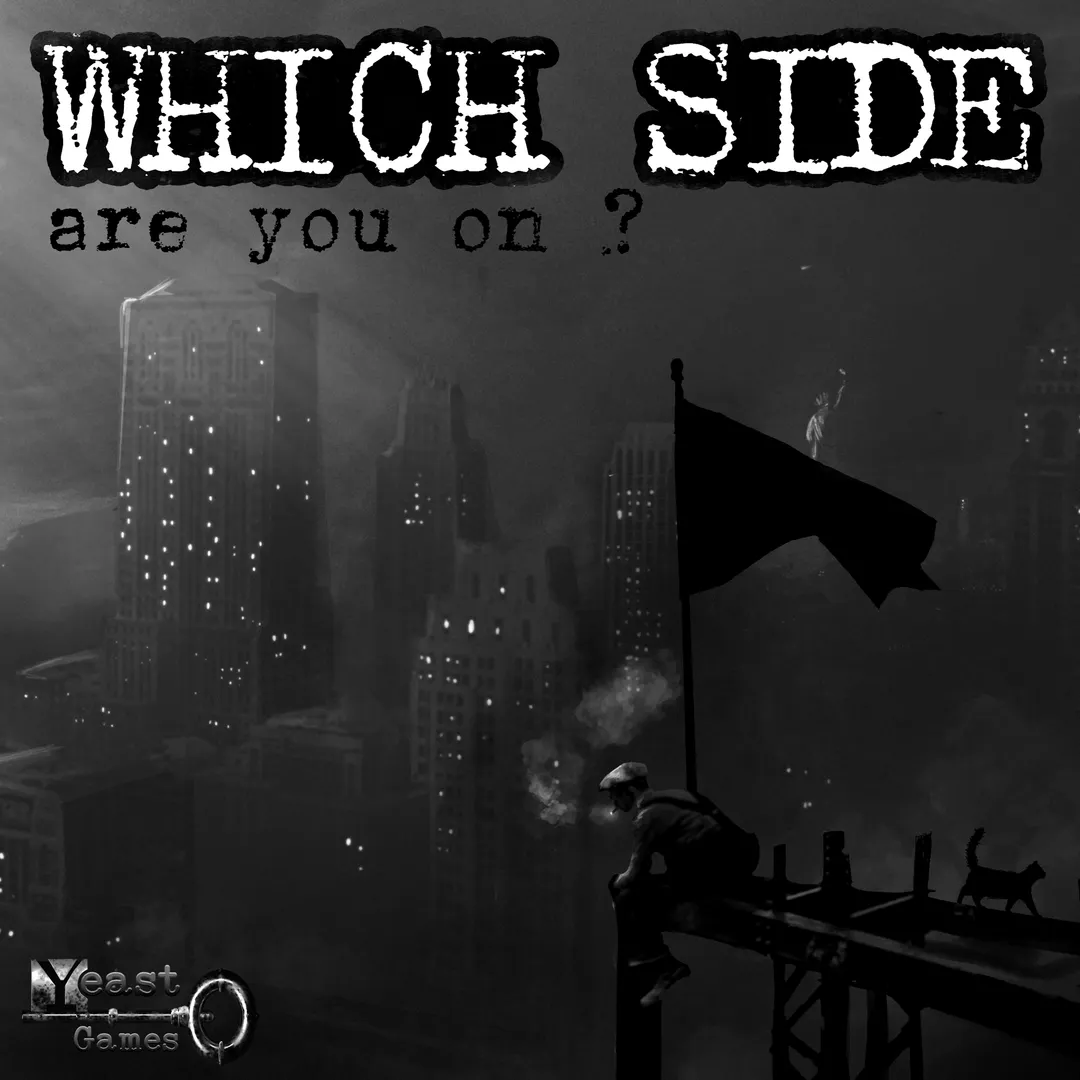
Which Side? ist ein Brettspiel aus dem Jahr 2021 für 1–4 Personen, mit 120–180 Minuten pro Partie und ab 14 Jahren. Entwickelt wurde es von Alexandre Weiss und Franck "Counit" Catoire; die wichtigsten Mechaniken sind Cooperative Game und Worker Placement.






Auf Englisch
CONTEXT At the beginning of the 20th century, capitalism and the nation-state are in full swing, workers have it hard: Working conditions; Work time; Wages; Unsanitary housing; everything systematically leans in favor of employers. Yet since May 1, 1886 and the Haymarket Massacre, workers have tried to organize and resist, supported by a new generation of increasingly committed anarchist and union activists. The scenario of "Which Side are you on?" takes place in New York, during the winter of 1910-1911 and stages homes of workers who try to survive and organize themselves to take control of the means of production before the employers become too powerful. It takes place between two events revealing the working conditions of textile workers: - On November 25, 1910, a fire occurred at a four-story factory in Newark, New Jersey. 25 factory workers, mostly young women, died. - On March 25, 1911, exactly four months after the Newark event, a fire engulfs the 8th, 9th, and 10th floors of the Asch Building, occupied by the Triangle Waist Company, causing the death of 146 workers. THE GAME "Which Side are you on?" is a historical and cooperative survival game that simulates the struggle of the workers in New York between the years 1910 and 1911; for their survival; against employer offensives; for the control of the means of production. Workers pose and resource collection mechanisms allow for a fluid game; and a system of elements with their historical context, which facilitates immersion. This game will particularly appeal to players who like adversity, cooperation, immersion, History ... and perseverance! HOW TO PLAY 1-A game lasts 10 turns. Each turn, the bosses carry out offensives through cards drawn at random. These cards establish temporary or permanent mini-rules against players. 2-You will be playing a family or a small group of people living together. Each member is one of your "workers" and has one action to perform per turn. 3-Each turn, you send your "workers" to the Tiles of New York in order to: a / work and be paid in order to pay your rent, your food and the expenses of the struggle; b / work in political places to cause agitation, strikes or sabotage. 4-Then, you will use agitation, strikes and sabotage to fight the bosses offensives against your rights. 5-With the added agitation, evolve the New York Tiles to make them more worker friendly; complete 6 objectives and take control of the means of production BEFORE the bosses take control of everything and even leave you enough to survive. 6-Be careful, each turn you will have to draw: a / misfortune cards which will make everyone's life even more difficult; b / incident cards which will strike the player who will have the most Risk (obtained according to the work), Police Threat (obtained by causing agitation) OR the least healthy. 7-You could end up with workers in prison, injured, or sick. Which will lower your possibilities for your next turn. HOW TO WIN 1-Victory: Take control of New York's means of production by purchasing 6 objectives with your resources. 2-You lose if you fail to pay the cost of your living or if the bosses reach turn 10. —description from the publisher
Laut Katalog unterstützt Which Side? 1–4 Personen. Diese Spanne entspricht der vom Verlag angegebenen Spielerzahl, das Spiel lässt sich also für jede Gruppengröße innerhalb dieser Spanne aufbauen. Aufbau, einzelne Regeln und Wertungsdetails können je nach Personenzahl trotzdem abweichen; prüfe daher die genaue Konfiguration in der Anleitung deiner Ausgabe.
Die angegebene Spieldauer für Which Side? beträgt 120–180 Minuten. Das ist die Schätzung des Verlags für eine vollständige Partie. Die tatsächliche Dauer hängt von der Gruppe, der Personenzahl und der Regelkenntnis ab: Erste Partien dauern meist länger, erfahrene Gruppen sind oft schneller fertig. Aufbau und Regelerklärung sind in dieser Schätzung nicht enthalten.
Im Katalog wird Which Side? ab 14 Jahren empfohlen. Das ist die Empfehlung des Verlags und berücksichtigt Leseanforderungen, Regelkomplexität und Kleinteile, nicht nur das Thema. Jüngere Kinder können oft mit Hilfe eines Erwachsenen mitspielen; beachte die Altersangabe deiner Ausgabe und die Brettspielerfahrung deiner Gruppe.
Which Side? hat bei BoardGameGeek eine Komplexitätswertung von 3,7 von 5 und gilt damit als mittelschweres Spiel. Die Wertung zeigt, wie viel Regelwissen, Planung und Entscheidungen eine typische Partie verlangt. Schwerere Spiele brauchen bei der ersten Erklärung mehr Zeit, daher hilft vor dem Spieleabend eine Vorbereitungsanleitung.
Which Side? gehört zu diesen Kategorien: Political, Educational und Industry / Manufacturing. Die wichtigsten Mechaniken sind Cooperative Game und Worker Placement. Kategorien beschreiben Thema und Setting eines Spiels, Mechaniken dagegen, was die Spielenden in ihrem Zug tatsächlich tun. Jede Mechanik führt zu einer Katalogseite mit ähnlichen Spielen, falls du etwas Vergleichbares suchst.
Als Autoren von Which Side? sind angegeben: Alexandre Weiss und Franck "Counit" Catoire. Diese Angaben stammen aus den veröffentlichten Spieldaten und nennen die für das Spieldesign verantwortlichen Personen, nicht die Illustratoren oder Verlage. Die Autorenseiten auf MeepleRules sammeln weitere Titel derselben Autoren – praktisch, wenn dir ein Spiel gefällt und du ähnliche Spiele suchst.
Im Katalog ist Which Side? als Grundspiel aufgeführt. Es lässt sich eigenständig mit dem Material aus der Schachtel spielen und benötigt keinen weiteren Titel. Erweiterungen, sofern es welche gibt, ergänzen neues Material oder neue Regeln und sind im Katalog separat mit einem Verweis auf dieses Grundspiel aufgeführt.