
Yggdrasil Chronicles: Les Voyages de Rig Scenario
- 1–5 Spieler
- 90 Min.
- 2020
2019
Regelhilfe für Yggdrasil Chronicles
Verständliche Erklärungen zu Spielzügen, Karteneffekten und strittigen Situationen mit Verweisen auf offizielle Quellen und gespeichertem Fragenverlauf.
Für 1 Person
Was möchtest du wissen?
Antworten stammen aus dem offiziellen Regelheft, mit Seitenangabe zum Nachprüfen.
Yggdrasil Chronicles ist ein Brettspiel aus dem Jahr 2019 für 1–5 Personen, mit 90 Minuten pro Partie und ab 14 Jahren. Entwickelt wurde es von Cédric Lefebvre; die wichtigsten Mechaniken sind Variable Player Powers, Cooperative Game und Map Deformation.

Auf Englisch
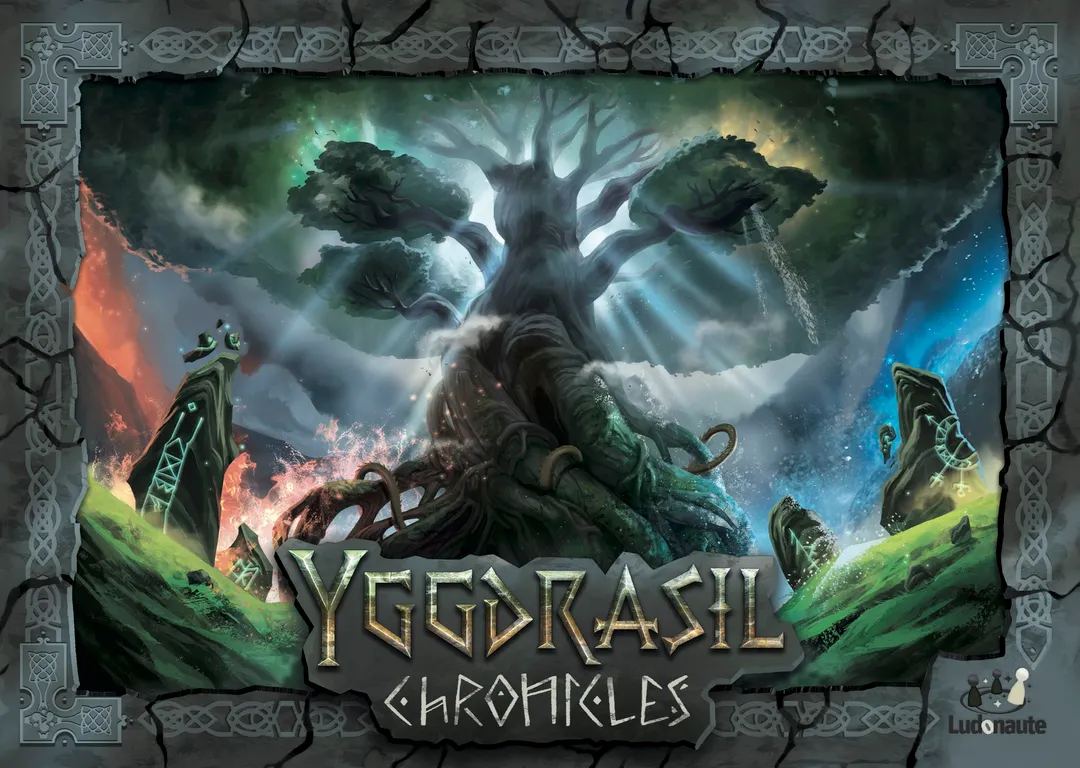
In Yggdrasil Chronicles, each player takes the role of a Norse god and attempts to keep evil forces from devastating the nine worlds, destroying the world tree Yggdrasil, and surviving the onset of Ragnarök. To set up, each player takes one of the seven Norse gods, 5-9 life points (depending on the player count), and a set of cards showing the six enemies who are attacking the nine worlds; you shuffle these enemy cards and place them next to you. These nine worlds are represented on a three-level, 3D game board, with the board having locations for artifact cards, creature cards, hero pawns, elf pawns, anonymous pawns, and more. Each level of the board depicts three worlds on it, and the middle board rotates. At the start of a round, each player places the top card of their enemy deck on the "Wheel of Enemies". Players can take turns in any order. On a player's turn, they first reveal their enemy card. If this is the first appearance of this enemy this round, the player continues their turn; if not, then the enemy is activated, typically moving to a different world, then taking some action. If the enemy can't move, e.g., Surt is supposed to move up a level, but is already on the top level, you lose the game. If the enemy can't take its action, e.g., Loki needs to place an Iotunn pawn, but none remain in Iotunheim, you lose the game. While normally you hope to avoid duplicating an enemy, you want to double up on Nidhögg as that enemy starts on the leftmost space in your saga book, and if Nidhögg moves all the way to the tree icon, you win the game. (Nidhögg might also trigger effects when moving to a new location.) If an enemy moves to where another enemy is located, that world is devastated and no action is possible there except for healing the world tree. Whether or not an enemy is activated, you can then move — either to a different world on the same level or a different level above or below your current location — then act, either performing the action of the world in which you're now located or fighting. Powerful god that you are, you always win a fight, but you suffer "risks" equal to the strength of the enemy. You can sacrifice heroes in Valhalla to remove risks or make saving throws on dice, possibly with an elf assist, but each risk you don't prevent costs you 1 life point — and if any god runs out of life points, you lose the game. As for performing world actions, you can collect elves, heroes, artifact cards; remove Hel's anonymous minions or Surt's fire giants; or receive help from worldly creatures. If another god stands in this world, your action is improved; if an enemy stands in that world, then your action is penalized. In addition to that base game, you can play Yggdrasil Chronicles on the hard mode, which increases the challenge of gameplay while giving each god unique powers. The game also includes a six-saga "Ragnarök campaign" that begins with Baldr's murder, then carries on from there.
Laut Katalog unterstützt Yggdrasil Chronicles 1–5 Personen. Diese Spanne entspricht der vom Verlag angegebenen Spielerzahl, das Spiel lässt sich also für jede Gruppengröße innerhalb dieser Spanne aufbauen. Aufbau, einzelne Regeln und Wertungsdetails können je nach Personenzahl trotzdem abweichen; prüfe daher die genaue Konfiguration in der Anleitung deiner Ausgabe.
Die angegebene Spieldauer für Yggdrasil Chronicles beträgt 90 Minuten. Das ist die Schätzung des Verlags für eine vollständige Partie. Die tatsächliche Dauer hängt von der Gruppe, der Personenzahl und der Regelkenntnis ab: Erste Partien dauern meist länger, erfahrene Gruppen sind oft schneller fertig. Aufbau und Regelerklärung sind in dieser Schätzung nicht enthalten.
Im Katalog wird Yggdrasil Chronicles ab 14 Jahren empfohlen. Das ist die Empfehlung des Verlags und berücksichtigt Leseanforderungen, Regelkomplexität und Kleinteile, nicht nur das Thema. Jüngere Kinder können oft mit Hilfe eines Erwachsenen mitspielen; beachte die Altersangabe deiner Ausgabe und die Brettspielerfahrung deiner Gruppe.
Yggdrasil Chronicles hat bei BoardGameGeek eine Komplexitätswertung von 3,0 von 5 und gilt damit als eher leichtes Spiel. Die Wertung zeigt, wie viel Regelwissen, Planung und Entscheidungen eine typische Partie verlangt. Schwerere Spiele brauchen bei der ersten Erklärung mehr Zeit, daher hilft vor dem Spieleabend eine Vorbereitungsanleitung.
Yggdrasil Chronicles gehört zu diesen Kategorien: Mythology. Die wichtigsten Mechaniken sind Variable Player Powers, Cooperative Game und Map Deformation. Kategorien beschreiben Thema und Setting eines Spiels, Mechaniken dagegen, was die Spielenden in ihrem Zug tatsächlich tun. Jede Mechanik führt zu einer Katalogseite mit ähnlichen Spielen, falls du etwas Vergleichbares suchst.
Als Autoren von Yggdrasil Chronicles sind angegeben: Cédric Lefebvre. Diese Angaben stammen aus den veröffentlichten Spieldaten und nennen die für das Spieldesign verantwortlichen Personen, nicht die Illustratoren oder Verlage. Die Autorenseiten auf MeepleRules sammeln weitere Titel derselben Autoren – praktisch, wenn dir ein Spiel gefällt und du ähnliche Spiele suchst.
Im Katalog ist Yggdrasil Chronicles als Grundspiel aufgeführt. Es lässt sich eigenständig mit dem Material aus der Schachtel spielen und benötigt keinen weiteren Titel. Erweiterungen, sofern es welche gibt, ergänzen neues Material oder neue Regeln und sind im Katalog separat mit einem Verweis auf dieses Grundspiel aufgeführt.