
- BGG rating
- 8.0
221B Baker St.: Sherlock Holmes & the Time Machine – Set #2
- 2–6 players
- 1997

1996
Rules assistance for 221B Baker St.: Sherlock Holmes & the Time Machine
Plain-language explanations of turns, card effects and disputed situations, with official source references and saved question history.
What would you like to know?
Answers come from the official rulebook, with the page to check.
221B Baker St.: Sherlock Holmes & the Time Machine is a board game released in 1996 for 2–6 players, 45 minutes per game, and ages 12 and up. It was designed by Jay Moriarty and Antler Productions and its main mechanics are Roll / Spin and Move.
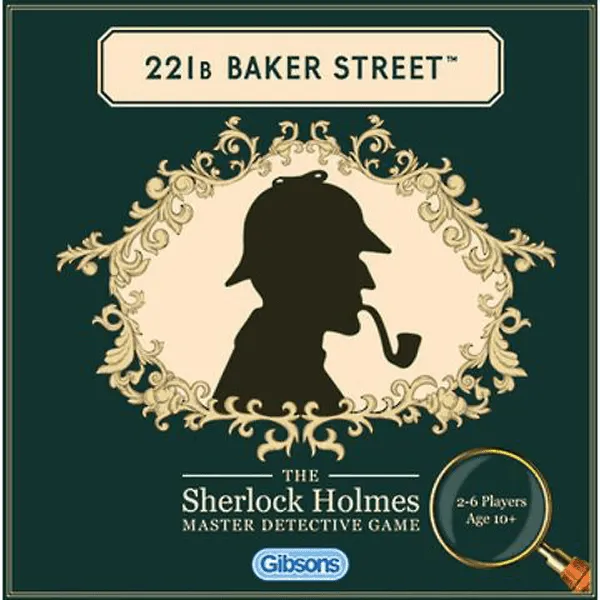




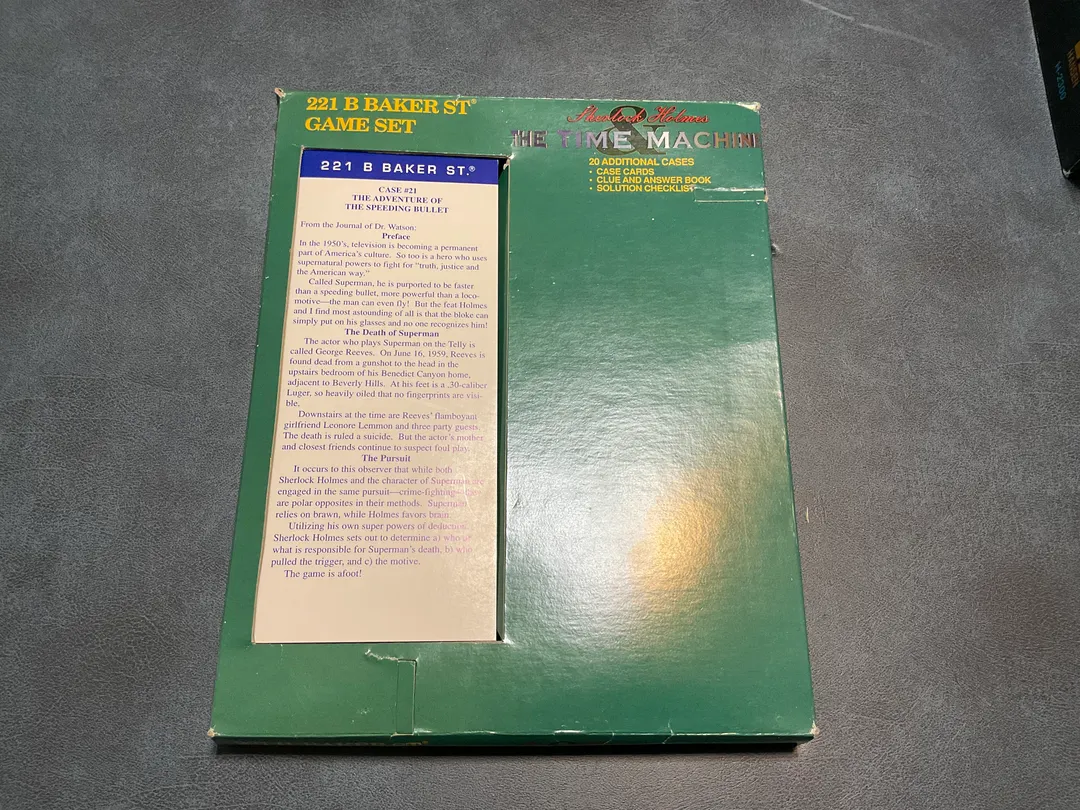
This is the newest edition of the 221B Baker St. game, and the gameplay is nearly identical to the original. Twenty "all-new, all-true" mysteries of the 20th century include: The JFK assassination in "The Camelot Conspiracy, Pt. I and II" Jimmy Hoffa's disappearance in "The Vanishing Teamster" Elvis's death in "The King's Early Exit" 221B Baker Street is the London address of the world's most celebrated fictional detective, Sherlock Holmes, and his dedicated companion, Dr. Watson. However, instead of staying in London, in this version players use H. G. Wells' Time Machine to travel to the future, attempting to solve infamous cases from the 20th Century. Each player assumes the role of Holmes and matches wits with the other players to determine who possesses the most skillful powers of deduction. The game includes 20 cases based on famous crimes and criminals of the 20th Century, including the Zodiac Killer, Sacco and Vanzetti, the Lindbergh Kidnapping, and "The Black Dahlia". Each case is represented by a card that features a crime told in story form, a selection of probable suspects and a list of locations involved in that crime. The board represents the various cities the crimes occurred in, with eighteen generic locations to find clues (Pharmacy, Hotel, Airport, Supermarket, Tavern, Harbor, FBI, etc.). Players must collect clues from different locations, noting them down on their checklists as they attempt to find the answers to the questions listed on the case card. Movement is via die roll. Naturally, the crime scene will often contain vital clues, and a prudent detective always checks with the neighbors. Still, you can learn something important almost anywhere in town. The first player to figure out the correct answers to a particular mystery or crime, return to the Time Machine and announce the solution, is the winner. There are two versions of this edition: Standard and Deluxe. The Standard version uses regular movers, while the Deluxe version includes six "collectible" pewter playing pieces: Deerstalker Cap, Time Machine, Dark Lantern, Magnifying Glass, Violin, Pipe. Contents: Rules Game Board 6 Tokens Die Badge Cards Key Cards Checklist Pad Clues & Solutions Booklet 20 Case Cards (based on true, unsolved mysteries of the 20th Century) For 2 – 6 players ages 12+
221B Baker St.: Sherlock Holmes & the Time Machine supports 2–6 players according to the catalogue. This range comes from the publisher’s listed player count, so the game can be set up for any group size within it. Some setups, rules and scoring details may still vary by player count, so check your edition’s rulebook for the exact configuration.
The listed playing time for 221B Baker St.: Sherlock Holmes & the Time Machine is 45 minutes. This is the publisher’s estimate for a full game. The actual duration depends on the group, the player count and familiarity with the rules: first sessions usually run longer, while experienced groups often finish faster. Setup and teaching time are not included in this estimate.
The catalogue lists 221B Baker St.: Sherlock Holmes & the Time Machine for ages 12 and up. This is the publisher’s recommendation and reflects reading demands, rule complexity and small components rather than theme alone. Younger players can often join with help from an adult, so check the age guidance on your edition and consider your group’s experience with board games.
221B Baker St.: Sherlock Holmes & the Time Machine has a complexity rating of 2.0 out of 5 from BoardGameGeek players, which makes it a medium-light game. The rating reflects how much rules knowledge, planning and decision-making a typical game demands. Expect a longer first teach for heavier games, and use a preparation guide before game night.
221B Baker St.: Sherlock Holmes & the Time Machine belongs to these categories: Deduction, Murder / Mystery, and Novel-based. Its main mechanics are Roll / Spin and Move. Categories describe the theme and setting of a game, while mechanics describe what players actually do on their turns. Each mechanic links to a catalogue hub with similar games, which helps when you want something comparable.
The credited designers of 221B Baker St.: Sherlock Holmes & the Time Machine are: Jay Moriarty and Antler Productions. These credits come from the published game data and name the people responsible for the game’s design, not its illustrators or publishers. Designer pages on MeepleRules collect other titles by the same designers, which helps when you enjoy a game and want to find similar ones.
The catalogue lists 221B Baker St.: Sherlock Holmes & the Time Machine as a base game. It can be played on its own with the components in the box and does not require any other title. Expansions, if any exist, add new content or rules on top of it and are listed separately in the catalogue with a link back to this base game.