
- BGG rank
- BGG #3,567
- BGG rating
- 7.4
Barbarians: The Invasion
- 1–4 players
- 90 min
- Complexity 3.2/5
- 2018
2012
Rules assistance for Al Rashid
Plain-language explanations of turns, card effects and disputed situations, with official source references and saved question history.
What would you like to know?
Answers come from the official rulebook, with the page to check.
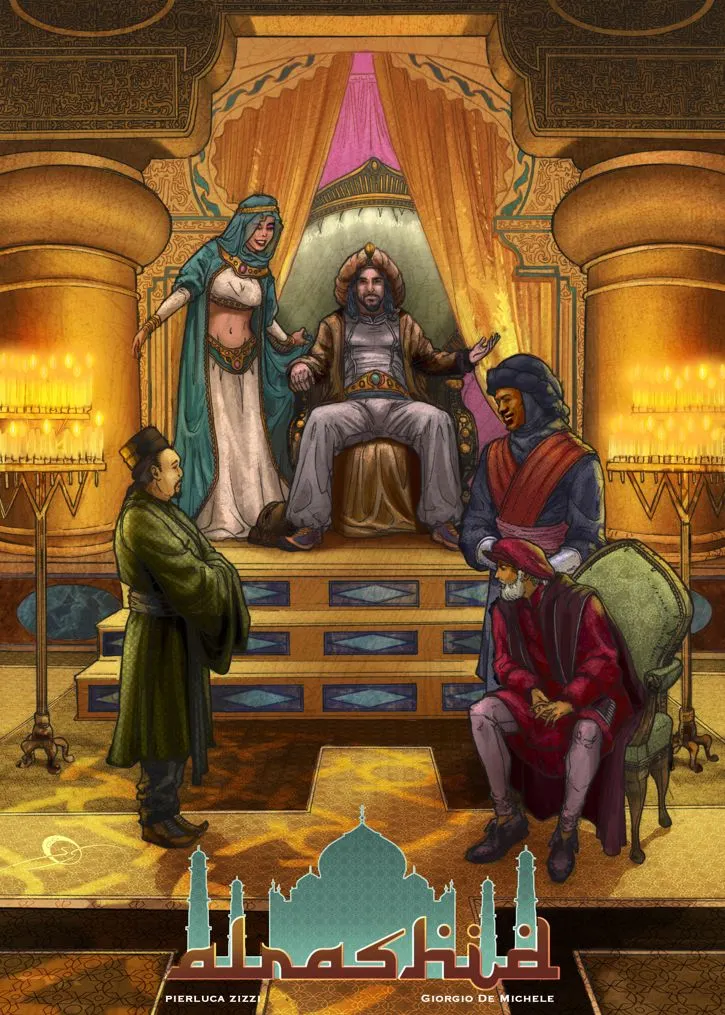
Al Rashid is a board game released in 2012 for 2–5 players, 100 minutes per game, and ages 13 and up. It was designed by Pierluca Zizzi and Giorgio De Michele and its main mechanics are Set Collection, Area Majority / Influence, and Variable Phase Order.




Harun al-Rashid was the fifth Great Caliph of the Abbasid Dinasty, and he ruled over the Middle East between the years 786 and 809. His reign was full of prosperity in all areas, like culture, science and politics. His life and his famous court are said to be the ispiration for the "One Thousand and One Nights" collection of folk stories. In Al Rashid, players will take the role of the heads of powerful families, and will use the members of their families for trading, travelling, and ultimately trying to exercise influence over the court of the powerful ruler. Al Rashid is a mostly deterministic strategy game – with a slight hint of randomness – based on worker placement, influence, resource management, and the efficient scoring of prestige points (PPs). As heads of families, players will have three different worker types at their disposal: the Sage, the Merchant and the Pasha. The three different types of workers, each with a different influence value, can be placed on the map of ancient Middle East to gain resources, or can be placed on the corporations to get more workers, or on government and imperial offices. The corporations represent several powers at the court of the Caliph: Intrigue, War, Science, Commerce, and Politics. The game takes place over five turns, with turns split into two main phases: the placement phase and the resolution phase. Each phase is split in several rounds. During the placement phase players take turns placing their workers on the board. During the resolution phase they take turns deciding which action will be resolved. Each action, either a zone on the map or a corporation, can hold workers from all of the five players, but only the top three players, identified by influence and placement order will get to resolve the move. During placement workers can be added to the same areas to improve a players's influence. Players with higher influence will get a bigger and better effect out of the action they are resolving. Resolving geographical areas will give a player resources. The resources come in five flavors: Wood, Pottery, Metal, Spice and Silk, and they can be used in trades. The dominating player – that is, the one with more influence, or in case of a tie, the one who placed first – will get three different resources, or all of the resources of one type (resources are distributed unevenly on the map), the second player will get two different resources and the third player just one. The resources gained by resolving geographical areas can be used in the corporations to buy more workers or get government offices. Government offices work more or less like buildings in other placement games. Some give permanent advantages, some have a one-shot effect, and some can be used every turn. As for the geographical areas, having more influence will be advantageous, and dominating players will get cheaper workers or better effects out of the corporations. The game contains no currency, so players will need to be careful when they combine resources to get money because if they pay more than they should, no change will be returned. Every turn raiders will spontaneously appear on random locations on the map, so players will need to use some of their actions to hire mercenaries that can be used to combat the raiders and give them access to resources. Players accumulate PPs when they buy offices and workers, and at the end of the fifth turn the player with more PPs is declared the winner.
Al Rashid supports 2–5 players according to the catalogue. This range comes from the publisher’s listed player count, so the game can be set up for any group size within it. Some setups, rules and scoring details may still vary by player count, so check your edition’s rulebook for the exact configuration.
The listed playing time for Al Rashid is 100 minutes. This is the publisher’s estimate for a full game. The actual duration depends on the group, the player count and familiarity with the rules: first sessions usually run longer, while experienced groups often finish faster. Setup and teaching time are not included in this estimate.
The catalogue lists Al Rashid for ages 13 and up. This is the publisher’s recommendation and reflects reading demands, rule complexity and small components rather than theme alone. Younger players can often join with help from an adult, so check the age guidance on your edition and consider your group’s experience with board games.
Al Rashid has a complexity rating of 3.5 out of 5 from BoardGameGeek players, which makes it a medium-weight game. The rating reflects how much rules knowledge, planning and decision-making a typical game demands. Expect a longer first teach for heavier games, and use a preparation guide before game night.
Al Rashid belongs to these categories: Economic and Arabian. Its main mechanics are Set Collection, Area Majority / Influence, and Variable Phase Order. Categories describe the theme and setting of a game, while mechanics describe what players actually do on their turns. Each mechanic links to a catalogue hub with similar games, which helps when you want something comparable.
The credited designers of Al Rashid are: Pierluca Zizzi and Giorgio De Michele. These credits come from the published game data and name the people responsible for the game’s design, not its illustrators or publishers. Designer pages on MeepleRules collect other titles by the same designers, which helps when you enjoy a game and want to find similar ones.
The catalogue lists Al Rashid as a base game. It can be played on its own with the components in the box and does not require any other title. Expansions, if any exist, add new content or rules on top of it and are listed separately in the catalogue with a link back to this base game.