
- BGG rank
- BGG #21,979
- BGG rating
- 6.1
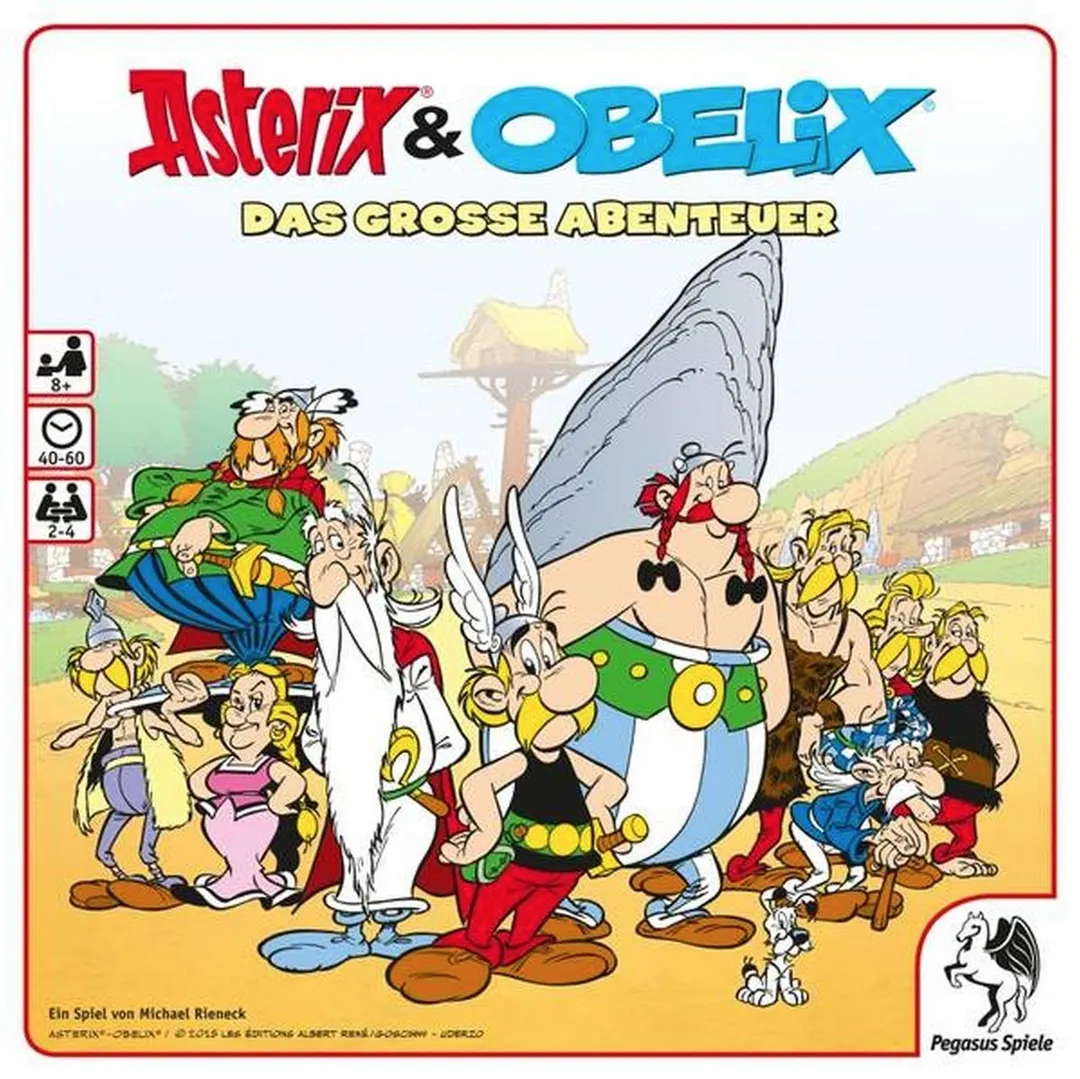
Asterix & Obelix: Das große Abenteuer
- 2–4 players
- 40–60 min
- Complexity 1.7/5
- 2016
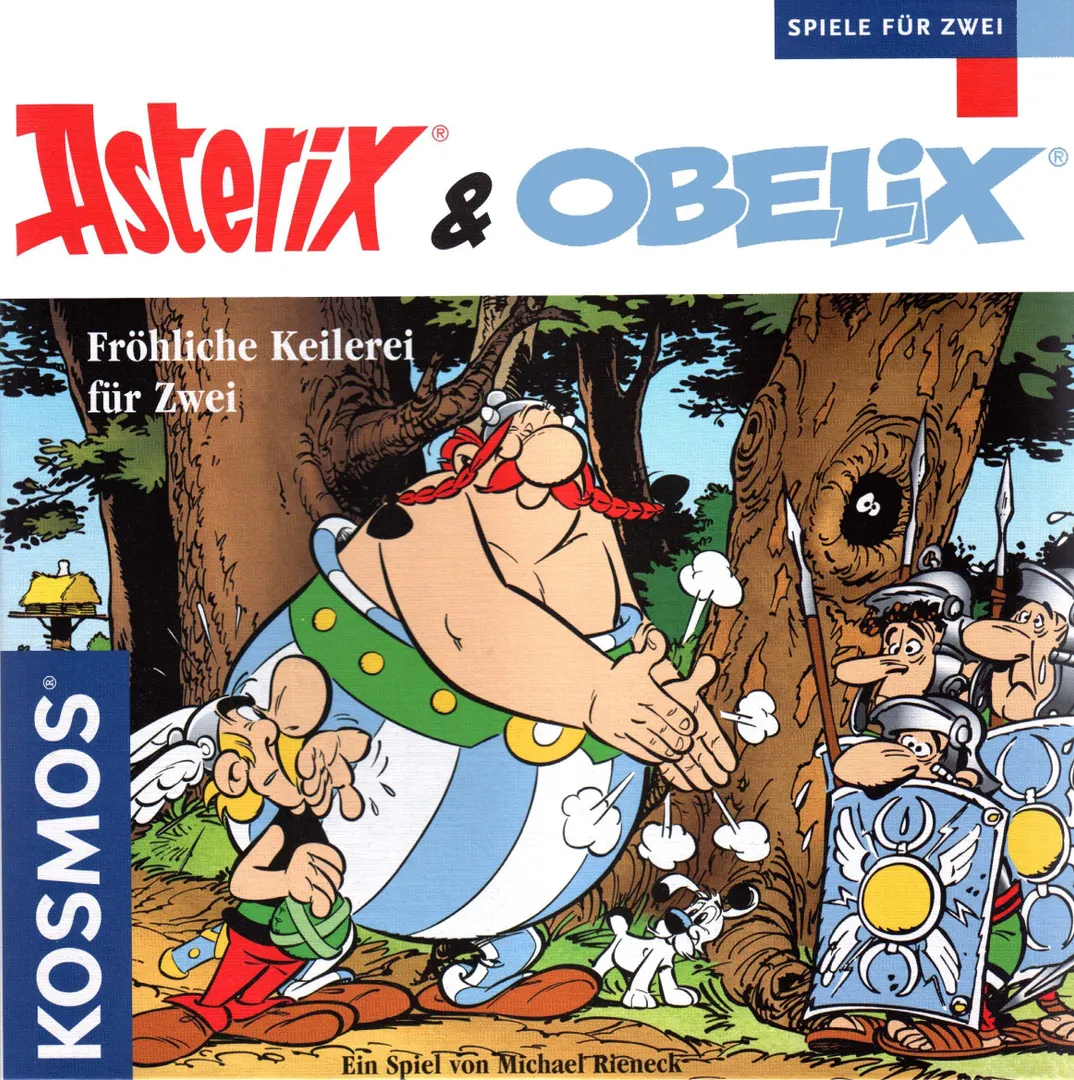
2006
Rules assistance for Asterix & Obelix
Plain-language explanations of turns, card effects and disputed situations, with official source references and saved question history.
For 2 players
What would you like to know?
Answers come from the official rulebook, with the page to check.
Asterix & Obelix is a board game released in 2006 for 2 players, 20 minutes per game, and ages 8 and up. It was designed by Michael Rieneck and its main mechanics are Open Drafting.


This is a game in the Kosmos two-player series. Description from Kosmos: In this two-player game featuring Gallic heroes Asterix & Obelix, the occupying Romans wear the usual costume for those stationed here: bumps and bruises. New Roman overseer Zenturio has let the money-hungry Gallic chief Moralelastix convince him to mount an operation against his little village. As usual, the question isn't "Will the Romans get beat up?", it's "How badly will the Romans get beat up?" The two players play as Asterix and Obelix. Each takes the matching playing figure as well as a set of 15 beating cards (3 cards in each of 5 different colors), which he places in front of himself as a face-down deck. Each player takes the top 5 cards in hand. In addition to the beating cards, there are Roman cards. Most of them show Roman Legionnaires (in 5 different colors), but there are also Pirates, Wild Boars, the traitor Moralelastix and 5 Village Feast cards. The 40 cards are well shuffled and placed as a face-down pile. Then, the top 16 cards are drawn and placed face-down on the table in classic Phalanx formation (4x4 grid). The remaining cards act as a draw pile. The player with the longest mustache (or alternately the biggest belly) begins. He places his figure in front of one of the four Phalanx rows and turns the topmost card over. A red Roman! Red Romans can only get beat up by Red beating cards. If the active player doesn't have any, then the Roman card is turned back over again and that player's turn is over. If he does has a red card, though, then he has to choose whether to end his turn (taking the beaten Roman as a trophy) or turn another card over, hoping to press his luck. A player can keep going until (in an extreme case) he's cleared an entire row of the Phalanx. In that case, the active player gets to refill his hand to 5 cards and then start in on another row. Of course, that may not be such a good idea. Because if he keeps going and finds a Roman card he can't beat up, then his turn is over and he receives nothing. All of the Romans he would have won are removed from the game instead. Players can reduce the luck a little bit, in that they can discard one card from their hand to look at the last card in the row where they placed their figure. When a player ends his turn (freely or because he was forced to), then he refills his hand to five cards and it is the other player's turn. Any holes in the Roman Phalanx are also filled back in with cards from the draw pile. Lastly, the player whose turn just ended gets to block the next player from trying one of the rows (either horizontally or vertically). Of the 40 Roman cards, only 30 show actual Romans (as well as Zenturios himself). The remaining 10 cards are: 3 Pirates, 1 Wild Boar, Moralelastix, and 5 Evening Feasts. Pirates are easy to beat: Any card will do. To get Moralelastix, two cards of a single color are needed. The Wild Boar ends the player's turn immediately, but he gets to keep the Romans he beat up on so far. If a Feast is revealed, nothing happens and the player gets to keep going. Revealed Feasts are set aside, and once the fifth Feast shows up the game is over. Now, the players count their victory points. The purple point goes to the player who got Moralelastix. A brown point is for the most pirates. The majorities in the five Roman colors are worth the red, blue, yellow, green and black points, respectively. The player with the most victory points wins.
Asterix & Obelix supports 2 players according to the catalogue. This is the publisher’s listed player count, so the game is designed for exactly that number of participants. Variants for other group sizes, if any, are described in the rulebook of your edition, so check it before setting up a different configuration.
The listed playing time for Asterix & Obelix is 20 minutes. This is the publisher’s estimate for a full game. The actual duration depends on the group, the player count and familiarity with the rules: first sessions usually run longer, while experienced groups often finish faster. Setup and teaching time are not included in this estimate.
The catalogue lists Asterix & Obelix for ages 8 and up. This is the publisher’s recommendation and reflects reading demands, rule complexity and small components rather than theme alone. Younger players can often join with help from an adult, so check the age guidance on your edition and consider your group’s experience with board games.
Asterix & Obelix has a complexity rating of 1.2 out of 5 from BoardGameGeek players, which makes it a light game. The rating reflects how much rules knowledge, planning and decision-making a typical game demands. Expect a longer first teach for heavier games, and use a preparation guide before game night.
Asterix & Obelix belongs to these categories: Card Game, Fighting, and Comic Book / Strip. Its main mechanics are Open Drafting. Categories describe the theme and setting of a game, while mechanics describe what players actually do on their turns. Each mechanic links to a catalogue hub with similar games, which helps when you want something comparable.
The credited designers of Asterix & Obelix are: Michael Rieneck. These credits come from the published game data and name the people responsible for the game’s design, not its illustrators or publishers. Designer pages on MeepleRules collect other titles by the same designers, which helps when you enjoy a game and want to find similar ones.
The catalogue lists Asterix & Obelix as a base game. It can be played on its own with the components in the box and does not require any other title. Expansions, if any exist, add new content or rules on top of it and are listed separately in the catalogue with a link back to this base game.