

- BGG rank
- BGG #5,300
- BGG rating
- 8.1
UND1C1
- 2–4 players
- 45–60 min
- Complexity 2.7/5
- 2022
2025
Rules assistance for Baseball Card GM
Plain-language explanations of turns, card effects and disputed situations, with official source references and saved question history.
What would you like to know?
Answers come from the official rulebook, with the page to check.
Baseball Card GM is a board game released in 2025 for 1–2 players, 30–45 minutes per game, and ages 7 and up. Its main mechanics are Dice Rolling, Simulation, and Deck Construction.







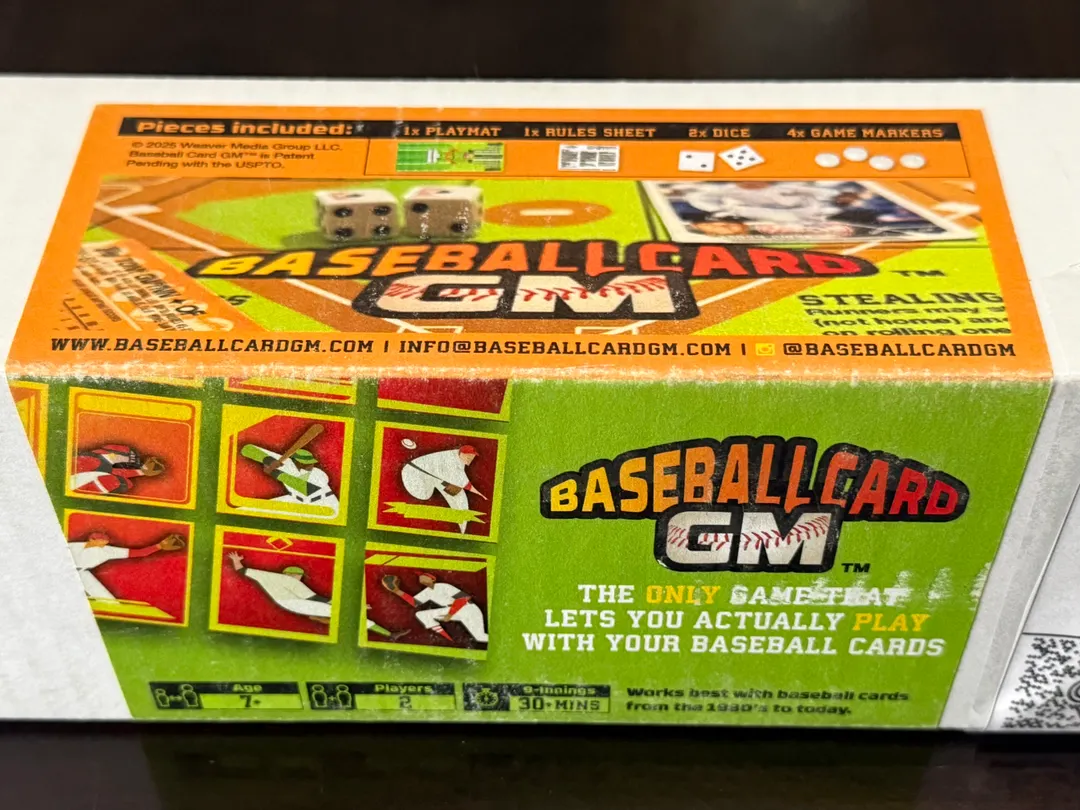
It all started in 2024, when Garrett Weaver (then just seven) asked a simple question: “How can I actually play with my baseball cards?” When no games existed, he and his younger brother Simon invented a set of rules at their dining-room table, which today after play-testing with their friends, schoolmates, and baseball teammates has become Baseball Card GM. The game is a sturdy 36"x18" neoprene playmat (which can be rolled for easy storage/travel) with all rules on the playmat itself. A 9-inning game takes about 30 minutes to play, good for ages 7+. It's easy as 1-2-3: 1. Draft your team from your own baseball cards. You are the GM, so you can create any team you want, any way you want, with whatever cards you have! You can make your ultimate Dream Team, recreate an actual historic team, build along a specific theme (ex: MVP’s and CY’s of the 2000’s), do an actual draft alternating picks with your competitor, or crack some new packs and play with whatever you get. The possibilities are endless, and even a random stack of cards can be hours of fun. The game works best with baseball cards from the 1980’s to today (ie most likely to have all the stats needed for the game: HR, 3B, 2B, Avg, BBs, Hits, RBIs, SBs), but you can use older cards as well because the stats used in the game are nearly universal to all cards. Once you have your team, you will build your line-up, choose your starting pitcher, and fill out your bench and bullpen. Then you are ready to play ball! 2. Use the stats on the back of the cards. A good GM knows player analytics, and for you that means diving into the stats on the back of the cards! Your batter getting a single, double, triple, homerun, walk, strikeout, ground-out (G/O), fly-out (F/O) or pop-out (P/O) is all based on a combination of whichever single year of their major league stats you choose from the back of their card, the stats of the pitcher they are facing, whether the pitcher/batter are righty or lefty, and the outcome of rolling two dice. The odds are all worked out right on the playmat so potential batting outcomes are just like how it COULD have happened historically in real life. Better batters will have better chances to roll better outcomes with the same frequency as their stats dictate. Remember not all players excel at every stat, so build your line-up accordingly! 3. Play a real game that is true to the stats. A GM has to know all the nuances of baseball, and here all the normal baseball rules apply! Run through your line-up in order, alternating between Visitors and Home teams, placing cards as they move around the bases. Substitute batters, pitchers, or base runners just as the pro’s would in a real game. Track Outs, Runs, and the Top-Bottom of the nine inning game with the markers placed in the appropriate squares on the playmat. Special circumstances when runners are already on base are described on the playmat too: double plays, sac flies, scoring from second on a single, and stealing bases can and will happen! —description from the designer
Baseball Card GM supports 1–2 players according to the catalogue. This range comes from the publisher’s listed player count, so the game can be set up for any group size within it. Some setups, rules and scoring details may still vary by player count, so check your edition’s rulebook for the exact configuration.
The listed playing time for Baseball Card GM is 30–45 minutes. This is the publisher’s estimate for a full game. The actual duration depends on the group, the player count and familiarity with the rules: first sessions usually run longer, while experienced groups often finish faster. Setup and teaching time are not included in this estimate.
The catalogue lists Baseball Card GM for ages 7 and up. This is the publisher’s recommendation and reflects reading demands, rule complexity and small components rather than theme alone. Younger players can often join with help from an adult, so check the age guidance on your edition and consider your group’s experience with board games.
Baseball Card GM has a complexity rating of 1.3 out of 5 from BoardGameGeek players, which makes it a light game. The rating reflects how much rules knowledge, planning and decision-making a typical game demands. Expect a longer first teach for heavier games, and use a preparation guide before game night.
Baseball Card GM belongs to these categories: Dice and Sports. Its main mechanics are Dice Rolling, Simulation, and Deck Construction. Categories describe the theme and setting of a game, while mechanics describe what players actually do on their turns. Each mechanic links to a catalogue hub with similar games, which helps when you want something comparable.
The catalogue lists Baseball Card GM as a base game. It can be played on its own with the components in the box and does not require any other title. Expansions, if any exist, add new content or rules on top of it and are listed separately in the catalogue with a link back to this base game.