
- BGG rank
- BGG #21,114
- BGG rating
- 6.3
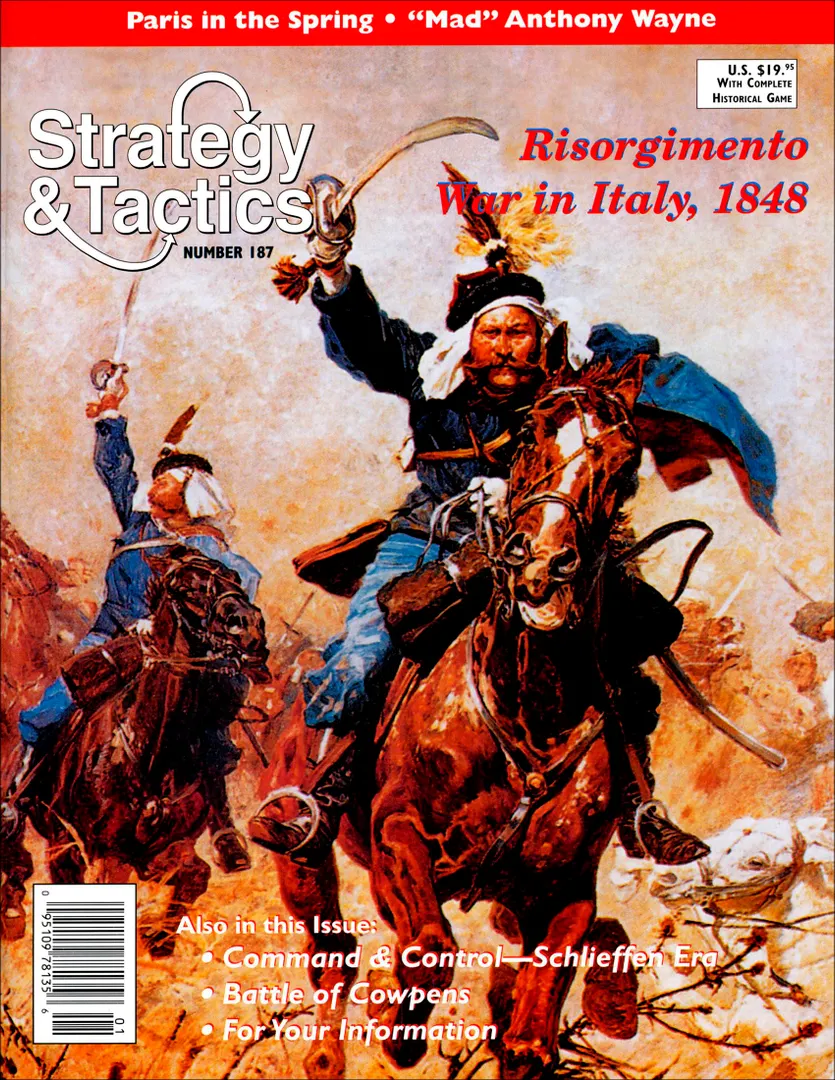
Risorgimento: Italy's Wars of Liberation 1848-1866
- 2 players
- 480 min
- Complexity 2.9/5
- 1997

1993
Rules assistance for Blood & Iron: Bismarck's Wars for Empire
Plain-language explanations of turns, card effects and disputed situations, with official source references and saved question history.
For 2 players
What would you like to know?
Answers come from the official rulebook, with the page to check.
Blood & Iron: Bismarck's Wars for Empire is a board game released in 1993 for 2 players, 60 minutes per game, and ages 12 and up. It was designed by Michael Bennighof and its main mechanics are Hexagon Grid and Simulation.






This Corps-Division level wargame covers 5 formative wars of the mid-19 Century : The Risorgimento of 1859 between France and Austria that resulted in the formation of modern Italy; The German-Danish War of 1864 that established Prussia as the Protector of German Nationalism; The Seven Weeks' War of 1866 where Prussia beat Austria to become the political and military leader of central Europe; The Italo-Austrian War of 1866 that introduced iron-clad steam-powered warship fleets to the military balance of power; The Franco-Prussian War of 1870 that allowed the realization of the Prussian dream of a German Empire and set the stage for World War One. Players are faced with strategic and operational challenges as they form their units into field corps and armies, never quite certain of the enemy's strength and intentions. Geography will determine areas of maneuver. Once battle is joined, commanders will have to decide whether to fight, reinforce, or withdraw. Winning or losing one battle may trigger military action on the part of other nations that can help or hurt your cause. Command, supply, and technology will all play their respective roles in these wars. Each scenario has specific rules that focus the game system on the military advances and limitations of each of the 5 conflicts. Extensive historical commentary illuminates the importance of the military actions within the politics of 19th Century Europe. The armies of 21 nations, large and small, took part in these struggles for continental domination - from France, Prussia, and Austria to Saxe-Meinigen and the Papal States. Every signficant field force is represented in this intensive study of strategy and operational interaction. Scale is 35 mies per hex and 3 days per turn. BLOOD & IRON contains Second Edition rules incorporating all known errata and frequently asked questions from the First Edition. The Second Edition rules may be distinguished by looking at the upper right hand corner of the back cover where the changes from the First Edition rules are noted. There are three games called Blood & Iron, the other two are more tactical.
Blood & Iron: Bismarck's Wars for Empire supports 2 players according to the catalogue. This is the publisher’s listed player count, so the game is designed for exactly that number of participants. Variants for other group sizes, if any, are described in the rulebook of your edition, so check it before setting up a different configuration.
The listed playing time for Blood & Iron: Bismarck's Wars for Empire is 60 minutes. This is the publisher’s estimate for a full game. The actual duration depends on the group, the player count and familiarity with the rules: first sessions usually run longer, while experienced groups often finish faster. Setup and teaching time are not included in this estimate.
The catalogue lists Blood & Iron: Bismarck's Wars for Empire for ages 12 and up. This is the publisher’s recommendation and reflects reading demands, rule complexity and small components rather than theme alone. Younger players can often join with help from an adult, so check the age guidance on your edition and consider your group’s experience with board games.
Blood & Iron: Bismarck's Wars for Empire has a complexity rating of 3.2 out of 5 from BoardGameGeek players, which makes it a medium-weight game. The rating reflects how much rules knowledge, planning and decision-making a typical game demands. Expect a longer first teach for heavier games, and use a preparation guide before game night.
Blood & Iron: Bismarck's Wars for Empire belongs to these categories: Wargame and Post-Napoleonic. Its main mechanics are Hexagon Grid and Simulation. Categories describe the theme and setting of a game, while mechanics describe what players actually do on their turns. Each mechanic links to a catalogue hub with similar games, which helps when you want something comparable.
The credited designers of Blood & Iron: Bismarck's Wars for Empire are: Michael Bennighof. These credits come from the published game data and name the people responsible for the game’s design, not its illustrators or publishers. Designer pages on MeepleRules collect other titles by the same designers, which helps when you enjoy a game and want to find similar ones.
The catalogue lists Blood & Iron: Bismarck's Wars for Empire as a base game. It can be played on its own with the components in the box and does not require any other title. Expansions, if any exist, add new content or rules on top of it and are listed separately in the catalogue with a link back to this base game.