

- BGG rank
- BGG #141
- BGG rating
- 8.0
Tainted Grail: The Fall of Avalon
- 1–4 players
- 60–120 min
- Complexity 3.4/5
- 2019
2022
Rules assistance for Castle Von Loghan
Plain-language explanations of turns, card effects and disputed situations, with official source references and saved question history.
For 1 player
What would you like to know?
Answers come from the official rulebook, with the page to check.
Castle Von Loghan is a board game released in 2022 for 1–8 players, 60–120 minutes per game, and ages 8 and up. It was designed by Jan Wagner, Paul Toderas, and Mihnea Dragoman and its main mechanics are Variable Player Powers, Hand Management, and Area Movement.



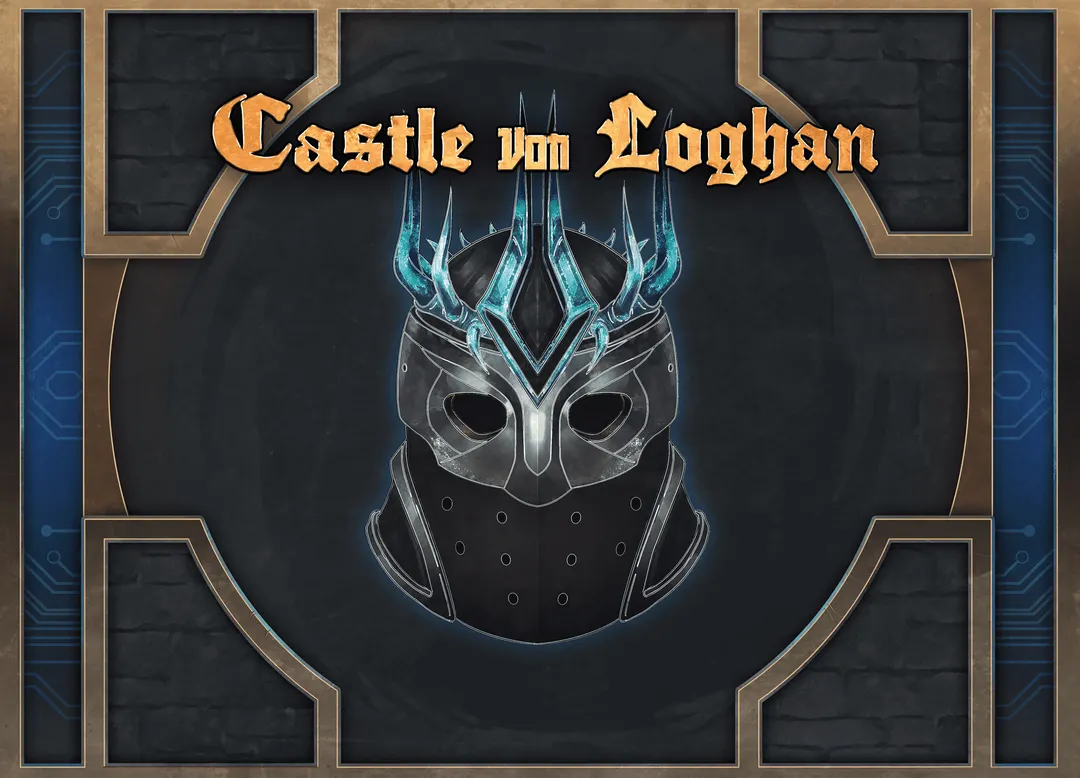
Castle Von Loghan is a co-op, group-decision making, survival board game that offers a unique narrative and dungeon-crawling gaming experience. The game includes several game modes, such as Story Campaign and Exploration. Working together as one group, the players adventure inside Castle von Loghan where they will face an array of dangers but also will find several valuable treasures. During each turn, players have to decide where to go next, solve the secrets of the room in which they have arrived, battle the enemies protecting it, then prepare for the next encounter. The only route to winning the game is through survival — and to survive, they need to work together. Notable mechanisms: Sharing of health and clarity, unique narrative events that require careful listening and decision making, a ten-game-long Story Campaign that is filled with the best RPG elements one could expect, easy-to-understand card-based tactical combat that comes with a variety of outcomes. Intro to the story: In 1970, inside the Albatross Scientific Institute (LOS ANGELES), a group of scientists make contact with a group of hyper-intelligent beings known as the CeDI (Celestial entities from the Downing Ipsys) who claim that humankind is doomed. They have brought with them some of their advanced technology, instructing the humans to make use of it in order to evacuate the Earth which, according to the aliens, will become uninhabitable in approximately 100 years. Aided by the scientists at the Institute, the aliens unlock G.O.D.O.S., an AI they have brought with them from their galaxy. They claim G.O.D.O.S. will help all of humanity... but the aliens seem to have a personal mission linked to G.O.D.O.S. as well; one which they haven’t revealed to anyone else. On the 27th of August, G.O.D.O.S. is activated. A council is formed and, with the help of the aliens, they begin work on Project KARR. The goal is to build at least five ships that are not only capable of carrying about 1 billion people each, but can keep them alive for hundreds of years. The KARR also serve as colonization units. The news of the aliens and of Project KARR is shared, bit by bit, with the humans, and by 2067, the ships are ready to launch. In 2068, the ships leave earth, leaving behind all those who refuse to go. Each ship heads towards a different point in space in the hopes of finding a suitable planet to serve as a new home. They cannot go to the aliens’ solar system, since humans can not survive such a long journey or the interstellar travel required to get there. After several years in transit, the KARR-5 ship collides with a huge meteorite and is heavily damaged. Hundreds of thousands of humans die, and many of the ship’s sectors are damaged beyond repair. In his desperation, a certain human decides to take matters into his own hands. Owning the only copy of G.O.D.O.S., a man named Deacon Padjin, the Prime Commander of the KARR-5, uploads G.O.D.O.S. to the KARR-5 ship’s operating systems. G.O.D.O.S. takes over the entire ship! With the help of G.O.D.O.S., the ship is saved. Humans learn how to resurrect the dead by placing the “souls” of deceased individuals into androids. The newly-resurrected individuals, known as the Resurrected, remain ignorant of their death and subsequent resurrection. This technology becomes so advanced over the years, that it is almost impossible for someone to tell if they’re human or a Resurrected. The KARR-5’s population begins growing back to its original size. G.O.D.O.S. secretly develops a semi-functional time-machine, but after extensive testing, the results are grim: it can only send people to the past, but it can’t bring them back, and it cannot send anyone into the future. G.O.D.O.S. A few years pass; the KARR-5 is still stationary. Deacon Padjin, who is still deeply involved with the time-travel project, develops a module that allows time-travel to the future. After managing to remove G.O.D.O.S. from the ship's systems, he uses the time-machine to escape to the past, safely, taking the AI and some other people back with him. The remaining leaders of the KARR-5 assess the situation and, after 10 years of testing and many different iterations, manage to partially replicate the time-machine. Having done so, about ten years later, they send a group of KarrSEC agents after Deacon and G.O.D.O.O.S. armed with a state-of-the-art tracking device, capable of following someone through time. As there have been no changes to their timeline, it is a widely-believed hypothesis that Deacon succumbed to an untimely death, either during the jump or as a result of it. However, the KARR-5 Council, and the KarrSEC, want to ensure that G.O.D.O.S. be dismantled so that it can’t make any modifications to the timeline, thus changing the course of History forever. Meanwhile, the CeDI engage in secret meetings with some of the scientists from the Institute, informing them that the loss of G.O.D.O.S. will most likely have disastrous consequences. The CeDI finally reveal their true intentions: they need G.O.D.O.S. to break through a time bubble that has been placed around their planet in which an intergalactic battle is being fought. Without G.O.D.O.S., the CeDI will likely lose the battle, which could easily spread to other parts of the galaxy, a threat that none but the CeDI is prepared to face.
Castle Von Loghan supports 1–8 players according to the catalogue. This range comes from the publisher’s listed player count, so the game can be set up for any group size within it. Some setups, rules and scoring details may still vary by player count, so check your edition’s rulebook for the exact configuration.
The listed playing time for Castle Von Loghan is 60–120 minutes. This is the publisher’s estimate for a full game. The actual duration depends on the group, the player count and familiarity with the rules: first sessions usually run longer, while experienced groups often finish faster. Setup and teaching time are not included in this estimate.
The catalogue lists Castle Von Loghan for ages 8 and up. This is the publisher’s recommendation and reflects reading demands, rule complexity and small components rather than theme alone. Younger players can often join with help from an adult, so check the age guidance on your edition and consider your group’s experience with board games.
Castle Von Loghan has a complexity rating of 2.5 out of 5 from BoardGameGeek players, which makes it a medium-light game. The rating reflects how much rules knowledge, planning and decision-making a typical game demands. Expect a longer first teach for heavier games, and use a preparation guide before game night.
Castle Von Loghan belongs to these categories: Fantasy, Bluffing, and Travel. Its main mechanics are Variable Player Powers, Hand Management, and Area Movement. Categories describe the theme and setting of a game, while mechanics describe what players actually do on their turns. Each mechanic links to a catalogue hub with similar games, which helps when you want something comparable.
The credited designers of Castle Von Loghan are: Jan Wagner, Paul Toderas, and Mihnea Dragoman. These credits come from the published game data and name the people responsible for the game’s design, not its illustrators or publishers. Designer pages on MeepleRules collect other titles by the same designers, which helps when you enjoy a game and want to find similar ones.
The catalogue lists Castle Von Loghan as a base game. It can be played on its own with the components in the box and does not require any other title. Expansions, if any exist, add new content or rules on top of it and are listed separately in the catalogue with a link back to this base game.