

- BGG rank
- BGG #1,299
- BGG rating
- 7.2
Bonsai
- 1–4 players
- 40 min
- Complexity 1.8/5
- 2023
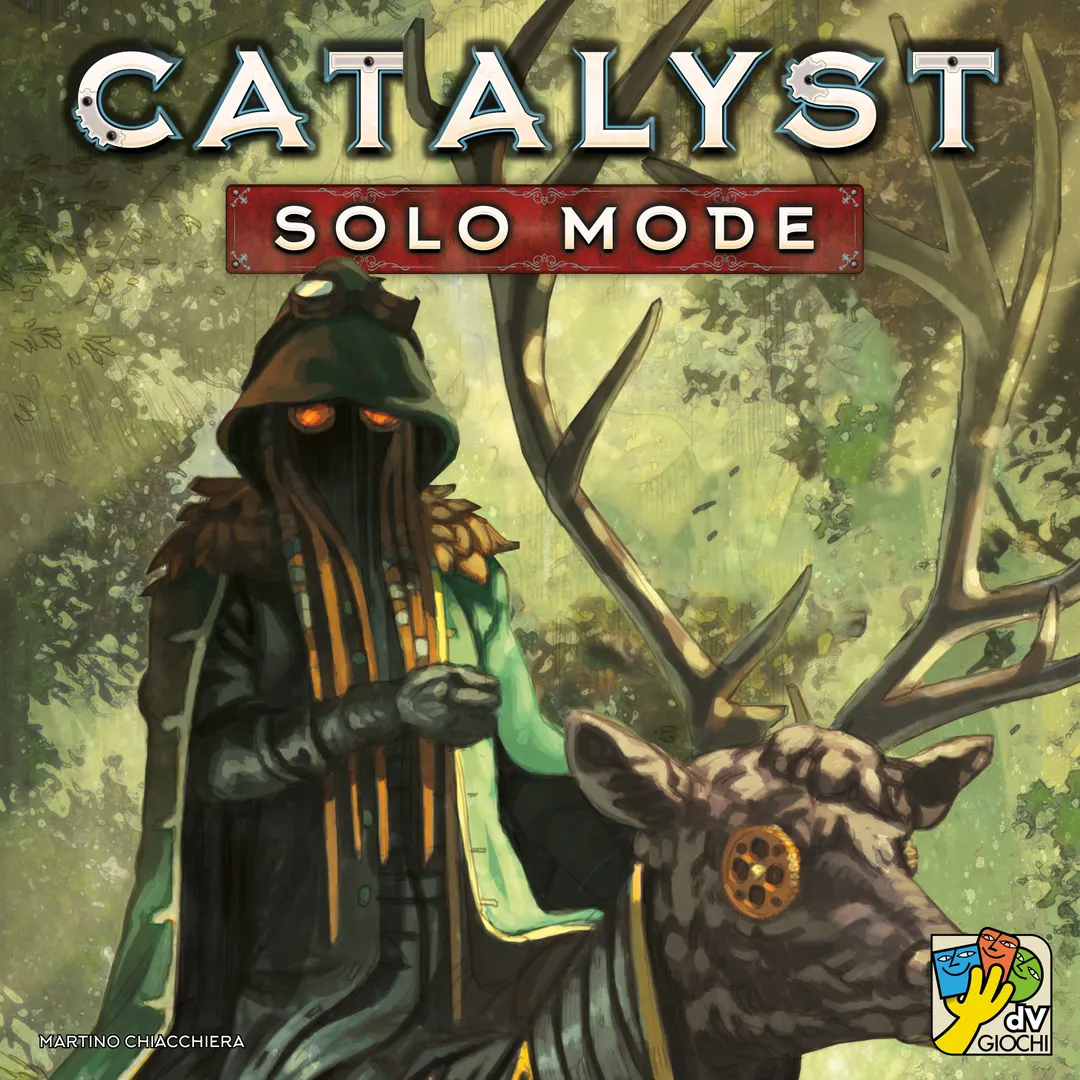
Rules assistance for Catalyst: Solo mode
Plain-language explanations of turns, card effects and disputed situations, with official source references and saved question history.
What would you like to know?
Answers come from the official rulebook, with the page to check.
Catalyst: Solo mode is an expansion for Catalyst released in 2019 for 1 player, 20–30 minutes per game, and ages 8 and up. It was designed by Martino Chiacchiera and its main mechanics are Set Collection and Open Drafting.


The official solo mode of Catalyst - originally released as a promotional set of rules in IoGioco game magazine. GOAL OF THE GAME Confront your skills against a fearsome Artificial Intelligence (AI). PREPARATION Choose the difficulty level: easy (+10 PV), standard (+20 PV), advanced (+30 PV). Follow the instructions for preparing a 2-player game. You are the first player. Return all building cards to the box with the exception of a building costing 1, one that costs 2, one that costs 3 and one that costs 4. They must all be of a different color and randomly selected (e.g.: play with the blue “1” building, the “2” red building, the “3” yellow building and the “4” green building). PLAYING THE GAME Play multiple turns in a row until the game ends. During each of your turns you must perform one of the three actions of the game, with the following additions to the normal rules: Collect Contributions: you get coins as usual, and the AI gets a military power token. Recruit a Catalyst: You recruit a Catalyst as usual, then take the first card to the left of the one you recruited and place it, without looking at it, in the deck of AI's scoring pile. If you recruit the first Catalyst to the right of the deck (the one on the space marked with “+1”), then place the top card of the draw pile, without looking at it, in the scoring pile of the AI. Activate a Catalyst: activate a Catalyst as usual, then place the card on top of the drawing deck, without looking at it, in the AI’s scoring pile. Note: When you get coins or actions to recruit a Catalyst through a Catalyst or a building’s effects, and when you spend Chain activation tokens to activate Catalysts, the additions to the normal rules (see above) do not apply: This means that while you perform the effect of an activated Catalyst or building, the AI does not get any military power tokens nor you must put cards in its scoring pile. THE END OF YOUR TURN As in the standard rules, after you have chosen and performed one action (and possibly the AI has gained a card in its scoring pile or a military power token), your turn is over. If one or more spaces of the board are empty, slide the other cards to the right until there are no gaps, then draw new cards from the deck to fill the board back up to 5 cards. THE END OF THE GAME When the last card of the reserve deck is discarded or put on the board, the game ends immediately. Count your VPs as usual, including the goal card’s points. The AI instead obtains the VPs written on the cards in its scoring pile, the VPs provided by each pair of its military power tokens (and for the majority), and additional VPs depending on the difficulty level chosen (see Preparation). If you scored at least 1 VP more than the AI, you won – otherwise, try harder! —description from the publisher
Catalyst: Solo mode supports 1 player according to the catalogue. This is the publisher’s listed player count, so the game is designed for exactly that number of participants. Variants for other group sizes, if any, are described in the rulebook of your edition, so check it before setting up a different configuration.
The listed playing time for Catalyst: Solo mode is 20–30 minutes. This is the publisher’s estimate for a full game. The actual duration depends on the group, the player count and familiarity with the rules: first sessions usually run longer, while experienced groups often finish faster. Setup and teaching time are not included in this estimate.
The catalogue lists Catalyst: Solo mode for ages 8 and up. This is the publisher’s recommendation and reflects reading demands, rule complexity and small components rather than theme alone. Younger players can often join with help from an adult, so check the age guidance on your edition and consider your group’s experience with board games.
Catalyst: Solo mode belongs to these categories: Card Game and Expansion for Base-game. Its main mechanics are Set Collection and Open Drafting. Categories describe the theme and setting of a game, while mechanics describe what players actually do on their turns. Each mechanic links to a catalogue hub with similar games, which helps when you want something comparable.
The credited designers of Catalyst: Solo mode are: Martino Chiacchiera. These credits come from the published game data and name the people responsible for the game’s design, not its illustrators or publishers. Designer pages on MeepleRules collect other titles by the same designers, which helps when you enjoy a game and want to find similar ones.
The catalogue lists Catalyst: Solo mode as an expansion for Catalyst. Expansions add new content, rules or scenarios to the base game and usually cannot be played on their own, so you need Catalyst to use it. Check that your edition of Catalyst is compatible, as some expansions were revised between editions.