
- BGG rank
- BGG #21,794
- BGG rating
- 6.7
First Bull Run: 150th Anniversary Edition
- 1–2 players
- 180 min
- Complexity 2.6/5
- 2012
2009
Rules assistance for Chainmail: Medieval Combat
Plain-language explanations of turns, card effects and disputed situations, with official source references and saved question history.
For 1 player
What would you like to know?
Answers come from the official rulebook, with the page to check.
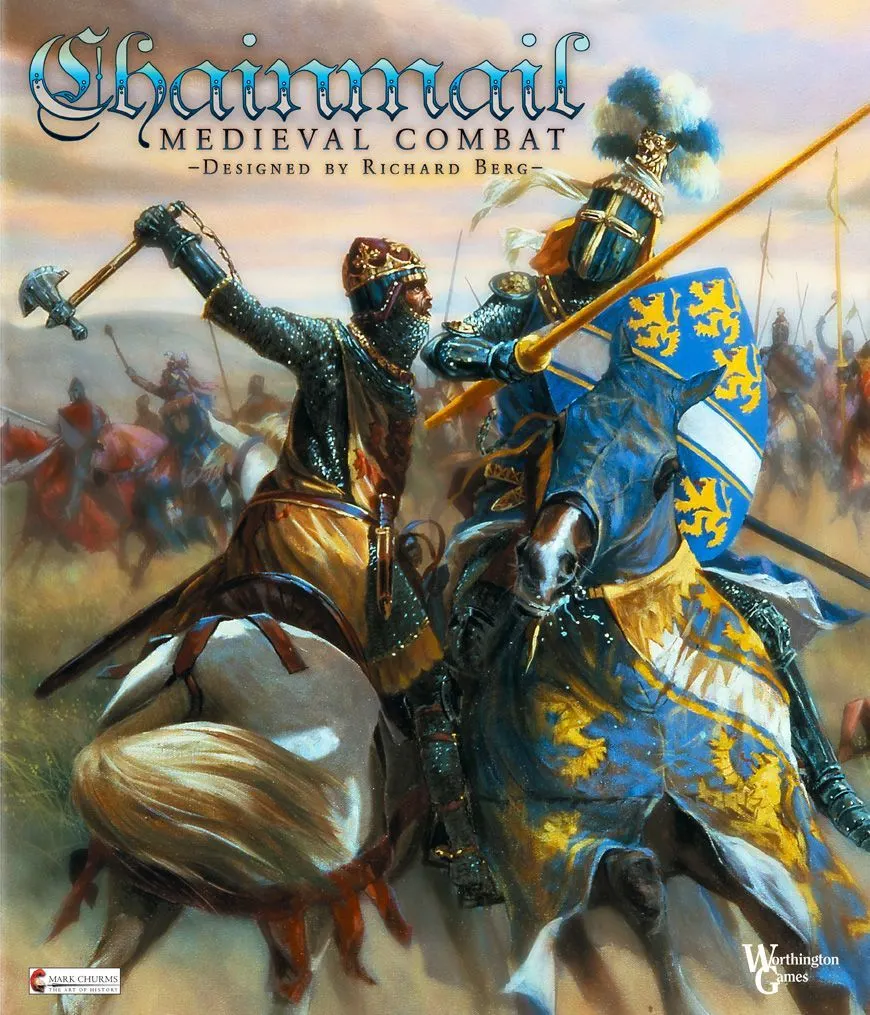
Chainmail: Medieval Combat is a board game released in 2009 for 1–2 players, 120 minutes per game, and ages 12 and up. It was designed by Richard H. Berg and its main mechanics are Hand Management, Square Grid, and Campaign / Battle Card Driven.


Not to be Confused With: Chainmail: Rules for Medieval Miniatures The game uses cards, one deck for each player (whose cards are somewhat different from those of the other player) to drive the game. Each player gets a certain number of cards each turn - but never his full deck. The cards are used to determine movement, combat, and actions such as Axemen, Knights Charge, Chivalry Charge, and Strategic Movement, among others. Players may play each card for only one of the possible three purposes. CHAINMAIL is thus a game of card play and management, which unfolds on the historical battle map - it uses squares, rather than hexes – with the use of some beautiful, super-size counters. This is a game of position, feint, and sudden attack with what you hope are better odds (since you don’t know what cards your opponent will play, if any, and you never know what his final strength will be). No dice are used. And there are no CRT’s. Skill determines the outcome. The game thus becomes a tense battle. When do you play your cards? How many do you play? What do you do with them? Will you be caught short and be subject to a sudden attack by your opponent? CHAINMAIL includes four of the major battles of the Medieval period: Legnano (1176), Bouvines (1214), Lewes (1264), and Bannockburn (1314). LEGNANO The Battle of Legnano, May 29, 1176, was a major defeat of the Holy Roman Emperor Barbarossa by members of the Lombard League. It was a major setback to his plans for imperial domination of Italy and showed for the first time of infantry against feudal cavalry. BOUVINES The Battle of Bouvines, July 27, 1214, was a conclusive medieval battle ending the twelve year old War of Bouvines that was important to the early development of both the French state by confirming the French crown’s sovereignty over the Norman lands of Brittany and Normandy. LEWES The Battle of Lewes, May 12, 1264, was a one of two main battles of the conflict known as the Second Barons' War. It was the high point of the career of Simon De Montfort, 6th Earl of Leicester and made him the "uncrowned King of England". BANNOCKBURN The Battle of Bannockburn, 24 June 1314, was a significant Scottish victory in the Wars of Scottish Independence. It was the decisive battle in the First War of Scottish Independence.
Chainmail: Medieval Combat supports 1–2 players according to the catalogue. This range comes from the publisher’s listed player count, so the game can be set up for any group size within it. Some setups, rules and scoring details may still vary by player count, so check your edition’s rulebook for the exact configuration.
The listed playing time for Chainmail: Medieval Combat is 120 minutes. This is the publisher’s estimate for a full game. The actual duration depends on the group, the player count and familiarity with the rules: first sessions usually run longer, while experienced groups often finish faster. Setup and teaching time are not included in this estimate.
The catalogue lists Chainmail: Medieval Combat for ages 12 and up. This is the publisher’s recommendation and reflects reading demands, rule complexity and small components rather than theme alone. Younger players can often join with help from an adult, so check the age guidance on your edition and consider your group’s experience with board games.
Chainmail: Medieval Combat has a complexity rating of 2.4 out of 5 from BoardGameGeek players, which makes it a medium-light game. The rating reflects how much rules knowledge, planning and decision-making a typical game demands. Expect a longer first teach for heavier games, and use a preparation guide before game night.
Chainmail: Medieval Combat belongs to these categories: Wargame and Medieval. Its main mechanics are Hand Management, Square Grid, and Campaign / Battle Card Driven. Categories describe the theme and setting of a game, while mechanics describe what players actually do on their turns. Each mechanic links to a catalogue hub with similar games, which helps when you want something comparable.
The credited designers of Chainmail: Medieval Combat are: Richard H. Berg. These credits come from the published game data and name the people responsible for the game’s design, not its illustrators or publishers. Designer pages on MeepleRules collect other titles by the same designers, which helps when you enjoy a game and want to find similar ones.
The catalogue lists Chainmail: Medieval Combat as a base game. It can be played on its own with the components in the box and does not require any other title. Expansions, if any exist, add new content or rules on top of it and are listed separately in the catalogue with a link back to this base game.