
- BGG rank
- BGG #13,483
- BGG rating
- 6.8
What Price Glory?
- 2 players
- 240 min
- Complexity 2.1/5
- 2013
2011
Rules assistance for Conflict of Alliances: Warring States
Plain-language explanations of turns, card effects and disputed situations, with official source references and saved question history.
For 2 players
What would you like to know?
Answers come from the official rulebook, with the page to check.
Conflict of Alliances: Warring States is a board game released in 2011 for 2 players, 40–60 minutes per game, and ages 10 and up. It was designed by Sun Wei and its main mechanics are Simulation, Campaign / Battle Card Driven, and Area-Impulse.
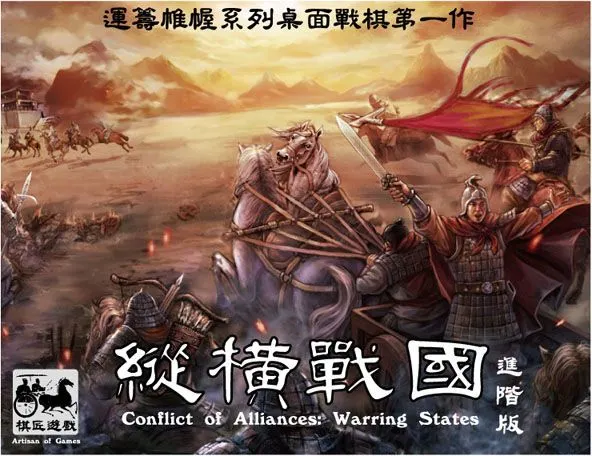
Conflict of Alliances: Warring States (纵横战国) is a two player game about diplomacy and warfare in period of the Warring States in ancient China. The game begins in the year 312 BC, when state of Qin (秦国)had just become the most powerful state in China. The strategy of Qin is to unite the States in “horizontal alliance”(连横)and to conquer the States in “vertical alliance”(合纵). In this game, one player controls the “horizontal alliance”, the other player controls the “vertical alliance”. The game integrates diplomacy, warfare, reinforcements and initiative(天时)in a simple Card Driven mechanic. The game integrates diplomacy and warfare in a simple Card Driven mechanic. The game places heavy emphasis on diplomatic struggle. Each state except Qin is either belongs to “horizontal alliance” or “vertical alliance” or neutral. A state in an alliance may shift to the other alliance and can be controlled by the other player during the game. The game is easy to learn and difficult to master, there are plenty of examples in the rule book and play book.
Conflict of Alliances: Warring States supports 2 players according to the catalogue. This is the publisher’s listed player count, so the game is designed for exactly that number of participants. Variants for other group sizes, if any, are described in the rulebook of your edition, so check it before setting up a different configuration.
The listed playing time for Conflict of Alliances: Warring States is 40–60 minutes. This is the publisher’s estimate for a full game. The actual duration depends on the group, the player count and familiarity with the rules: first sessions usually run longer, while experienced groups often finish faster. Setup and teaching time are not included in this estimate.
The catalogue lists Conflict of Alliances: Warring States for ages 10 and up. This is the publisher’s recommendation and reflects reading demands, rule complexity and small components rather than theme alone. Younger players can often join with help from an adult, so check the age guidance on your edition and consider your group’s experience with board games.
Conflict of Alliances: Warring States has a complexity rating of 2.5 out of 5 from BoardGameGeek players, which makes it a medium-light game. The rating reflects how much rules knowledge, planning and decision-making a typical game demands. Expect a longer first teach for heavier games, and use a preparation guide before game night.
Conflict of Alliances: Warring States belongs to these categories: Wargame and Ancient. Its main mechanics are Simulation, Campaign / Battle Card Driven, and Area-Impulse. Categories describe the theme and setting of a game, while mechanics describe what players actually do on their turns. Each mechanic links to a catalogue hub with similar games, which helps when you want something comparable.
The credited designers of Conflict of Alliances: Warring States are: Sun Wei. These credits come from the published game data and name the people responsible for the game’s design, not its illustrators or publishers. Designer pages on MeepleRules collect other titles by the same designers, which helps when you enjoy a game and want to find similar ones.
The catalogue lists Conflict of Alliances: Warring States as a base game. It can be played on its own with the components in the box and does not require any other title. Expansions, if any exist, add new content or rules on top of it and are listed separately in the catalogue with a link back to this base game.