
- BGG rank
- BGG #15,613
- BGG rating
- 7.9
Ada Lovelace: Legacy of the Analytical Engine
- 1 player
- 100–200 min
- Complexity 1.5/5
- 2020
2016
Rules assistance for Deep Future
Plain-language explanations of turns, card effects and disputed situations, with official source references and saved question history.
What would you like to know?
Answers come from the official rulebook, with the page to check.
Deep Future is a board game released in 2016 for 1–3 players and 30–90 minutes per game. It was designed by R. Winder and its main mechanics are Hand Management, Paper-and-Pencil, and Hexagon Grid.



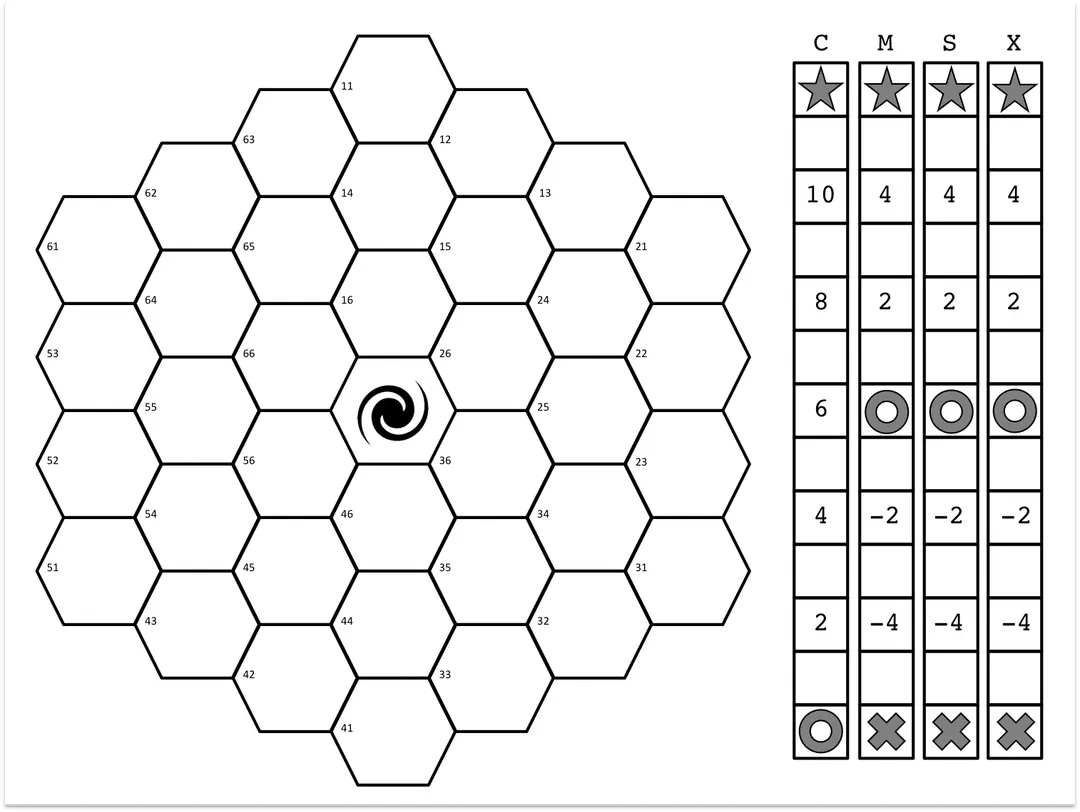
Humanity has inherited the stars, but humanity being what it is, the stars forever slip from its grasp. Even the First Sovereignty, which scattered humanity to a million worlds, has collapsed, consigned to oblivion. No one remembers what brought it about, whether a withering apathy, rebellions across its repressed worlds, or the impenetrable whims of the enigmatic, inhuman Xeno. Yet humanity is tenacious. There are always more fledgling civilizations ready to rise to the heights of power and culture, invent new technologies, and usher in a new millennium. Deep Future is a card-driven board game for 1-3 players of empire and innovation spanning the rise and fall of the countless worlds of the galaxy. You will settle on planets, expand your influence across sectors, invent new technologies and rediscover old ones, and face challenges that threaten to tear your civilization apart as you try to achieve one of several paths to victory. Deep Future is a “Make-as-You-Play” game, which means that the game starts with a few materials (a map, paper, index cards, and colored cubes) and the remaining components will be generated as needed during play. Each game will see the addition of new cards, which represent the worlds in the galaxy, the techs invented, and the lasting impact of previous civilizations. The rules include tables and guidelines for creating new cards as needed, and this makes every copy of Deep Future an evolving galaxy. In addition, it means that each game inherits all components added or changed in the previous games. The galaxy’s content — its worlds, techs, and history — can grow endlessly over a connected campaign as players return to see what each new era holds for the future of humanity.
Deep Future supports 1–3 players according to the catalogue. This range comes from the publisher’s listed player count, so the game can be set up for any group size within it. Some setups, rules and scoring details may still vary by player count, so check your edition’s rulebook for the exact configuration.
The listed playing time for Deep Future is 30–90 minutes. This is the publisher’s estimate for a full game. The actual duration depends on the group, the player count and familiarity with the rules: first sessions usually run longer, while experienced groups often finish faster. Setup and teaching time are not included in this estimate.
Deep Future has a complexity rating of 3.1 out of 5 from BoardGameGeek players, which makes it a medium-weight game. The rating reflects how much rules knowledge, planning and decision-making a typical game demands. Expect a longer first teach for heavier games, and use a preparation guide before game night.
Deep Future belongs to these categories: Print & Play, Science Fiction, and Civilization. Its main mechanics are Hand Management, Paper-and-Pencil, and Hexagon Grid. Categories describe the theme and setting of a game, while mechanics describe what players actually do on their turns. Each mechanic links to a catalogue hub with similar games, which helps when you want something comparable.
The credited designers of Deep Future are: R. Winder. These credits come from the published game data and name the people responsible for the game’s design, not its illustrators or publishers. Designer pages on MeepleRules collect other titles by the same designers, which helps when you enjoy a game and want to find similar ones.
The catalogue lists Deep Future as a base game. It can be played on its own with the components in the box and does not require any other title. Expansions, if any exist, add new content or rules on top of it and are listed separately in the catalogue with a link back to this base game.