
- BGG rank
- BGG #115
- BGG rating
- 7.8
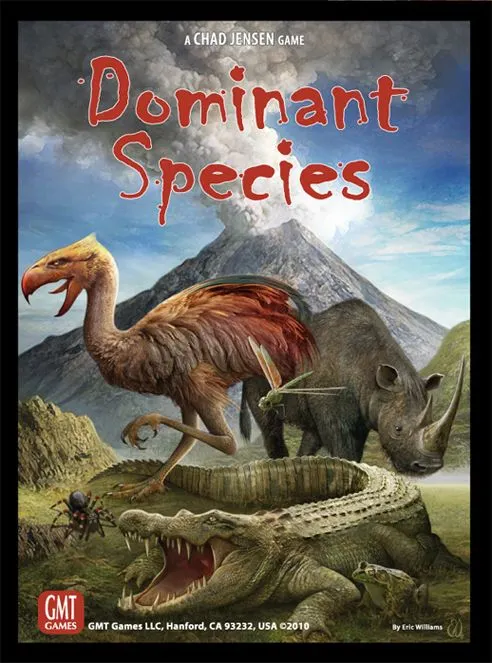
Dominant Species
- 2–6 players
- 120–240 min
- Complexity 4.0/5
- 2010
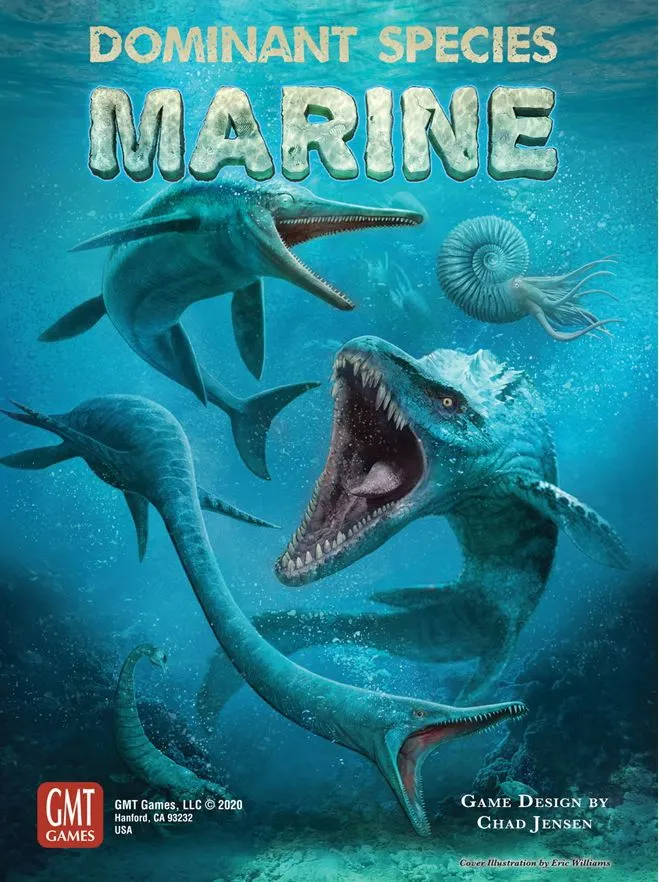
2021
Rules assistance for Dominant Species: Marine
Plain-language explanations of turns, card effects and disputed situations, with official source references and saved question history.
For 2 players
What would you like to know?
Answers come from the official rulebook, with the page to check.
Dominant Species: Marine is a board game released in 2021 for 2–4 players, 90–150 minutes per game, and ages 14 and up. It was designed by Chad Jensen and its main mechanics are Variable Player Powers, Area Majority / Influence, and Tile Placement.








Sixty-Something Millions of Years Ago — A great ice age has ended. With massive warming altering the globe, another titanic struggle for supremacy has unwittingly commenced between the varying animal species. Dominant Species: Marine is a game that abstractly recreates a small portion of ancient history: the ending of an onerous ice age and what that entails for the living creatures trying to adapt to the slowly-changing earth. Each player will assume the role of one of four major aquatic-based animal classes — reptiles, fish, cephalopod or crustacean. Each begins the game more or less in a state of natural balance in relation to one another. But that won’t last: It is indeed “survival of the fittest.” Through wily action pawn placement, you will attempt to thrive in as many different habitats as possible in order to claim powerful card effects. You will also want to propagate your individual species in order to earn victory points for your animal. You will be aided in these endeavors via speciation, migration and adaptation actions, among others. All of this eventually leads to the end game – the final ascent of a vast tropical ocean and its shorelines – where the player having accumulated the most victory points will have their animal crowned the Dominant Species. But somebody better become dominant quickly, because there’s a large asteroid heading this way.... Game Play The large hexagonal tiles are used throughout the game to create an ever-expanding interpretation of the main ocean on earth as it might have appeared tens of millions of years ago. The smaller Hydrothermal Vent tiles will be placed atop some of the larger tiles throughout play, converting them into Vents in the process. The action pawns drive the game. Each pawn allows a player to perform the various actions that can be taken—such as speciation, environmental change, migration or evolution. When placed on the action display, a pawn will immediately trigger that particular action for its owning player. Dominant Species: Marine includes new “special” pawns that can be acquired during the course of play. These special pawns have enhanced placement capabilities over the “basic” pawns that each player begins the game with. Generally, players will be trying to enhance their own animal’s survivability while simultaneously trying to hinder that of their opponents’—hopefully collecting valuable victory points along the way. The various cards will aid in these efforts, giving players useful one-time abilities, ongoing benefits, or an opportunity for recurring VP gains. Throughout the game species cubes will be added to, moved about on, and removed from the tiles in play (“earth”). Element disks will be added to and removed from both animals and earth. When the game ends, players will conduct a final scoring of each tile and score their controlled special pawns—after which the player controlling the animal with the highest VP total wins the game. Dominant Species Veterans For players of the original Dominant Species, this iteration introduces several key evolutions to the system (pun definitely intended): Actions are taken immediately whenever a pawn is placed instead of waiting to execute actions after all pawns are on the board. This gives players a bit more flexibility in their strategy, doesn’t increase game time when more pawns are acquired by players, and lessens the brain-burn quite a bit since it alleviates the burden of having to plan out an entire turn in advance. Domination is no longer on a per-tile basis, and is no longer ‘competitive’ with other players. In this game you check dominance for each element type over the entire earth, and whether or not you dominate an element type is independent of whether one or more opponents also dominate it. Domination of an element is how you acquire – and try to maintain – control of the special pawns. Animals no longer have default special abilities. Now, players are dealt 3 Trait cards during setup, choosing one to keep and putting the others back in the box. The chosen Trait gives their animal one of eighteen unique abilities spread amongst the Trait cards. Acquiring special pawns through domination gives a player great flexibility in planning and executing a strategy. Special pawns can ‘bump’ an opponent’s basic pawn in order to take an action that would otherwise be blocked. They can be placed anywhere on the action display (where basic pawns must be placed in top-to-bottom order only). There are powerful action spaces where only a special pawn can be placed. And at the end of the game, each special pawn awards its owner VPs according to its highest achieved dominance value. —description from the publisher
Dominant Species: Marine supports 2–4 players according to the catalogue. This range comes from the publisher’s listed player count, so the game can be set up for any group size within it. Some setups, rules and scoring details may still vary by player count, so check your edition’s rulebook for the exact configuration.
The listed playing time for Dominant Species: Marine is 90–150 minutes. This is the publisher’s estimate for a full game. The actual duration depends on the group, the player count and familiarity with the rules: first sessions usually run longer, while experienced groups often finish faster. Setup and teaching time are not included in this estimate.
The catalogue lists Dominant Species: Marine for ages 14 and up. This is the publisher’s recommendation and reflects reading demands, rule complexity and small components rather than theme alone. Younger players can often join with help from an adult, so check the age guidance on your edition and consider your group’s experience with board games.
Dominant Species: Marine has a complexity rating of 3.7 out of 5 from BoardGameGeek players, which makes it a medium-weight game. The rating reflects how much rules knowledge, planning and decision-making a typical game demands. Expect a longer first teach for heavier games, and use a preparation guide before game night.
Dominant Species: Marine belongs to these categories: Animals, Prehistoric, and Environmental. Its main mechanics are Variable Player Powers, Area Majority / Influence, and Tile Placement. Categories describe the theme and setting of a game, while mechanics describe what players actually do on their turns. Each mechanic links to a catalogue hub with similar games, which helps when you want something comparable.
The credited designers of Dominant Species: Marine are: Chad Jensen. These credits come from the published game data and name the people responsible for the game’s design, not its illustrators or publishers. Designer pages on MeepleRules collect other titles by the same designers, which helps when you enjoy a game and want to find similar ones.
The catalogue lists Dominant Species: Marine as a base game. It can be played on its own with the components in the box and does not require any other title. Expansions, if any exist, add new content or rules on top of it and are listed separately in the catalogue with a link back to this base game.