- BGG rank
- BGG #16,175
- BGG rating
- 8.5
First Monday in October
2026
Rules assistance for First Monday in October
Plain-language explanations of turns, card effects and disputed situations, with official source references and saved question history.
- 1–4 players
- 90–120 min
- 12+
- Complexity 3.0/5

For 1 player
Rules assistant for First Monday in October
What would you like to know?
Answers come from the official rulebook, with the page to check.
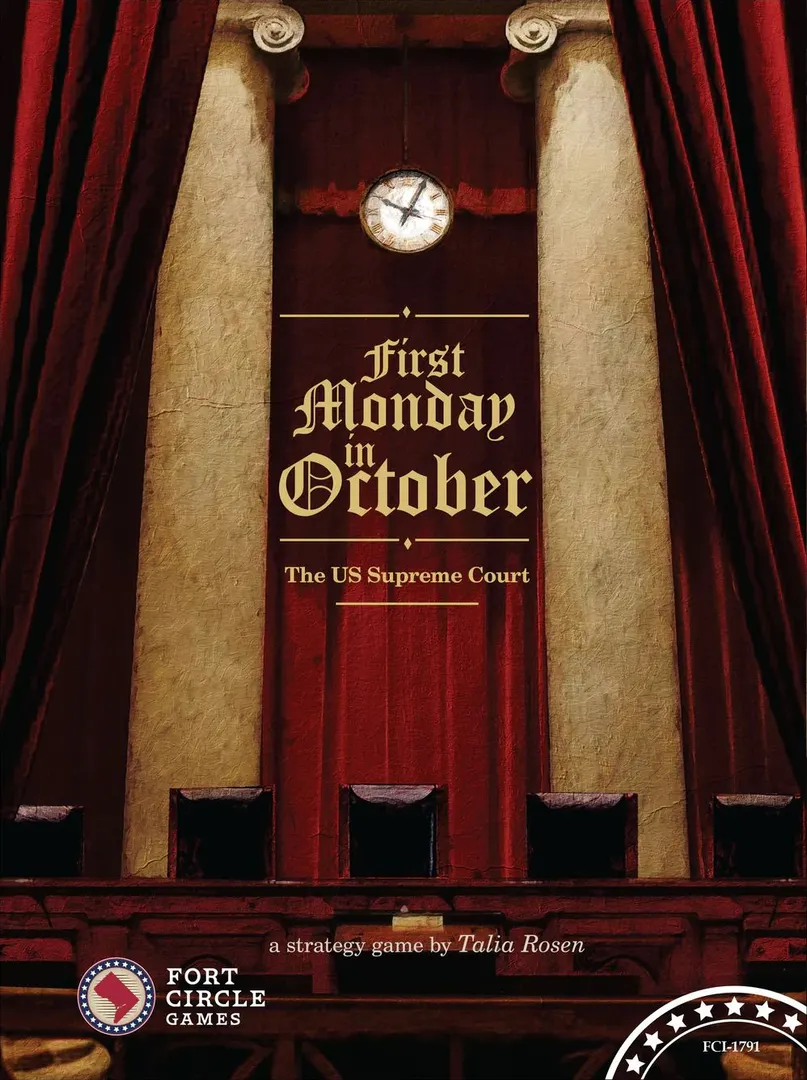
First Monday in October is a board game released in 2026 for 1–4 players, 90–120 minutes per game, and ages 12 and up. It was designed by Talia Rosen and its main mechanics are Dice Rolling, Area Majority / Influence, and End Game Bonuses.
About the game
On the First Monday in October, the all-powerful Justices of the U.S. Supreme Court gather each year in their "marble palace" to decide the fate of a nation. Over the course of two hours, First Monday in October re-creates the history of the U.S. Supreme Court from 1789 to the present day, through three distinct eras: Era I represents the founding of the Court in 1789 through the Civil War in 1865; Era II represents the time period from 1866 until the seminal decision of Brown v. Board in 1954; and Era III represents the modern era from 1955 until 2010. Players compete to score renown points in this card-driven strategy game by advocating for the winning side of cases decided by the Supreme Court and by shaping the judicial philosophy of the Court to align with their objectives. During each round, players can choose to place their clerks on what they hope to be the winning side of cases as they progress along the Docket track. In order to help their litigants win, players can take actions to change the composition of the Court by encouraging Justices throughout history to retire and by supporting judicial candidates. At the end of each round, one case will be scored and awarded to the player with the most clerks on the prevailing side. The player with the most points at the end of the game wins. Each player represents a long-standing institution or school of thought attempting to gain renown by shaping the composition of the high court. Players need to use their limited influence and actions wisely to manipulate the judicial philosophy of the Court and to prevail in as many cases as possible. Commerce Clause: This track represents the scope of Article I, Section 8 of the U.S. Constitution, which grants Congress the power to "regulate commerce" among the several states. Equality & Liberty: This track broadly represents the scope of individual equality and liberty, including but not limited to the 14th Amendment (i.e., equal protection, due process, and privacy rights). Free Speech: This track represents the obligation in the 1st Amendment that Congress make no law abridging a person's freedom of speech, and the scope of permissible restrictions on that freedom. Executive Power: This track broadly represents the scope of Article II of the U.S. Constitution, which enumerates the powers of the executive branch, including the Office of the President and law enforcement. Shifting each philosophy one way generally represents a more expansive Federalist interpretation of the above constitutional provisions that supports a stronger centralized federal government, whereas shifting each philosophy the other direction generally represents a more narrow Anti-Federalist application of these provisions that supports a more decentralized approach to government with less power concentrated at the federal level. —description from the publisher
Categories
Designers
Publishers
- Fort Circle Games
Questions and answers
First Monday in October supports 1–4 players according to the catalogue. This range comes from the publisher’s listed player count, so the game can be set up for any group size within it. Some setups, rules and scoring details may still vary by player count, so check your edition’s rulebook for the exact configuration.
The listed playing time for First Monday in October is 90–120 minutes. This is the publisher’s estimate for a full game. The actual duration depends on the group, the player count and familiarity with the rules: first sessions usually run longer, while experienced groups often finish faster. Setup and teaching time are not included in this estimate.
The catalogue lists First Monday in October for ages 12 and up. This is the publisher’s recommendation and reflects reading demands, rule complexity and small components rather than theme alone. Younger players can often join with help from an adult, so check the age guidance on your edition and consider your group’s experience with board games.
First Monday in October has a complexity rating of 3.0 out of 5 from BoardGameGeek players, which makes it a medium-weight game. The rating reflects how much rules knowledge, planning and decision-making a typical game demands. Expect a longer first teach for heavier games, and use a preparation guide before game night.
First Monday in October belongs to these categories: Political and Educational. Its main mechanics are Dice Rolling, Area Majority / Influence, and End Game Bonuses. Categories describe the theme and setting of a game, while mechanics describe what players actually do on their turns. Each mechanic links to a catalogue hub with similar games, which helps when you want something comparable.
The credited designers of First Monday in October are: Talia Rosen. These credits come from the published game data and name the people responsible for the game’s design, not its illustrators or publishers. Designer pages on MeepleRules collect other titles by the same designers, which helps when you enjoy a game and want to find similar ones.
The catalogue lists First Monday in October as a base game. It can be played on its own with the components in the box and does not require any other title. Expansions, if any exist, add new content or rules on top of it and are listed separately in the catalogue with a link back to this base game.