
- BGG rating
- 7.7
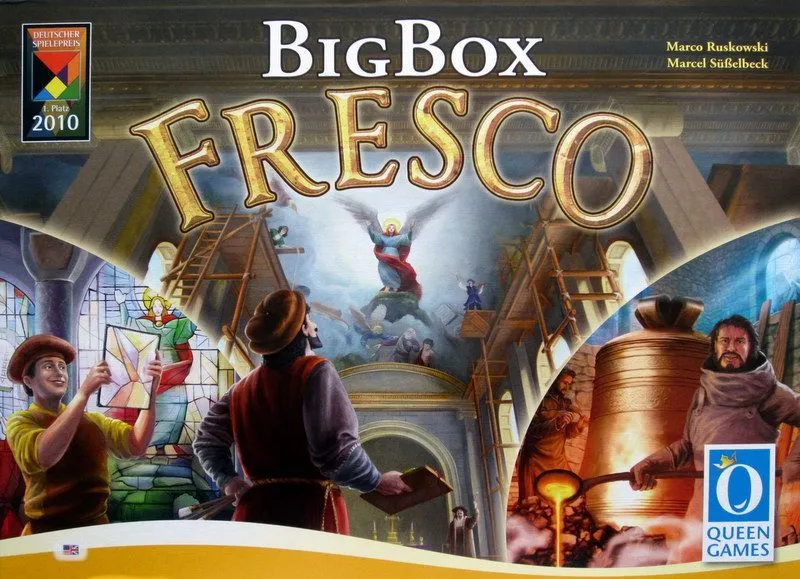
Fresco: Big Box
- 2–4 players
- 60 min
- Complexity 2.8/5
- 2014
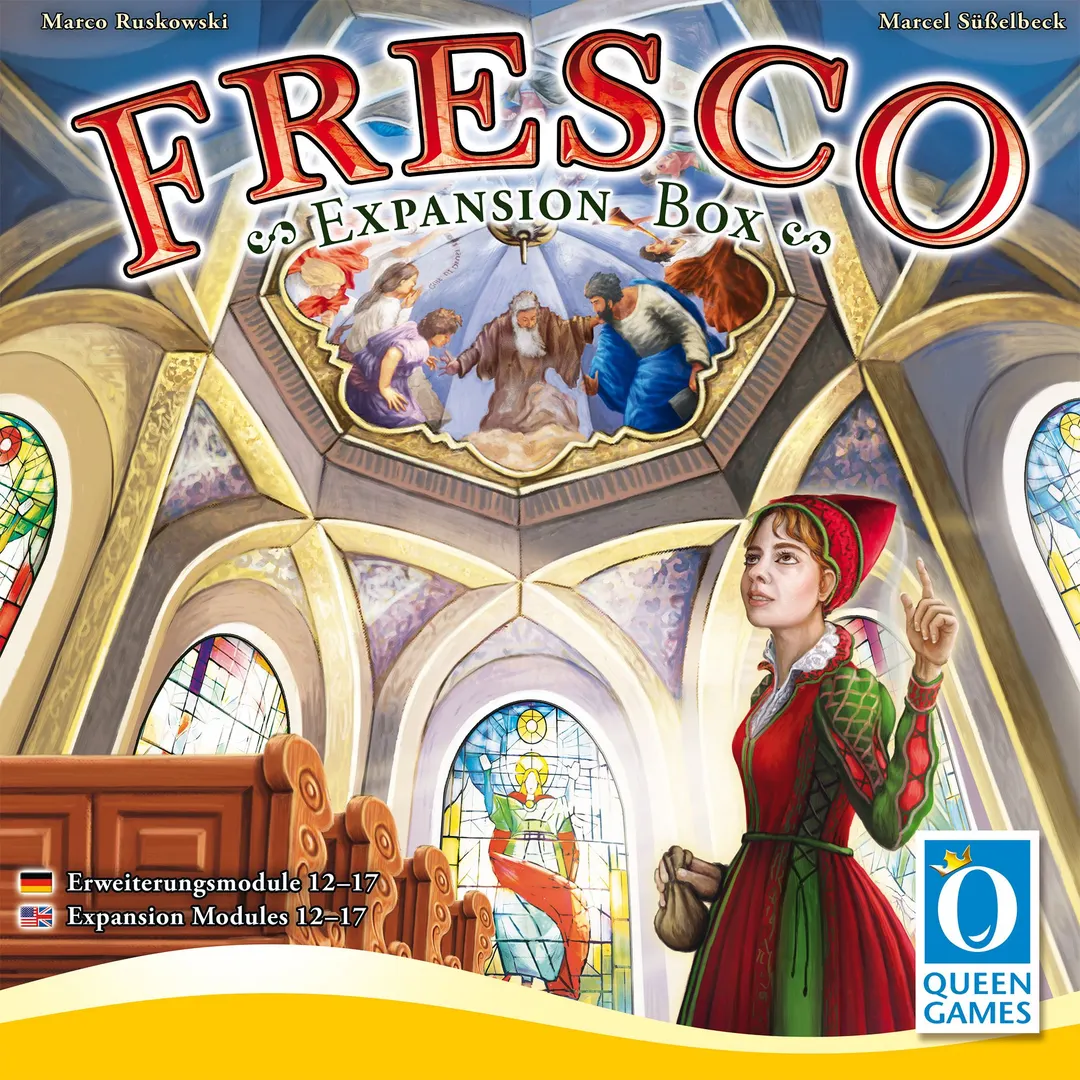
Rules assistance for Fresco: Expansion Box
Plain-language explanations of turns, card effects and disputed situations, with official source references and saved question history.
What would you like to know?
Answers come from the official rulebook, with the page to check.
Fresco: Expansion Box is an expansion for Fresco released in 2020 for 2–4 players, 60 minutes per game, and ages 10 and up. It was designed by Marco Ruskowski and Marcel Süßelbeck and its main mechanics are Set Collection, Grid Movement, and Action Queue.



Includes expansion modules 12 - 17. 6 new expansion modules: The Ladies, The Catacombs, The Pews, The Dome, The Black Market, and The Guild Helps. Module 12: The Ladies In this module, players receive an extra player board that allows for special actions. Two tiles can be switched in the market, a fresco tile can be reserved in the Cathedral, more coins can be earned in the studio, colors can be exchanged in the workshop, and in the Theater the mood can be lifted even further. Module 13: The Catacombs This module changes the Hostel, Cathedral, and the Planning phase. The catacomb tiles are first placed face down in the cathedral and the fresco tiles are placed on top of them. Players can now purchase cartographer tiles in the hostel, which show locations in the cathedral that have to be painted in order to gain access to the catacomb tiles below. A catacomb tile can be sold for coins or kept till the end of the game, in which case the bishop awards extra victory points to the players. Module 14: The Pews This module changes the market action and the planning phase. The chapel board is placed next to the game board and every player takes six wooden planks and places them in front of their screen. New market tiles will allow the players to purchase these when they visit the market. In the planning phase players may place their assistants on the new action tiles to use their collected wood to build pews for the church and collect some extra points. Module 15: The Dome The dome tiles are shuffled and placed on the nine central fresco spaces, before the fresco tiles are placed on top. When a player finishes a fresco tile, they take the dome tile underneath and places it in front of them. A dome tile shows a combination of two colors that the player needs to gain the depicted victory points. However, these tiles can only be painted at the end of the game, after the fresco in the cathedral is finished. So good planning and timing will be needed in order to keep the necessary paint cubes to finish the dome at the end of the game. Module 16: The Black Market A poor painter canʼt be faulted for succumbing to a tempting offer from the dubious merchants of the black market. Their paints, stored in large barrels, are not expensive, but you never know which paint you will get... When you visit a market booth to buy paints, you may assign one of your apprentices to visit the Black Market instead. For this apprentice, a paint tile will be pulled at random from the draw bag, and the player must purchase this paint if possible. Since tiles are returned to the bag when a player visits a market booth or closes one down, players earlier in turn order will have a better guess what they might receive from the Black Market. Module 17: The Guild Helps Painters often are missing urgently needed supplies for their work, but thankfully the members of the Painters Guild stick together and are willing to exchange among themselves. A lucky painter may find what they need at the guild. Each round one random basic paint and one random blended paint are placed on the guild tile. Using one of the two actions received for sending an apprentice to blend paints, the player may exchange one of their paints for the same type of paint from the guild tile (basic for basic and blended for blended). A player may now make two exchanges, two blends, or do one of each.
Fresco: Expansion Box supports 2–4 players according to the catalogue. This range comes from the publisher’s listed player count, so the game can be set up for any group size within it. Some setups, rules and scoring details may still vary by player count, so check your edition’s rulebook for the exact configuration.
The listed playing time for Fresco: Expansion Box is 60 minutes. This is the publisher’s estimate for a full game. The actual duration depends on the group, the player count and familiarity with the rules: first sessions usually run longer, while experienced groups often finish faster. Setup and teaching time are not included in this estimate.
The catalogue lists Fresco: Expansion Box for ages 10 and up. This is the publisher’s recommendation and reflects reading demands, rule complexity and small components rather than theme alone. Younger players can often join with help from an adult, so check the age guidance on your edition and consider your group’s experience with board games.
Fresco: Expansion Box belongs to these categories: Expansion for Base-game and Renaissance. Its main mechanics are Set Collection, Grid Movement, and Action Queue. Categories describe the theme and setting of a game, while mechanics describe what players actually do on their turns. Each mechanic links to a catalogue hub with similar games, which helps when you want something comparable.
The credited designers of Fresco: Expansion Box are: Marco Ruskowski and Marcel Süßelbeck. These credits come from the published game data and name the people responsible for the game’s design, not its illustrators or publishers. Designer pages on MeepleRules collect other titles by the same designers, which helps when you enjoy a game and want to find similar ones.
The catalogue lists Fresco: Expansion Box as an expansion for Fresco. Expansions add new content, rules or scenarios to the base game and usually cannot be played on their own, so you need Fresco to use it. Check that your edition of Fresco is compatible, as some expansions were revised between editions.