
- BGG rank
- BGG #22,276
- BGG rating
- 6.2
Duel in the Desert: Rommel's Campaign in North Africa
- 2 players
- 90 min
- Complexity 2.5/5
- 1986
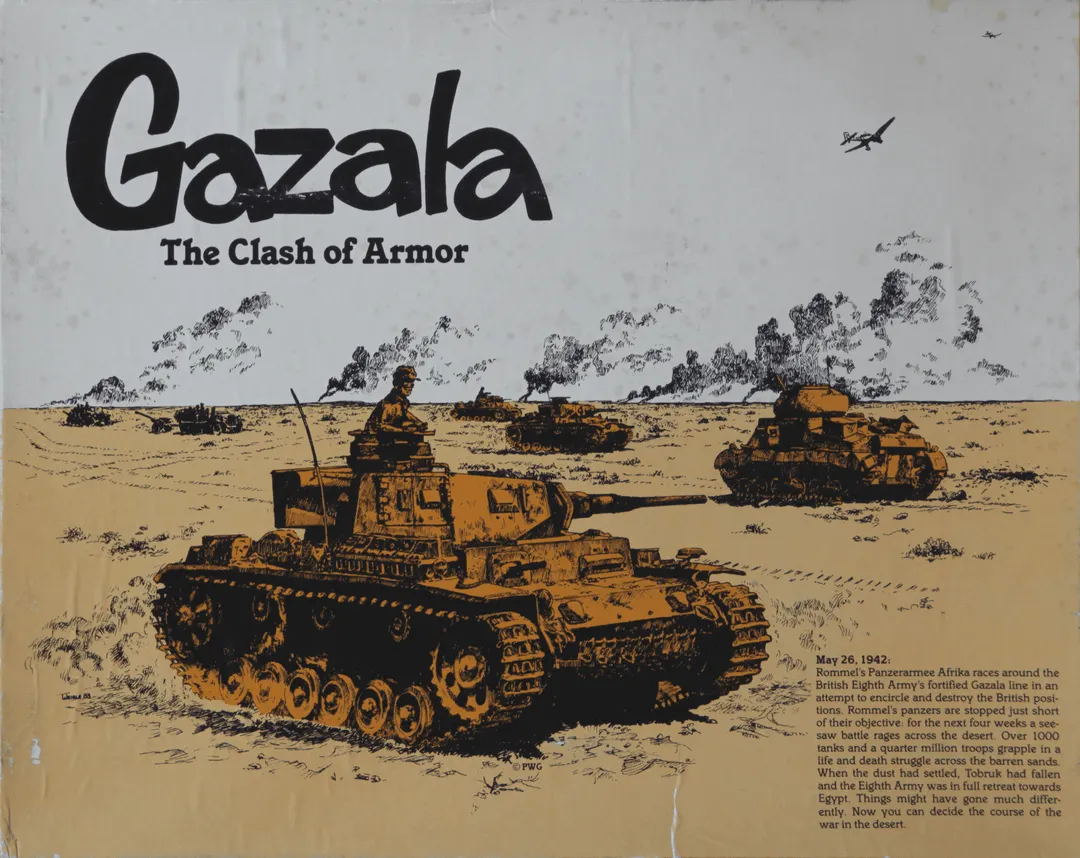
1983
Rules assistance for Gazala: The Clash of Armor
Plain-language explanations of turns, card effects and disputed situations, with official source references and saved question history.
For 2 players
What would you like to know?
Answers come from the official rulebook, with the page to check.
Gazala: The Clash of Armor is a board game released in 1983 for 2 players, 180 minutes per game, and ages 12 and up. It was designed by David Bolt and its main mechanics are Dice Rolling, Variable Set-up, and Grid Movement.
The History Late May 1942 saw the massing of unprecedented strength on both sides of the desert war. For several months the front had lain static and quiet while the opposing armies absorbed hundreds of new tanks and guns. The front erupted in a massive armored battle on May 27, which continued for four long weeks. In battle after battle Rommel, the desert fox, seemed to be surrounded and defeated, only to slip away and strike again. The British superiority in armor was hurled repeatedly against the deadly German 88 mm flak guns, leaving the desert covered with tank wrecks. Bravery was common among all the nationalities present: German, British, Free French, Italian, Indian, and South African troops all fought fiercely among the desert sands for the citadel of Tobruk. The Game The game GAZALA 1942 has daily turns that are composed of morning, afternoon, and evening phases. Each phase has a movement, combat, and exploitation segment. Players alternate moving formations (regiments, divisions, and corps) in a uniquely integrated movement system. The player with the initiative attempts to move one formation of his choice, and if successful in activating the formation, he may move all the units that belong to it. The opposing player than has the opportunity to move one of his formations in response, if he can activate it. This system captures the feeling of desert warfare in which neither side knew for certain who was going to move what where. Combined with the unlimited possibilities of movement is a hidden unit rule that has units on the map inverted, only a dust-cloud is shown to the opponent. Players must conduct reconnaissance in order to determine if a single inverted unit on the map represents an infantry battalion, or an entire panzer regiment. Units are composed of strength points: each strength point represents 100 infantry, or 3 tanks, or 3–6 guns. Movement points, which are expended at different rates by moving units that have different mobility abilities, are also spent to prepare for combat, perform reconnaissance, and cross minefields. Both players participate in the same combat phase with everything from anti-tank fire (differentiated for range), direct fire and assaults (which occur between opposing units that occupy the same hex), barrages, and airstrikes (plotted in advance, and liable to come down on your troops if you aren’t careful). The rules cover the full range of features that were characteristic of desert warfare. There are five scenarios including an introductory scenario, and a campaign game. With full examples of play, extensive players’ notes, and an Order of Battle compiled by Gary Helmer, Frank Prieskop, and David Bolt, GAZALA 1942 offers players a detailed and comprehensive insight into one of the most mobile and fluid periods of warfare ever known. 5 scenarios (campaign game 27 May - 2 June) Scale 1,5 miles per hex 1 battalion per counter 1 day per turn Components 32 pages rulebook 1 map (86 x 55.7 cm) 600 counters 6 standard size pages of charts (from the back box and BGG user)
Gazala: The Clash of Armor supports 2 players according to the catalogue. This is the publisher’s listed player count, so the game is designed for exactly that number of participants. Variants for other group sizes, if any, are described in the rulebook of your edition, so check it before setting up a different configuration.
The listed playing time for Gazala: The Clash of Armor is 180 minutes. This is the publisher’s estimate for a full game. The actual duration depends on the group, the player count and familiarity with the rules: first sessions usually run longer, while experienced groups often finish faster. Setup and teaching time are not included in this estimate.
The catalogue lists Gazala: The Clash of Armor for ages 12 and up. This is the publisher’s recommendation and reflects reading demands, rule complexity and small components rather than theme alone. Younger players can often join with help from an adult, so check the age guidance on your edition and consider your group’s experience with board games.
Gazala: The Clash of Armor has a complexity rating of 4.2 out of 5 from BoardGameGeek players, which makes it a heavy game. The rating reflects how much rules knowledge, planning and decision-making a typical game demands. Expect a longer first teach for heavier games, and use a preparation guide before game night.
Gazala: The Clash of Armor belongs to these categories: Wargame and World War II. Its main mechanics are Dice Rolling, Variable Set-up, and Grid Movement. Categories describe the theme and setting of a game, while mechanics describe what players actually do on their turns. Each mechanic links to a catalogue hub with similar games, which helps when you want something comparable.
The credited designers of Gazala: The Clash of Armor are: David Bolt. These credits come from the published game data and name the people responsible for the game’s design, not its illustrators or publishers. Designer pages on MeepleRules collect other titles by the same designers, which helps when you enjoy a game and want to find similar ones.
The catalogue lists Gazala: The Clash of Armor as a base game. It can be played on its own with the components in the box and does not require any other title. Expansions, if any exist, add new content or rules on top of it and are listed separately in the catalogue with a link back to this base game.