
- BGG rank
- BGG #1,891
- BGG rating
- 7.0
3 Chapters
- 2–6 players
- 30 min
- Complexity 1.7/5
- 2024
1930
Rules assistance for Klabberjass
Plain-language explanations of turns, card effects and disputed situations, with official source references and saved question history.
For 2 players
What would you like to know?
Answers come from the official rulebook, with the page to check.
Klabberjass is a board game released in 1930 for 2 players and 45 minutes per game. Its main mechanics are Set Collection and Trick-taking.



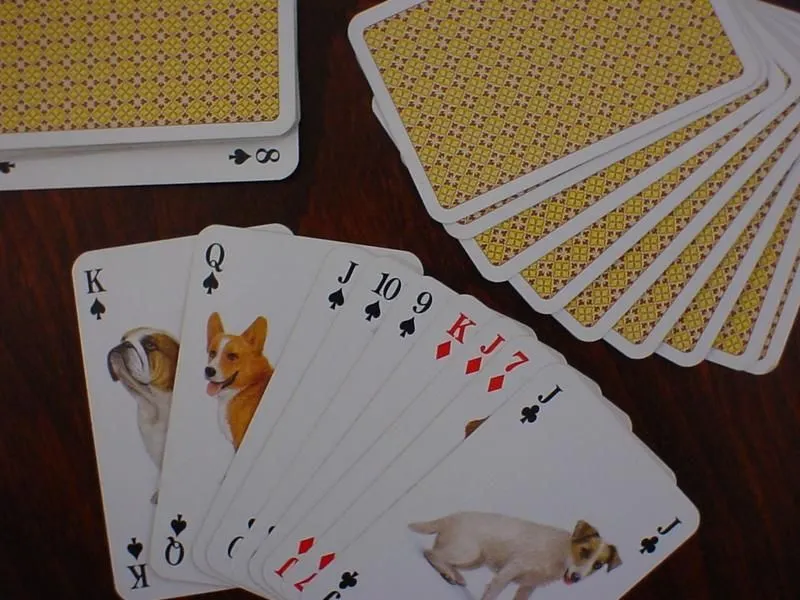
From The Complete Book of Indoor Games by Peter Arnold: Klabberjass is probably best known in America than in England, because under the names of Clabber,Clobber, Clubby, Klab and Klob, it occurs in Damon Runyon's amusing stories,and in 1937 a variation of the game, jo-jotte was publicized by Ely Culbertson. Despite the simularity of names it is not idenical with the Hungarian game of kalabrias, which is a game for three or four players. There may have been a common ancestor, or possibly the game was taken to the New World by Central European immigrants and there bowdlerized version of kalabrias. (Exeter Books, 1984) Klabberjass is played in the North American and Great Britain with the 32 card deck. (6s, 5s,4s,3s, and 2s removed from the standard 52 card deck.) The trump suit enjoys the strange ranking of the Jass genre: J 9 A 10 K Q 8 7. Non trump suit rank A 10 K Q J 9 8 7 as in the Skat-Pinochle family. Six cards are dealt to each player and a card is turned up. Non-dealer then begins a bidding round to first to accept the turn-up as trump. Or pass. If both pass on the turn-up card a second round is held. Here the non-dealer may take the bid by naming one of the other three suits or pass, dealer than may take the bid by naming the suit of throw in the hand. (Some allow for a bid of "Schmeiss" which means to the bidder will take the hand with the turn-up or the hand can be thrown in at the non-bidders discretion) After bidding, the dealer deals three more cards to the hand. Then sequences are scored. For this purpose the cards revert back to their numeral rank. A sequence of three scores 20 and a sequence of 4 or more scores 50. tiebreakers are decided by rank. As I will describe later, it may make sense not to score in this round and you are not obligated to do so. Non-dealer leads to first trick. A player must follow suit. If he cannot he must trump if able. If trump is lead he must play a higher trump if able. If he holds the King and Queen of trump he may announce "Bella" on play of the second card and score 50 points. Once again he may choose not to score for this. After the cards are played, both score for the following cards won: Jass (Jack of Trumps) 20 points Menel (9 of Trumps) 14 points. Any Ace 11 points Any 10 10 points. Any King 4 points. Any Queen 3 points. Any Jack 2 points. Last Trick 10 points. If the the high bidder (The one who established trump) scores the highest, both sides score what they made. If if opponent scores higher he scores for both totals. This is why the high bidder who realizes he is not going to beat his opponent in this hand may decide not to score or "Sink" points during the hand. 500 points wins the round. Prior to the onset of Gin Rummy, this was the most popular two handed game in the United States. It still holds a loyal following. Klabberjass remains a popular two handed game in the United States. There are several variations in play and several house rules. It is very popular in New England and especially Hartford, Connecticut.
Klabberjass supports 2 players according to the catalogue. This is the publisher’s listed player count, so the game is designed for exactly that number of participants. Variants for other group sizes, if any, are described in the rulebook of your edition, so check it before setting up a different configuration.
The listed playing time for Klabberjass is 45 minutes. This is the publisher’s estimate for a full game. The actual duration depends on the group, the player count and familiarity with the rules: first sessions usually run longer, while experienced groups often finish faster. Setup and teaching time are not included in this estimate.
Klabberjass has a complexity rating of 2.5 out of 5 from BoardGameGeek players, which makes it a medium-light game. The rating reflects how much rules knowledge, planning and decision-making a typical game demands. Expect a longer first teach for heavier games, and use a preparation guide before game night.
Klabberjass belongs to these categories: Card Game. Its main mechanics are Set Collection and Trick-taking. Categories describe the theme and setting of a game, while mechanics describe what players actually do on their turns. Each mechanic links to a catalogue hub with similar games, which helps when you want something comparable.
The catalogue lists Klabberjass as a base game. It can be played on its own with the components in the box and does not require any other title. Expansions, if any exist, add new content or rules on top of it and are listed separately in the catalogue with a link back to this base game.