
- BGG rank
- BGG #26,135
- BGG rating
- 5.7
Escape from New York
- 2–4 players
- 20–60 min
- Complexity 1.5/5
- 1981
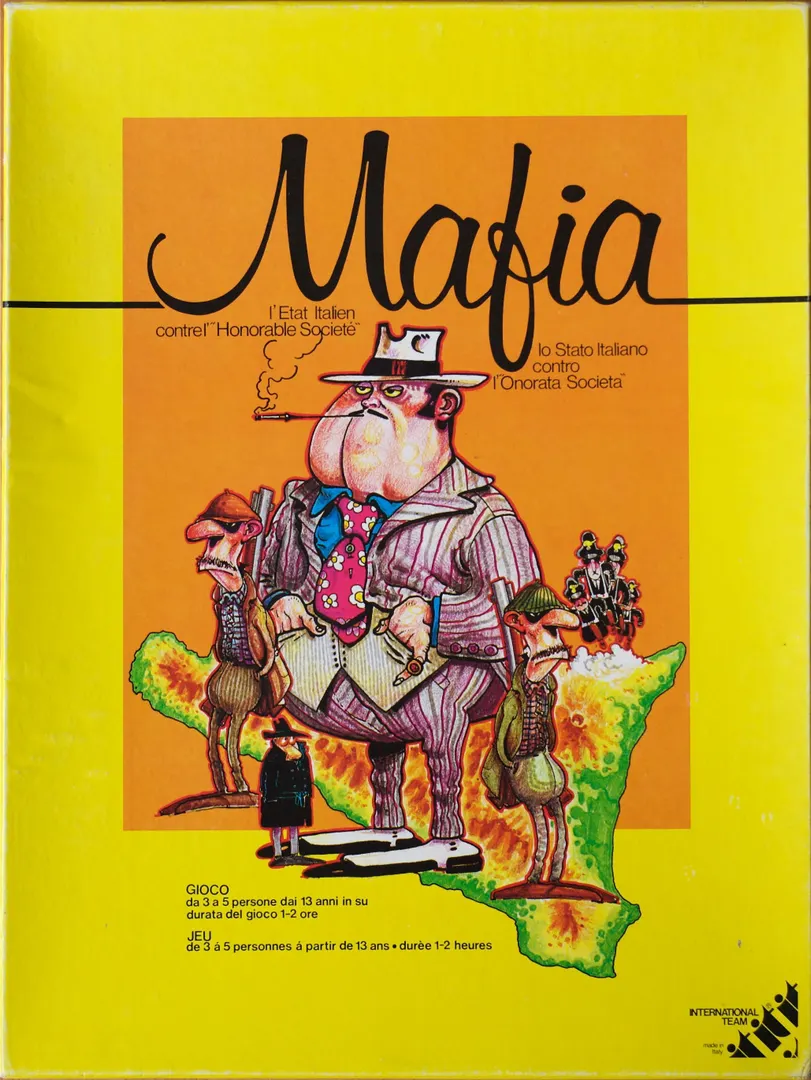
1981
Rules assistance for Mafia
Plain-language explanations of turns, card effects and disputed situations, with official source references and saved question history.
For 3 players
What would you like to know?
Answers come from the official rulebook, with the page to check.
Mafia is a board game released in 1981 for 3–5 players, 60–120 minutes per game, and ages 13 and up. It was designed by Marco Donadoni and its main mechanics are Take That, Race, and Set Collection.






Four Mafia "Families," controlled by two to four players, vie for control of the island of Sicily. Each Family consists of a Boss and two gangs of young thugs (picciotti). Mafia is a straightforward game with an unusual setting. It aroused some discussion in Italian newspapers when it first came out. The game approaches its deadly serious subject with a sarcastic tone, and somewhat sanitized violence, for a strategic and thematic gaming experience. The Families are in a race to be the first to control four spaces on the board, but the State can prevail if it imprisons enough Bosses and picciotti to remediate the plague of criminal violence. The mafioso are opposed by the forces of the Italian State who are controlled by an additional player (except under the four-player rules, where the players share responsibility for moving the State's counters). The State player controls the Prefetto (Prefect), three Carabinieri (military police) units, and a secret-service (SISDE) agent. The State has also established some static roadblocks around the island which can snare careless mafioso. Through their combined efforts, the forces of the State seek to arrest as many Bosses and picciotti as they can. The playing board is a track of 26 loosely-defined spaces running around the perimeter of the island of Sicily, and through the center, in a sort of a B-shaped pattern. The board includes three significant Sicilian cities (Palermo, Catania, and Enna) which can serve as headquarters for the Mafia Families. Units move by a roll of the dice in a clockwise fashion, using the combined total of the dice to move one unit, or the individual numbers shown on the dice to move two units. Two decks of cards are used to reflect events stemming from the influence of mafia allies in the United States and support for the Prefetto from the Italian continent. A third card deck represents the evidence the secret-service agent can gather to establish grounds for the Prefetto to arrest Bosses.
Mafia supports 3–5 players according to the catalogue. This range comes from the publisher’s listed player count, so the game can be set up for any group size within it. Some setups, rules and scoring details may still vary by player count, so check your edition’s rulebook for the exact configuration.
The listed playing time for Mafia is 60–120 minutes. This is the publisher’s estimate for a full game. The actual duration depends on the group, the player count and familiarity with the rules: first sessions usually run longer, while experienced groups often finish faster. Setup and teaching time are not included in this estimate.
The catalogue lists Mafia for ages 13 and up. This is the publisher’s recommendation and reflects reading demands, rule complexity and small components rather than theme alone. Younger players can often join with help from an adult, so check the age guidance on your edition and consider your group’s experience with board games.
Mafia has a complexity rating of 1.8 out of 5 from BoardGameGeek players, which makes it a light game. The rating reflects how much rules knowledge, planning and decision-making a typical game demands. Expect a longer first teach for heavier games, and use a preparation guide before game night.
Mafia belongs to these categories: Fighting, Humor, and Mafia. Its main mechanics are Take That, Race, and Set Collection. Categories describe the theme and setting of a game, while mechanics describe what players actually do on their turns. Each mechanic links to a catalogue hub with similar games, which helps when you want something comparable.
The credited designers of Mafia are: Marco Donadoni. These credits come from the published game data and name the people responsible for the game’s design, not its illustrators or publishers. Designer pages on MeepleRules collect other titles by the same designers, which helps when you enjoy a game and want to find similar ones.
The catalogue lists Mafia as a base game. It can be played on its own with the components in the box and does not require any other title. Expansions, if any exist, add new content or rules on top of it and are listed separately in the catalogue with a link back to this base game.