

- BGG rank
- BGG #2,203
- BGG rating
- 7.0
Capital Lux
- 2–4 players
- 30 min
- Complexity 2.0/5
- 2016
2014
Rules assistance for Mangrovia
Plain-language explanations of turns, card effects and disputed situations, with official source references and saved question history.
For 2 players
What would you like to know?
Answers come from the official rulebook, with the page to check.
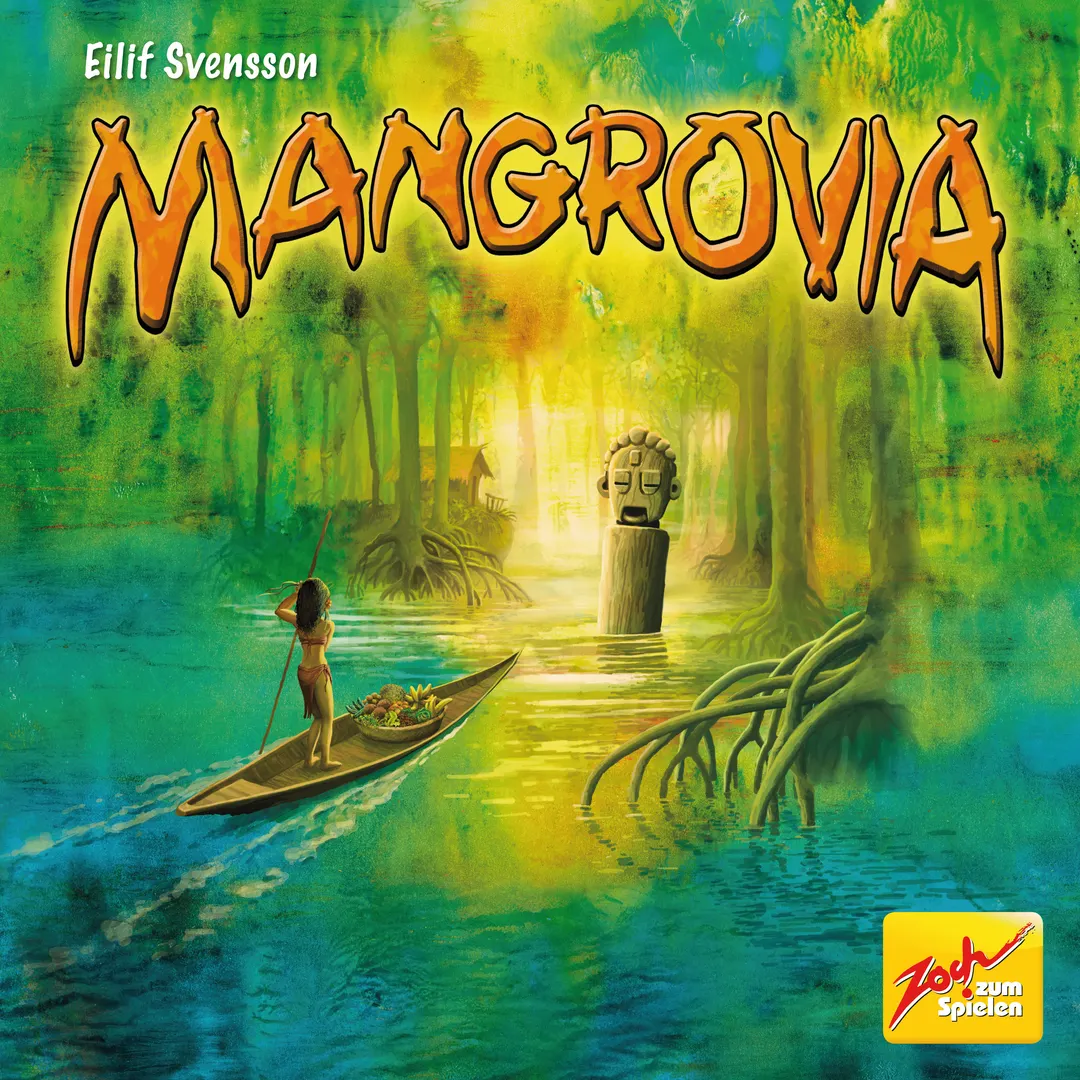
Mangrovia is a board game released in 2014 for 2–5 players, 75 minutes per game, and ages 10 and up. It was designed by Eilif Svensson and its main mechanics are Hand Management, Area Majority / Influence, and Variable Phase Order.


In Mangrovia, a light "gamer's game"/family game with a Caribbean mangrove setting, a clever role selection mechanism allows the players to choose two different bonuses/actions as well as the turn order in which they want these actions to be carried out — all by placing just one marker. Victory is achievable through a number of viable options, which guarantees high re-playability. The game is a fight over acquiring the best locations for your huts in this appealing and unspoiled landscape. If you manage to do so, you will become the rightful successor of the old chief and win the game. You gain Chief points by having the most huts (and the secondmost huts) along each of the eight divine paths monitored by the statues of Gods. Additional Chief points are earned by controlling sacred locations, by collecting amulets, and simply by building huts at lucrative spaces. Building a hut requires that the space's landscape is "active" and that you can pay the exact price (not overpay) for the space. Therefore, the game feels tight even from the very start. The game gets tighter and tighter towards the end of the game as you have fewer choices of spaces, and as the actions you choose become more and more crucial. In order to succeed in this game, you should carefully choose and time the best possible combination of actions, called "ritual sites". A boat goes from ritual site to ritual site, first on the west side, then on the east side (in opposite order), triggering each action. If, for instance, you choose a ritual site high up, you will have an early choice of cards, but a late choice of space to build your huts or to collect amulets (and vice versa). A fourth action type is to select "active landscapes" and become starting player, which makes it possible to control the next round. After all players have performed two actions, the round ends. The game is usually played over 10-14 rounds and ends when one player builds his last hut. Collecting amulets may be key in this game. Instead of keeping them as Chief points, you may use them to build huts on designated spaces which require payment in amulets instead of cards — and still to the exact price. Building huts on such spaces may be exactly what you need to get the majority along one or two divine paths. In order to gain enough amulets — and amulets of the appropriate values — you should position some of your huts on amulet spaces. The more huts you build on such spaces, the more amulets you can draw. The probability of getting the amulets you need will therefore increase. The game board is built as a matrix system, with some spaces being part of two divine paths while other spaces belong to just one. The spaces that are part of two divine paths are obviously most tempting, but can you afford to build your huts there?
Mangrovia supports 2–5 players according to the catalogue. This range comes from the publisher’s listed player count, so the game can be set up for any group size within it. Some setups, rules and scoring details may still vary by player count, so check your edition’s rulebook for the exact configuration.
The listed playing time for Mangrovia is 75 minutes. This is the publisher’s estimate for a full game. The actual duration depends on the group, the player count and familiarity with the rules: first sessions usually run longer, while experienced groups often finish faster. Setup and teaching time are not included in this estimate.
The catalogue lists Mangrovia for ages 10 and up. This is the publisher’s recommendation and reflects reading demands, rule complexity and small components rather than theme alone. Younger players can often join with help from an adult, so check the age guidance on your edition and consider your group’s experience with board games.
Mangrovia has a complexity rating of 2.4 out of 5 from BoardGameGeek players, which makes it a medium-light game. The rating reflects how much rules knowledge, planning and decision-making a typical game demands. Expect a longer first teach for heavier games, and use a preparation guide before game night.
The main mechanics of Mangrovia are Hand Management, Area Majority / Influence, and Variable Phase Order. Mechanics describe what players actually do on their turns, such as rolling dice, drafting cards or placing workers. Each mechanic links to a catalogue hub with similar games, which helps when you enjoyed Mangrovia and want something comparable.
The credited designers of Mangrovia are: Eilif Svensson. These credits come from the published game data and name the people responsible for the game’s design, not its illustrators or publishers. Designer pages on MeepleRules collect other titles by the same designers, which helps when you enjoy a game and want to find similar ones.
The catalogue lists Mangrovia as a base game. It can be played on its own with the components in the box and does not require any other title. Expansions, if any exist, add new content or rules on top of it and are listed separately in the catalogue with a link back to this base game.