- BGG rating
- 6.9
Metallum: Psi
- 2 players
- Complexity 1.0/5
- 2013
2013
Rules assistance for Metallum
Plain-language explanations of turns, card effects and disputed situations, with official source references and saved question history.
For 2 players
What would you like to know?
Answers come from the official rulebook, with the page to check.
Metallum is a board game released in 2013 for 2 players, 60 minutes per game, and ages 10 and up. It was designed by Wojtek Wojcik and Wojtek Krupnik and its main mechanics are Area Majority / Influence, Simultaneous Action Selection, and Modular Board.


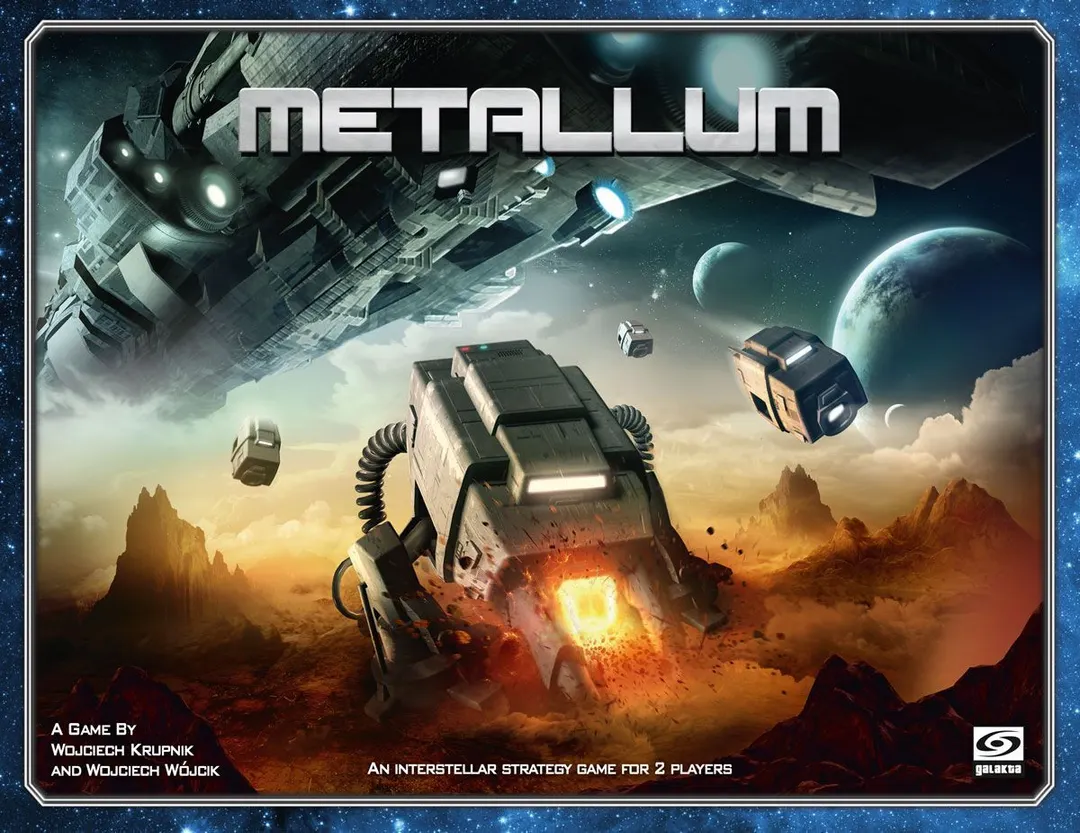
When it turned out that faster-than-light travel was deadly for every lifeform, humans sent their inventions out instead to explore the galaxy — colossal factory ships capable of building and deploying automated Extractors. Those ships drilled, mined and transported raw minerals from faraway planetary systems back to Earth. Soon hundreds upon hundreds of star systems were visited and their planets were drilled down to their cores and stripped of valuable resources. After the ships moved on to the next system, the leftover excavation installations still lingered as a grim sign of past mining operations. In no time, two corporations monopolized the galaxy mining business, but with myriad systems to exploit they remained in a state of uneasy peace — a peace about to be broken due to an automated analysis of reports from a system mined many decades ago that yielded something weird, that led to a discovery of...Metallum. This new substance, which seems to carry a promise for interstellar travel for living organisms, is bound to stir conflict. The Earth Government immediately steps in and claims ownership of the system in the name of the "good of mankind", but it's clear that one of the two corporations will be afforded the exclusive rights to extract Metallum – and the huge profits that come with it. The tension raises instantly. Outright corporate war is avoided only thanks to a promise to grant the mining rights to the corporation that will develop more efficient mining infrastructure on the planets. Incidents are bound to happen with old installations used to destroy enemy Extractors since it's clear that the Earth Government will be handing their grants based on Metallum extraction rates of each corporation before finally awarding exclusive mining rights to one of them. The best pilots from each corporation sit down behind their consoles as their factory ships approach the system with production of Extractors set to maximum. Metallum is a strategy game for two players who take on roles of corporate pilots charged with the task of directing their factory ships in order to construct a more efficient mining network on the system's planets than their opponent does. Each round consists of three main phases: Programming: Players simultaneously create a program by composing puzzle-like subroutines that activate various systems on the factory ship (engines for moving, production for deploying Extractors, etc.). Some of the more powerful subroutines take more time to execute and hence impede your ability to react to the other player's moves — and they might even prevent you from activating other ship systems. Action: Players execute programs composed during the programming phase. Since the order of execution of subroutines is decided by the player, the same program can yield vastly different outcomes, which leads to many interesting tactical decisions. During this phase new Extractors are also deployed on the system's planets. Profits: Players earn credits for the planets on which they have their Extractors depending on who has more of them. After nine rounds, the pilot who's earned the most credits for his corporation is declared the winner. Will you be able to cover the planets of the system with a network of your Extractors and at the same time disturb the plans of your opponent? Although the conflict is officially only an economic one, the successful pilot needs to know when to strike at a rival's mining infrastructure or make "slight modification" to it. When all is said and done, nobody will remember the details of the struggle — only the name of the greatest pilot in the history of the galaxy.
Metallum supports 2 players according to the catalogue. This is the publisher’s listed player count, so the game is designed for exactly that number of participants. Variants for other group sizes, if any, are described in the rulebook of your edition, so check it before setting up a different configuration.
The listed playing time for Metallum is 60 minutes. This is the publisher’s estimate for a full game. The actual duration depends on the group, the player count and familiarity with the rules: first sessions usually run longer, while experienced groups often finish faster. Setup and teaching time are not included in this estimate.
The catalogue lists Metallum for ages 10 and up. This is the publisher’s recommendation and reflects reading demands, rule complexity and small components rather than theme alone. Younger players can often join with help from an adult, so check the age guidance on your edition and consider your group’s experience with board games.
Metallum has a complexity rating of 2.7 out of 5 from BoardGameGeek players, which makes it a medium-light game. The rating reflects how much rules knowledge, planning and decision-making a typical game demands. Expect a longer first teach for heavier games, and use a preparation guide before game night.
Metallum belongs to these categories: Economic, Science Fiction, and Space Exploration. Its main mechanics are Area Majority / Influence, Simultaneous Action Selection, and Modular Board. Categories describe the theme and setting of a game, while mechanics describe what players actually do on their turns. Each mechanic links to a catalogue hub with similar games, which helps when you want something comparable.
The credited designers of Metallum are: Wojtek Wojcik and Wojtek Krupnik. These credits come from the published game data and name the people responsible for the game’s design, not its illustrators or publishers. Designer pages on MeepleRules collect other titles by the same designers, which helps when you enjoy a game and want to find similar ones.
The catalogue lists Metallum as a base game. It can be played on its own with the components in the box and does not require any other title. Expansions, if any exist, add new content or rules on top of it and are listed separately in the catalogue with a link back to this base game.