

- BGG rank
- BGG #252
- BGG rating
- 7.5
Sea Salt & Paper
- 2–4 players
- 30–45 min
- Complexity 1.5/5
- 2022
2019
Rules assistance for Naga Raja
Plain-language explanations of turns, card effects and disputed situations, with official source references and saved question history.
For 2 players
What would you like to know?
Answers come from the official rulebook, with the page to check.
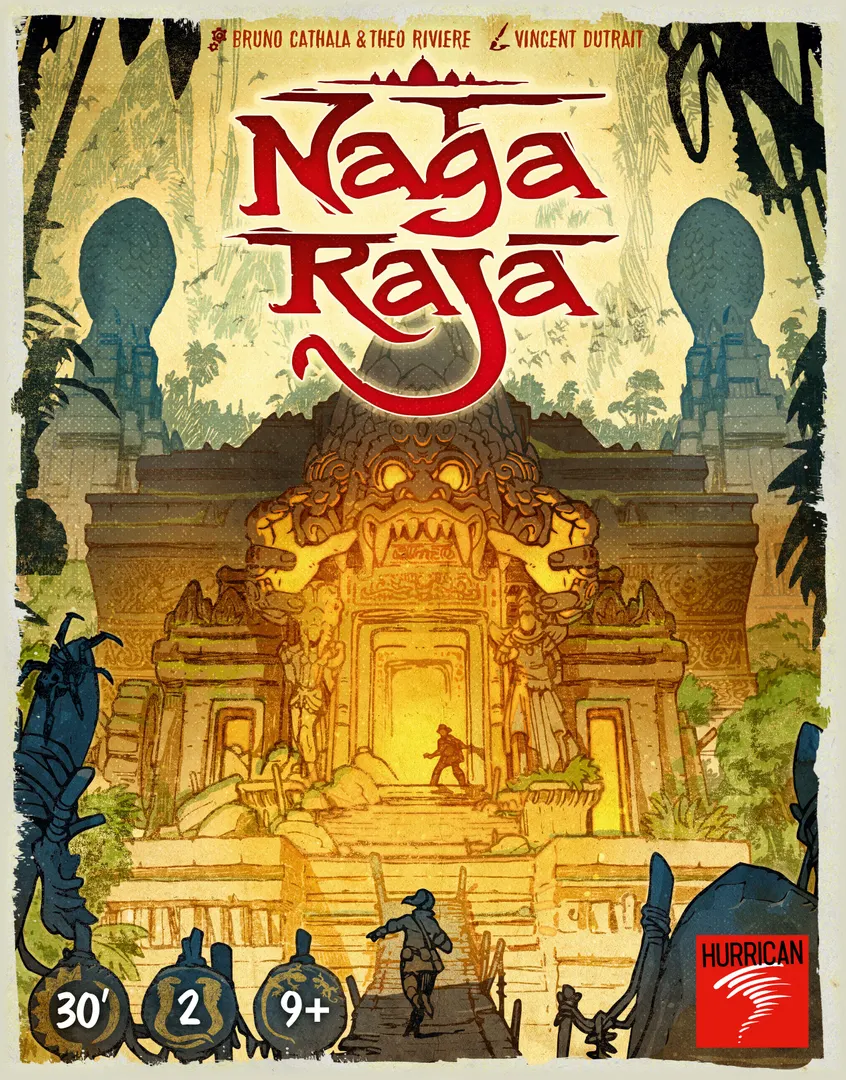
Naga Raja is a board game released in 2019 for 2 players, 30 minutes per game, and ages 9 and up. It was designed by Bruno Cathala and Théo Rivière and its main mechanics are Hand Management, Take That, and Dice Rolling.

Twin temples of two forgotten divinities containing ancient relics have been discovered in India. You set off on a treasure hunt, racing to find them before your rival, but your progress is slowed by a constantly shifting maze of paths... And eternal damnation awaits anyone foolish enough to uncover the three cursed relics of Garuda! MOVE QUICKLY... CHOOSE WISELY! A treasure race packed with tough choices, twists & turns! In this 2-players game, each player moves around their own temple, which has spaces for room tiles and hiding places for 9 sacred and cursed relics around. These relics are placed randomly, face-down, around the temples and worth victory points once flipped face-up. The first player to score 25 victory points wins the game. However, a player loses if they reveal all three cursed relics! Each round, the players compete to win a new room tile by using cards allowing them to throw fate sticks. The player with the most fate points showing on their sticks wins the room tile and places it in their temple. Each player attempts to create paths leading to their relics, enabling them to flip them face up and score victory points. Yet, Naga symbols on some sticks let you activate cards with powerful effects, so that you can never take anything for granted. A GAMEPLAY WITH DUAL-USE CARDS AND STICKS Players must decide how to use the cards in their hands: for throwing sticks or activating their effects? Card effects can be applied on you or opponent's game and are relating to: Sticks results Relic positions Room positions Card drawing Results on Fate sticks can be used to win the room at stake (using their Fate points) or to activate cards (using their Naga symbols). There are 3 types of sticks (number of Fate points or Naga faces are different for each type). DILEMMAS, TWISTS, LOW BLOWS! No temple room or Relic is locked in place, they can be moved/removed as you or your opponent activate cards… You could turn everything upside-down! For example: Make the maze slide Swap the positions of relics Place a Trap room in your opponent’s Temple Change the results of the sticks Discard action cards from your opponent's hand Make him throw again his sticks… IF YOU... Have ever dreamed of being an Indiana Jones, chasing relics in an Indian modular temple... Adore putting a spoke in the wheels of your opponent... Love gameplays balanced between strategy (cruel choices, anticipation) and fun... then Naga Raja is the perfect game for you!
Naga Raja supports 2 players according to the catalogue. This is the publisher’s listed player count, so the game is designed for exactly that number of participants. Variants for other group sizes, if any, are described in the rulebook of your edition, so check it before setting up a different configuration.
The listed playing time for Naga Raja is 30 minutes. This is the publisher’s estimate for a full game. The actual duration depends on the group, the player count and familiarity with the rules: first sessions usually run longer, while experienced groups often finish faster. Setup and teaching time are not included in this estimate.
The catalogue lists Naga Raja for ages 9 and up. This is the publisher’s recommendation and reflects reading demands, rule complexity and small components rather than theme alone. Younger players can often join with help from an adult, so check the age guidance on your edition and consider your group’s experience with board games.
Naga Raja has a complexity rating of 2.0 out of 5 from BoardGameGeek players, which makes it a medium-light game. The rating reflects how much rules knowledge, planning and decision-making a typical game demands. Expect a longer first teach for heavier games, and use a preparation guide before game night.
Naga Raja belongs to these categories: Bluffing, Exploration, and Adventure. Its main mechanics are Hand Management, Take That, and Dice Rolling. Categories describe the theme and setting of a game, while mechanics describe what players actually do on their turns. Each mechanic links to a catalogue hub with similar games, which helps when you want something comparable.
The credited designers of Naga Raja are: Bruno Cathala and Théo Rivière. These credits come from the published game data and name the people responsible for the game’s design, not its illustrators or publishers. Designer pages on MeepleRules collect other titles by the same designers, which helps when you enjoy a game and want to find similar ones.
The catalogue lists Naga Raja as a base game. It can be played on its own with the components in the box and does not require any other title. Expansions, if any exist, add new content or rules on top of it and are listed separately in the catalogue with a link back to this base game.