

- BGG rank
- BGG #135
- BGG rating
- 7.7
Tigris & Euphrates
- 2–4 players
- 60–120 min
- Complexity 3.5/5
- 1997
1994
Rules assistance for Neue Spiele im alten Rom
Plain-language explanations of turns, card effects and disputed situations, with official source references and saved question history.
For 2 players
What would you like to know?
Answers come from the official rulebook, with the page to check.
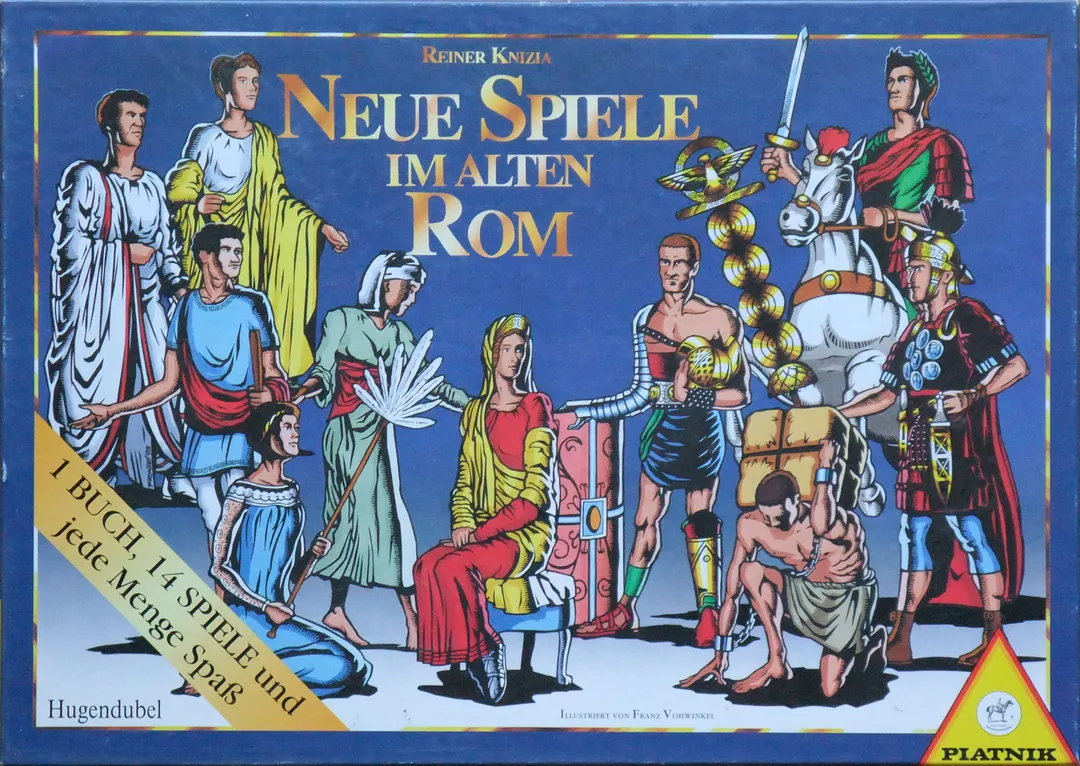
Neue Spiele im alten Rom is a board game released in 1994 for 2–7 players, 20–60 minutes per game, and ages 10 and up. It was designed by Reiner Knizia.



Neue Spiele im Alten Rom (or New Games in Old Rome (NGIOR)) is a compendium of games from Reiner Knizia. In the box are fourteen games themed on ancient Rome. The games are themed to cover, albeit in a highly abstract fashion, the rise of Rome, the Roman Republic and finally, the Empire. (7 of the games are described below) The Wheel of History : 2-5 players This is an early version of what was to become Bunte Runde. 25 cards are laid out in a large circle, representing the tribes to be united under early Rome. Players may advance a pawn one, two or three spaces forwards and collect a card. Cards are scored on face value, but there are some quirks that vary this. The Seven Hills of Rome : 2 players This is one of the easier games in the compendium. The theme here is you are battling your opponent for control of the seven hills of Rome. The hills are represented by seven cards, numbered 1 to 7, laid out between the players. Cards are played from a hand against the 'hills' in an attempt to influence them to your side. You sum the hills you control at the end of the game, and the highest total wins. Mercator : 3-7 players This game is Medici's ancestor. It is a simplified version of Medici, with the chief differences being you can hold six cards on your ship, and you are competing for highest value totals only. The number of each suit taken is meaningless, except in a variant where you get paid a bonus if you get one of each. The game lasts only one round. Medici is worth purchasing on its own, but this is still worth a look. Imperium : 3-5 players The aim is to earn points for control of each of the 9 areas on the board. The game lasts 9 turns, and at the end of each turn, the area matching the turn number is evaluated for control and points are awarded. On your turn, 3 cards are revealed simultaneously. These cards are numbered 1 to 9, with 2 additional banner cards. The numbers correspond to the areas you want to place control markers into. The banner cards indicate you want one or two extra chips placed in the indicated area. After control markers are placed, the current turn's area is evaluated - points being awarded to the winner and perhaps the second and third places as well. After 9 turns, the player with the most points wins. As you progress, the points awarded for each area increases, giving a nice feeling of acceleration. Senator : 2-3 players You play a Roman faction trying to position your people (a hand of cards) into the senate. They can only get their via the senate steps. The board is a grid of 5x5 spaces, The 9 spaces in the center are the senate, while 12 of the remaining 16 are the steps spaces that run around the perimeter of the senate. Cards are placed initially on the steps, and then pushed into the senate by placing more cards on the steps. Circus Maximus : 3-5 players A simple chariot racing game where players are competing to be the first to get their team of three chariots around the hex map circuit and onto the podium. Each player has a set of cards face up in front of them, numbered 1 to 5. To move a chariot they select up to three cards per chariot which that is the movement allowance for that piece. The movement off each card must be in a straight line, so some rather clumsy cornering ability is built into the game. Cards used by a chariot are turned face down, becoming unavailable for the other chariots still to move. Each chariot must be moved at least once per turn, if possible. Therefore, the trick is to maximize your movement with your 15 points each turn. Consul : 2-4 players This is an intriguing memory game, that, like most of the games in this compendium, have a hard time being fitted into a theme! Twenty-five cards are turned face down in a grid. Players start the game each holding three cards in their hand. On their turn, players make a bid to take a turn. The highest bid gets to turn up cards until they choose to finish, or make a mistake. Cards in a set can be of the same value, or same color, or both. The value of the set must equal of exceed the bid made, simply by summing the face values of the cards. If a mistake is made, the cards are turned face down, and the player must discard a card from their hand into the grid. If the bid is made, the cards are taken into the players hand. At the end of the game, the highest total held wins. -- Translated rulebook to the contrary, this game has never been published by an English publisher. Note: 3 of these have been printed/repackaged in English by GMT in Rome: Imperium, Circus Maximus, Hannibal vs Rome.
Neue Spiele im alten Rom supports 2–7 players according to the catalogue. This range comes from the publisher’s listed player count, so the game can be set up for any group size within it. Some setups, rules and scoring details may still vary by player count, so check your edition’s rulebook for the exact configuration.
The listed playing time for Neue Spiele im alten Rom is 20–60 minutes. This is the publisher’s estimate for a full game. The actual duration depends on the group, the player count and familiarity with the rules: first sessions usually run longer, while experienced groups often finish faster. Setup and teaching time are not included in this estimate.
The catalogue lists Neue Spiele im alten Rom for ages 10 and up. This is the publisher’s recommendation and reflects reading demands, rule complexity and small components rather than theme alone. Younger players can often join with help from an adult, so check the age guidance on your edition and consider your group’s experience with board games.
Neue Spiele im alten Rom has a complexity rating of 2.3 out of 5 from BoardGameGeek players, which makes it a medium-light game. The rating reflects how much rules knowledge, planning and decision-making a typical game demands. Expect a longer first teach for heavier games, and use a preparation guide before game night.
Neue Spiele im alten Rom belongs to these categories: Abstract Strategy and Game System. Categories describe the theme, setting and style of a game rather than its rules. Filter the catalogue by the same category to find similar games when you enjoyed Neue Spiele im alten Rom and want something comparable for your next game night.
The credited designers of Neue Spiele im alten Rom are: Reiner Knizia. These credits come from the published game data and name the people responsible for the game’s design, not its illustrators or publishers. Designer pages on MeepleRules collect other titles by the same designers, which helps when you enjoy a game and want to find similar ones.
The catalogue lists Neue Spiele im alten Rom as a base game. It can be played on its own with the components in the box and does not require any other title. Expansions, if any exist, add new content or rules on top of it and are listed separately in the catalogue with a link back to this base game.