

- BGG rank
- BGG #2
- BGG rating
- 8.5
Ark Nova
- 1–4 players
- 90–150 min
- Complexity 3.8/5
- 2021
Rules assistance for Okey
Plain-language explanations of turns, card effects and disputed situations, with official source references and saved question history.
For 2 players
What would you like to know?
Answers come from the official rulebook, with the page to check.
Okey is a board game for 2–4 players and 15–60 minutes per game. Its main mechanics are Set Collection.








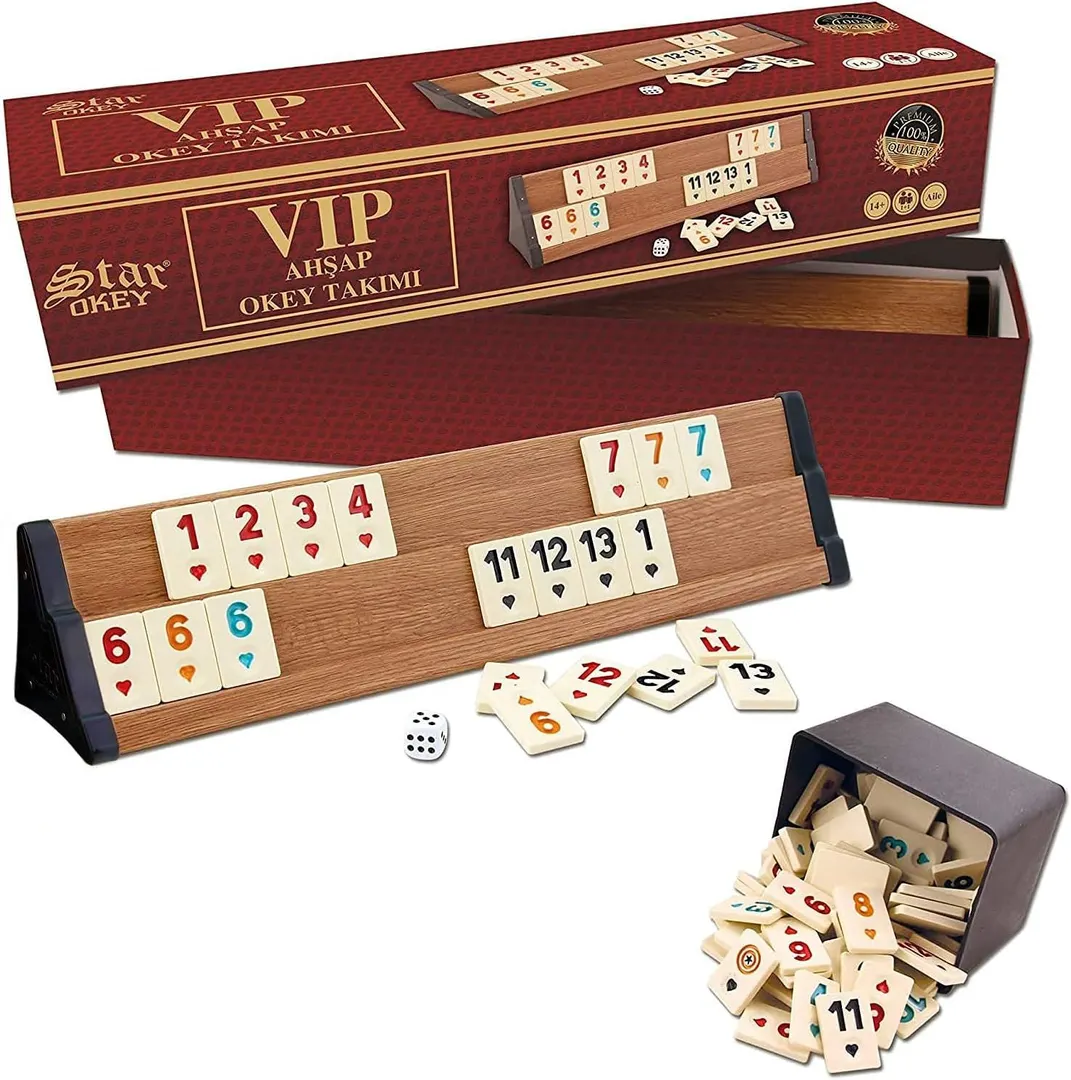
Okey is a traditional Turkish game, similar to Rummikub and Mahjong. Players manage their hand to make runs and sets. The first one to use all of their pieces wins the game. Suits come in 4 colors and run from 1 to 13. Notably, runs (of the same suit) can end with a 1 tile if they contain a 13 tile. The game needs paying careful attention on the opponent's discarded pieces and plan new series according to them, as there is only a pair of every piece. The game's namesake is the wild "Okey" tile, chosen randomly between the regular tiles at the start of every round. Depending on the last tile a player discards to win a round, they score different amounts of points- finishing by discarding a regular tile is worth 2 points, but discarding an Okey tile is worth 4 points. An "indicator" tile is used to determine the Okey every round, and if someone has the identical indicator tile in their starting hand, they score an extra point. Scoring is done in a unique manner- every point scored by a player is not added to their own total, but subtracted from every other player's score. The game ends when someone reaches 0 points or lower, and at that point the person with the highest remaining score wins. A usual game of Okey starts with 20 points per player.
Okey supports 2–4 players according to the catalogue. This range comes from the publisher’s listed player count, so the game can be set up for any group size within it. Some setups, rules and scoring details may still vary by player count, so check your edition’s rulebook for the exact configuration.
The listed playing time for Okey is 15–60 minutes. This is the publisher’s estimate for a full game. The actual duration depends on the group, the player count and familiarity with the rules: first sessions usually run longer, while experienced groups often finish faster. Setup and teaching time are not included in this estimate.
Okey has a complexity rating of 1.6 out of 5 from BoardGameGeek players, which makes it a light game. The rating reflects how much rules knowledge, planning and decision-making a typical game demands. Expect a longer first teach for heavier games, and use a preparation guide before game night.
The main mechanics of Okey are Set Collection. Mechanics describe what players actually do on their turns, such as rolling dice, drafting cards or placing workers. Each mechanic links to a catalogue hub with similar games, which helps when you enjoyed Okey and want something comparable.
The catalogue lists Okey as a base game. It can be played on its own with the components in the box and does not require any other title. Expansions, if any exist, add new content or rules on top of it and are listed separately in the catalogue with a link back to this base game.