
- BGG rank
- BGG #832
- BGG rating
- 8.3
D-Day at Omaha Beach
- 1 player
- 120–480 min
- Complexity 3.5/5
- 2009
2010
Rules assistance for Operation Jubilee: Dieppe, August 1942
Plain-language explanations of turns, card effects and disputed situations, with official source references and saved question history.
For 1 player
What would you like to know?
Answers come from the official rulebook, with the page to check.
Operation Jubilee: Dieppe, August 1942 is a board game released in 2010 for 1 player and 180–240 minutes per game. It was designed by John H. Butterfield and its main mechanics are Hexagon Grid.






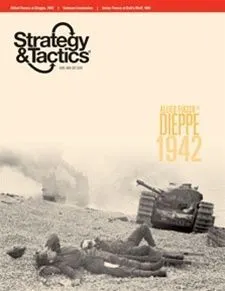
Portrays the disastrous Commonwealth raid against the German-held French port city of Dieppe in 1942. The game uses a simplified version of the D-Day at Omaha Beach system. (from Publisher website :)Operation Jubilee: Dieppe, August 1942 (OJ) is a purpose-designed solitaire game, by John Butterfield, simulating the disastrous Commonwealth raid against the German-held French port of Dieppe on 19 August 1942. It uses an evolution of his well-liked system from our earlier boxed game release: D-Day on Omaha Beach. Historically, a mixed force of Canadian troops and tanks and British Commandos landed on several beaches along a 16-mile stretch of coast, with a variety of objectives. While the commando raids on the flanks met with some success, the major action against Dieppe was a costly failure. It didn’t come close to achieving its objectives, and over 75 percent of that landing force were killed or captured. You control the CW forces assaulting the beaches and struggling to achieve their objectives against intense German resistance. The game system controls the German forces that oppose you. The overall 34x22” large-hex map, which is cut in half and reassembled into a 17"x42" play area, consists of three sector maps: the main map showing the French port of Dieppe and surrounding areas, and two smaller maps portraying coastal areas east and west of the main map. The main map is divided into four areas: Blue Beach, Dieppe town, Green Beach and Rear. Each hex represents 400 meters (438 yards) across; each game turn equals 20 minutes. Units of maneuver are companies and batteries; there are 176 large-size NATO-style and iconic counters in the mix. Rules cover such things as: coastal battery fire, random events, unit depth, command-control and communication, air attack, “what if” variants, amphibious warfare and much more. The game can be completed in about three to four hours. The turn sequence is as follows. I. CW Amphibious Transport Phase 1. Unit Transport 2. Landing Check II. Operations Phase III. Commonwealth Action Phase 1. Beach Landings or Evacuation. 2. CW Actions 3. Recovery IV. End of Turn Phase
Operation Jubilee: Dieppe, August 1942 supports 1 player according to the catalogue. This is the publisher’s listed player count, so the game is designed for exactly that number of participants. Variants for other group sizes, if any, are described in the rulebook of your edition, so check it before setting up a different configuration.
The listed playing time for Operation Jubilee: Dieppe, August 1942 is 180–240 minutes. This is the publisher’s estimate for a full game. The actual duration depends on the group, the player count and familiarity with the rules: first sessions usually run longer, while experienced groups often finish faster. Setup and teaching time are not included in this estimate.
Operation Jubilee: Dieppe, August 1942 has a complexity rating of 2.9 out of 5 from BoardGameGeek players, which makes it a medium-light game. The rating reflects how much rules knowledge, planning and decision-making a typical game demands. Expect a longer first teach for heavier games, and use a preparation guide before game night.
Operation Jubilee: Dieppe, August 1942 belongs to these categories: Wargame and World War II. Its main mechanics are Hexagon Grid. Categories describe the theme and setting of a game, while mechanics describe what players actually do on their turns. Each mechanic links to a catalogue hub with similar games, which helps when you want something comparable.
The credited designers of Operation Jubilee: Dieppe, August 1942 are: John H. Butterfield. These credits come from the published game data and name the people responsible for the game’s design, not its illustrators or publishers. Designer pages on MeepleRules collect other titles by the same designers, which helps when you enjoy a game and want to find similar ones.
The catalogue lists Operation Jubilee: Dieppe, August 1942 as a base game. It can be played on its own with the components in the box and does not require any other title. Expansions, if any exist, add new content or rules on top of it and are listed separately in the catalogue with a link back to this base game.

