- BGG rank
- BGG #135
- BGG rating
- 7.7
Tigris & Euphrates
2–4 players60–120 min1997
Complexity 3.5/5
2021
Rules assistance for OSIRIUM
Plain-language explanations of turns, card effects and disputed situations, with saved question history.
What would you like to know?
Answers come from the official rulebook, with the page to check.
OSIRIUM is a board game released in 2021 for 2–4 players, 30–90 minutes per game, and ages 10 and up. Its main mechanics are Variable Player Powers, Hand Management, and Race.
2–4 players60–120 min1997

1–4 players40–120 min2024
2–4 players120 min2020

2–4 players40–60 min2020

2–4 players60–120 min2023
1–4 players30–60 min2019
2–4 players20–25 min2023

2–4 players20–40 min2019

1–5 players60–150 min2020
1–4 players30–45 min2025
1–4 players45–90 min2014
1–4 players30–60 min2020
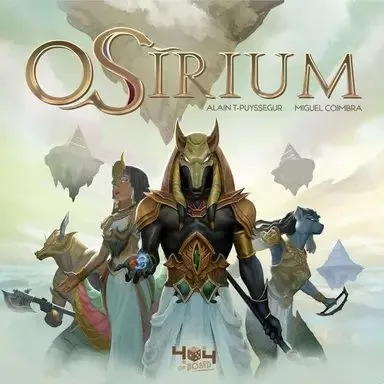
In Ancient Egypt, more than three millenia ago, men confronted each other in the Trial of Osirium under the eyes of the immortal Gods. Inspired by Osiris, the judge of souls who came back from the dead, the Osirium allowed to settle many conficts and to have the truth triumph. If honesty guides your actions, then you won’t be afraid of walking in the duat, and you will make your Deity proud. Goal of the Game Osirium is a trial. Your goal is to defeat your opponents to make the deity to whom you pledged allegiance proud. To do that, you need to collect as many points (or Ankhs) as possible, performing Rituals with various Amulets. 4 deities are available: Isis, Anubis, Bastet and Seth. The Trial The oldest player plays first, since it is assumed that they’ll join the gods sooner than the others… Then, the player on their left plays their turn, and so on. On your turn, You must play one of your 4 Amulet Cards. Place it on any free space of the board, choosing its orientation. Then, draw a new Amulet Card to have 4 Amulet Cards in your hand again. You can either take an Amulet Card from the Deities’ Market, or draw a random Amulet Card from the top of the draw pile. If you take a card from the Market, immediately replace it with a new card from the draw pile. You may cast one of the Rituals of your Deity Board (see Cast a Ritual on p.7). You can do this before or after placing an Amulet on the board. You can cast as many Rituals as you like. Casting a Ritual is not mandatory. Alternatively, you may decide to pass. This allows you to discard your entire hand of Amulet Cards to draw 4 new Amulet Cards instead. When you pass, ignore the two actions listed above. The Trial ends once a player has cast 5 Rituals. Check if any player has completed their Exaltation Card (a secret secondary objective), then proceed to final scoring. Cast a Ritual There are two types of Rituals: Simple Rituals and Advanced Rituals. Players receive Simple Rituals at the beginning of the game. They are easy to cast but do not score many points. Players may draw Advanced Rituals during the game. These Rituals score more points. Each Ritual Card depicts the Amulets required to cast the Ritual. To cast a Ritual, you must make sure that the depicted Amulets are correctly linked to each other: An Amulet is linked to the adjacent Amulet if both arrows are face to face. There must be no other Amulets between the arrows of the Amulets required to cast the Ritual. There can be more Amulets than required, of course. In that case, simply indicate the ones that you are using. A Ritual allows you to gain Ankhs (as many as indicated on the card, in front of the matching symbol). However, casting a Ritual consumes the Amulets’ energy. For this reason, some of them need to be broken. Remove the Amulet(s) of your choice from the ones used for the Ritual and place them in front of you. Rituals can be cast according to two principles: Order OR Chaos. ORDER : Such Rituals score more points and break less Amulets – which means that more Amulets remain available for the other players. CHAOS : The black symbols depict the Chaos Principle. Such Rituals score less points and break more Amulets. —description from the publisher
OSIRIUM supports 2–4 players according to the catalogue. This range comes from the publisher’s listed player count, so the game can be set up for any group size within it. Some setups, rules and scoring details may still vary by player count, so check your edition’s rulebook for the exact configuration.
The listed playing time for OSIRIUM is 30–90 minutes. This is the publisher’s estimate for a full game. The actual duration depends on the group, the player count and familiarity with the rules: first sessions usually run longer, while experienced groups often finish faster. Setup and teaching time are not included in this estimate.
The catalogue lists OSIRIUM for ages 10 and up. This is the publisher’s recommendation and reflects reading demands, rule complexity and small components rather than theme alone. Younger players can often join with help from an adult, so check the age guidance on your edition and consider your group’s experience with board games.
OSIRIUM has a complexity rating of 1.7 out of 5 from BoardGameGeek players, which makes it a light game. The rating reflects how much rules knowledge, planning and decision-making a typical game demands. Expect a longer first teach for heavier games, and use a preparation guide before game night.
OSIRIUM belongs to these categories: Card Game, Abstract Strategy, and Ancient. Its main mechanics are Variable Player Powers, Hand Management, and Race. Categories describe the theme and setting of a game, while mechanics describe what players actually do on their turns. Each mechanic links to a catalogue hub with similar games, which helps when you want something comparable.
The catalogue lists OSIRIUM as a base game. It can be played on its own with the components in the box and does not require any other title. Expansions, if any exist, add new content or rules on top of it and are listed separately in the catalogue with a link back to this base game.
