

- BGG rank
- BGG #9,724
- BGG rating
- 8.0
Grasse: Mestres Perfumistas
- 2–4 players
- 60–90 min
- Complexity 2.4/5
- 2018
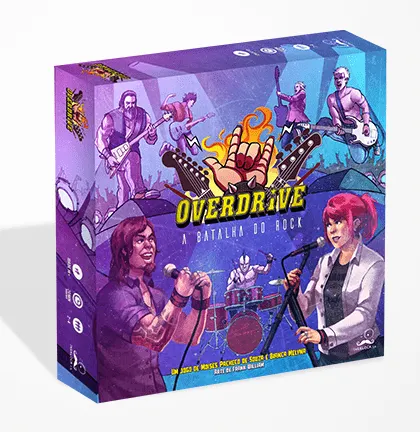
2018
Rules assistance for Overdrive
Plain-language explanations of turns, card effects and disputed situations, with official source references and saved question history.
What would you like to know?
Answers come from the official rulebook, with the page to check.
Overdrive is a board game released in 2018 for 2–4 players, 30–50 minutes per game, and ages 8 and up. It was designed by Moisés Pacheco de Souza and Bianca Melyna and its main mechanics are Variable Player Powers, Take That, and Set Collection.
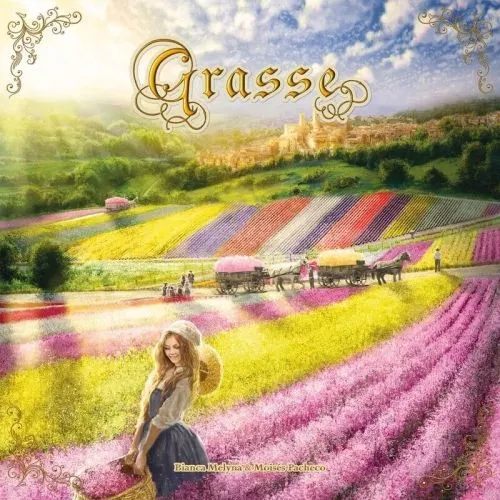




OVERDRIVE is a game of dice allocation, which represents the members of your band. Each player takes on the role of the best rock band in their universe, whose goal is to get the most points until the last battle of bands. Use unique techniques, optimize your bandwidth and invest in improvements to prove who is the biggest band in the whole multiverse. This is rock'n roll, baby! LIST OF COMPONENTS 1 Rules Book 5 Band Sheet 1 Game Board 4 Disc Award Tiles 16 cards of Opportunities 20 Cancellation tiles 1 First Player token 24 Custom dices The game board contains the most basic actions of dice allocation. With a combination of dice faces, the player allocates their dice in the spaces available to perform the specific actions. If a space already contains dices from other players, you can not use that space. All players receive at the beginning of the match 4 dices of their color, which represents the members of their band. On your turn, you use the faces of your rolled dice, and allocate them on the board. In addition to the board, there are the Hit Cards, which work the same way, as there are spaces available to allocate dice and receive the bonuses. The difference is that a player can buy a Hit, and when another player allocates dices on his Hit, you are also benefited. For this reason, there is a deck of Hits with 18 different cards to be restored to the table as the players buy them (only 3 are revealed). Each player also receives a Band Sheet from their band, and each of them has the Fan, Fame, Overdrive and Money tracks, which are marked with cubes. Throughout the match, each player, through their actions, can improve these attributes to try to improve their score at the end of the game. Each band also has special abilities that are unlocked throughout the match, optimizing their technique and improving their performance. At the table, there are 4 discs of awards, which are goals that bands can achieve to claim them, and increase their score. When you take an award disc (bronze, silver, gold or diamond), you become the owner of it, and another player can not take it from you. You still have the option of swapping it for another better scoring disc when you can meet your requirements, but you will have to return the lower scoring score, making it available to other players. Finally, at the end of rounds 3, 6 and 8 (total of 8 rounds) the Battle of Bands takes place. Players use their dices to fight between them, trying to eliminate opponents' dices for 2 scrolling acts and comparing results. You can only defeat an opponent's dice if you have more equal faces than the symbol you want to remove from it. For example, you can use 2 skull faces to defeat the only skull result of one of your target foes. At the end of the battle, the remaining dice will provide bonuses to the players. In addition to the game, there is also a concern to accumulate symbols for the collection, which are printed on the Hit Cards, the Band Sheet, and Dices at the end of the last battle. This will give you more points towards the end of the match, as you score with each collection of at least 3 identical or different symbols. The goal of the game is, at the end of round 8, to have more victory points than its opponents, thus becoming the best band of the multiverse. The game is for 2 to 4 players, and the starting time is around 45 minutes.
Overdrive supports 2–4 players according to the catalogue. This range comes from the publisher’s listed player count, so the game can be set up for any group size within it. Some setups, rules and scoring details may still vary by player count, so check your edition’s rulebook for the exact configuration.
The listed playing time for Overdrive is 30–50 minutes. This is the publisher’s estimate for a full game. The actual duration depends on the group, the player count and familiarity with the rules: first sessions usually run longer, while experienced groups often finish faster. Setup and teaching time are not included in this estimate.
The catalogue lists Overdrive for ages 8 and up. This is the publisher’s recommendation and reflects reading demands, rule complexity and small components rather than theme alone. Younger players can often join with help from an adult, so check the age guidance on your edition and consider your group’s experience with board games.
Overdrive has a complexity rating of 2.0 out of 5 from BoardGameGeek players, which makes it a medium-light game. The rating reflects how much rules knowledge, planning and decision-making a typical game demands. Expect a longer first teach for heavier games, and use a preparation guide before game night.
Overdrive belongs to these categories: Dice and Music. Its main mechanics are Variable Player Powers, Take That, and Set Collection. Categories describe the theme and setting of a game, while mechanics describe what players actually do on their turns. Each mechanic links to a catalogue hub with similar games, which helps when you want something comparable.
The credited designers of Overdrive are: Moisés Pacheco de Souza and Bianca Melyna. These credits come from the published game data and name the people responsible for the game’s design, not its illustrators or publishers. Designer pages on MeepleRules collect other titles by the same designers, which helps when you enjoy a game and want to find similar ones.
The catalogue lists Overdrive as a base game. It can be played on its own with the components in the box and does not require any other title. Expansions, if any exist, add new content or rules on top of it and are listed separately in the catalogue with a link back to this base game.