- BGG rank
- BGG #176
- BGG rating
- 7.5
Pandemic
2–4 players45 min2008
Complexity 2.4/5
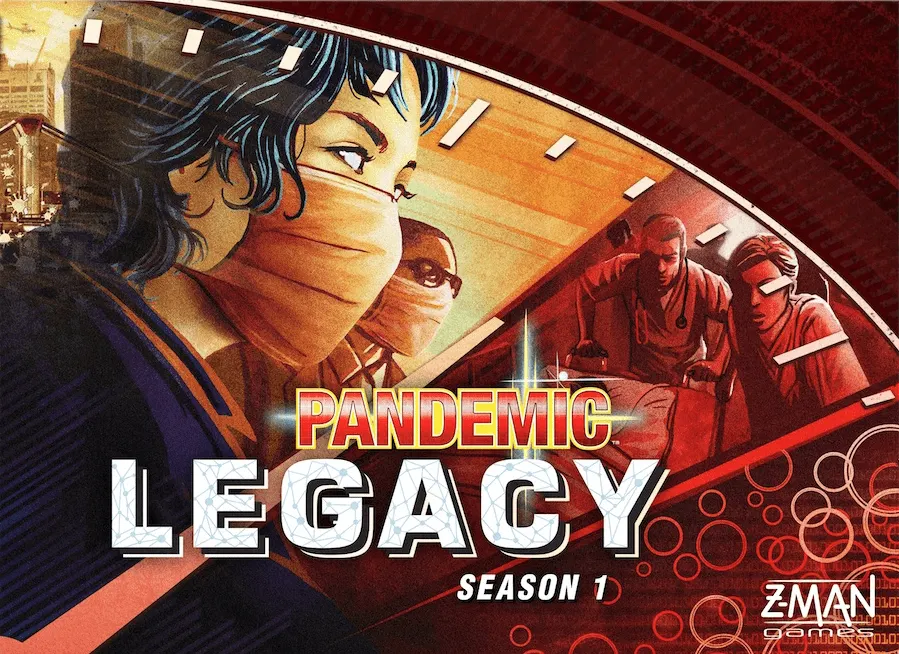
2015
Rules assistance for Pandemic Legacy: Season 1
Plain-language explanations of turns, card effects and disputed situations, with official source references and saved question history.
What would you like to know?
Answers come from the official rulebook, with the page to check.
Complete the required number of objectives, including every mandatory objective.
About 12 min · 8 steps
Step 1 of 8
Yes. Choose any combination of actions, and repeat actions if you wish.
Yes. Any research station works, regardless of its city’s color.
No. They can still spread until eradicated by removing their last cube.
Normally, the card must match the city where both players are together, and both must agree.
No. Resolve them immediately; they are not added to your hand or replaced.
It outbreaks instead of receiving a fourth cube. Outbreaks can chain into connected cities.
Yes. Events are not actions and may be played at any time except between drawing a card and resolving its effect.
Pandemic Legacy: Season 1 is a board game released in 2015 for 2–4 players, 60 minutes per game, and ages 13 and up. It was designed by Matt Leacock and Rob Daviau and its main mechanics are Variable Player Powers, Hand Management, and Set Collection. MeepleRules offers a rules assistant for Pandemic Legacy: Season 1 that explains turns, card effects and disputed situations in plain language.
1–5 players60–150 min2025
2–4 players45–60 min2020

2–5 players45 min2016

1–5 players45–60 min2018

2–4 players40 min2016

2–5 players30 min2014

2–4 players30–60 min2026

2–4 players30 min2020

1–4 players60–120 min2023
2–5 players45 min2017
2–4 players45 min2024
Pandemic Legacy is a co-operative campaign game, with an overarching story arc played through 12-24 sessions, depending on how well your group does at the game. At the beginning, the game starts in a very similar fashion as basic Pandemic, in which your team of disease-fighting specialists races against the clock to travel around the world, treating disease hot spots while researching cures for each of four plagues before they get out of hand. During a player's turn, they have four actions available, with which they may travel around in the world in various ways (sometimes needing to discard a card), build structures like research stations, treat diseases (removing one cube from the board; if all cubes of a color have been removed, the disease has been eradicated), trade cards with other players, or find a cure for a disease (requiring five cards of the same color to be discarded while at a research station). Each player has a unique role with special abilities to help them at these actions. After a player has taken their actions, they draw two cards. These cards can include epidemic cards, which will place new disease cubes on the board, and can lead to an outbreak, spreading disease cubes even further. Outbreaks additionally increase the panic level of a city, making that city more expensive to travel to. Each month in the game, you have two chances to achieve that month's objectives. If you succeed, you win and immediately move on to the next month. If you fail, you have a second chance, with more funding for beneficial event cards. During the campaign, new rules and components will be introduced. These will sometimes require you to permanently alter the components of the game; this includes writing on cards, ripping up cards, and placing permanent stickers on components. Your characters can gain new skills, or detrimental effects. A character can even be lost entirely, at which point it's no longer available for play. Part of the Pandemic series
Use the rules assistant for Pandemic Legacy: Season 1 to describe a turn, card effect or disputed situation. Get a plain-language explanation with official source references, then return to the question in your saved history. Select your edition when available so the sources match your game.
Ask about the rulesPandemic Legacy: Season 1 supports 2–4 players according to the catalogue. This range comes from the publisher’s listed player count, so the game can be set up for any group size within it. Some setups, rules and scoring details may still vary by player count, so check your edition’s rulebook for the exact configuration.
The listed playing time for Pandemic Legacy: Season 1 is 60 minutes. This is the publisher’s estimate for a full game. The actual duration depends on the group, the player count and familiarity with the rules: first sessions usually run longer, while experienced groups often finish faster. Setup and teaching time are not included in this estimate.
The catalogue lists Pandemic Legacy: Season 1 for ages 13 and up. This is the publisher’s recommendation and reflects reading demands, rule complexity and small components rather than theme alone. Younger players can often join with help from an adult, so check the age guidance on your edition and consider your group’s experience with board games.
Pandemic Legacy: Season 1 has a complexity rating of 2.8 out of 5 from BoardGameGeek players, which makes it a medium-light game. The rating reflects how much rules knowledge, planning and decision-making a typical game demands. Expect a longer first teach for heavier games, and use a preparation guide before game night.
Pandemic Legacy: Season 1 belongs to these categories: Medical and Environmental. Its main mechanics are Variable Player Powers, Hand Management, and Set Collection. Categories describe the theme and setting of a game, while mechanics describe what players actually do on their turns. Each mechanic links to a catalogue hub with similar games, which helps when you want something comparable.
The credited designers of Pandemic Legacy: Season 1 are: Matt Leacock and Rob Daviau. These credits come from the published game data and name the people responsible for the game’s design, not its illustrators or publishers. Designer pages on MeepleRules collect other titles by the same designers, which helps when you enjoy a game and want to find similar ones.
The catalogue lists Pandemic Legacy: Season 1 as a base game. It can be played on its own with the components in the box and does not require any other title. Expansions, if any exist, add new content or rules on top of it and are listed separately in the catalogue with a link back to this base game.