
- BGG rank
- BGG #2,078
- BGG rating
- 7.3
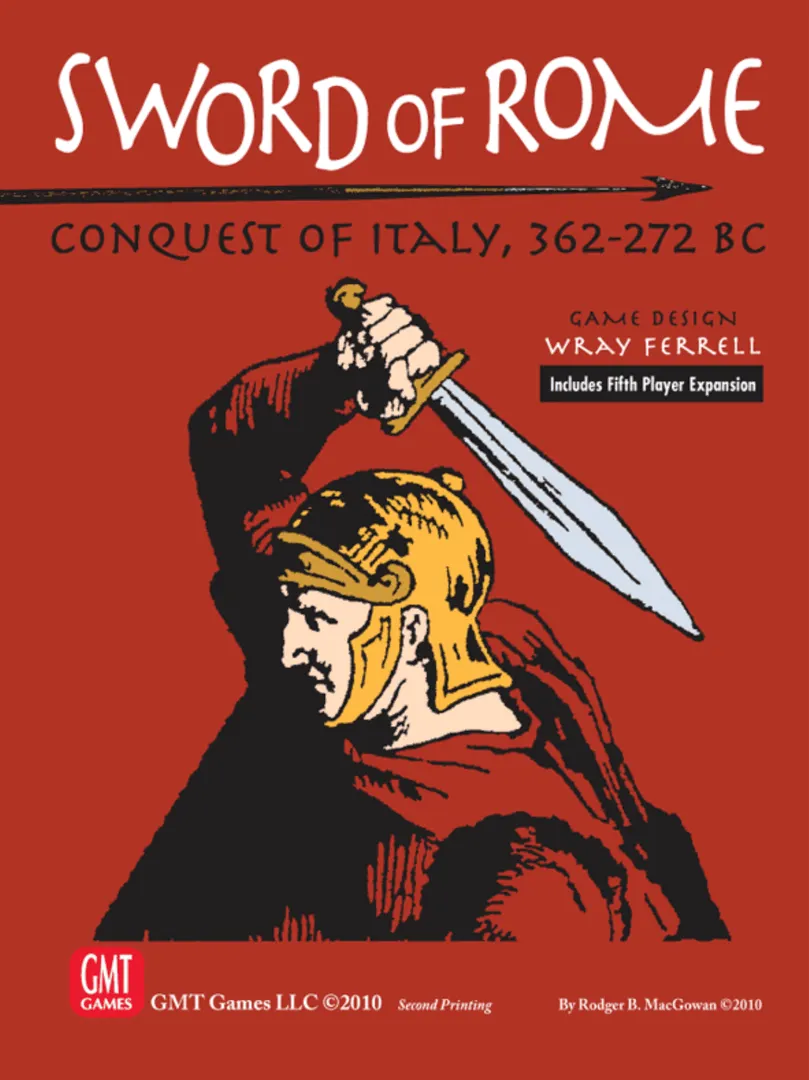
Sword of Rome: Conquest of Italy, 362-272 BC
- 2–5 players
- 360 min
- Complexity 3.3/5
- 2004
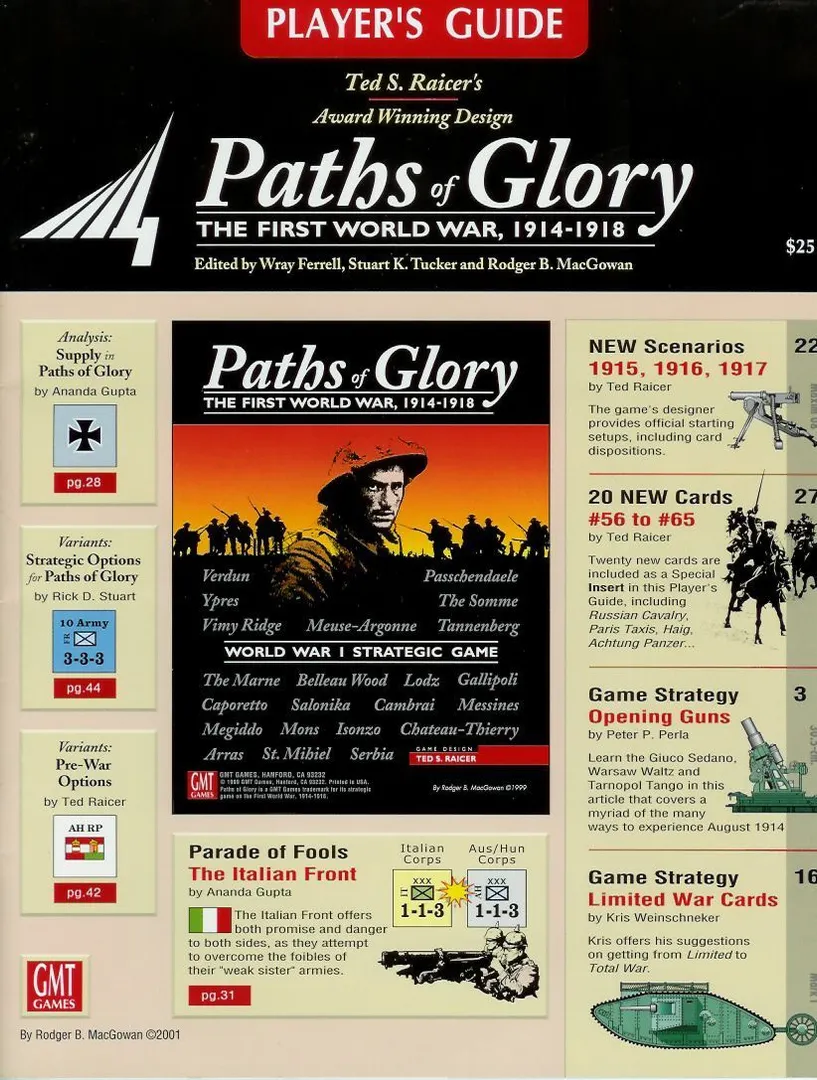
Rules assistance for Paths of Glory: Player's Guide
Plain-language explanations of turns, card effects and disputed situations, with official source references and saved question history.
What would you like to know?
Answers come from the official rulebook, with the page to check.
Paths of Glory: Player's Guide is an expansion for Paths of Glory released in 2001 for 2 players and ages 14 and up. It was designed by Ted Raicer, Rodger B. MacGowan, Stuart K. Tucker, and Wray Ferrell and its main mechanics are Dice Rolling, Simulation, and Campaign / Battle Card Driven.




The Player's Guide contains articles that describe tips, tactics, strategies, and variants available for Paths of Glory. In addition to the 48-page magazine, the Player's Guide includes 20 new cards and a 1/4 sheet of additional counters. Recent deluxe editions of the base game (6th edition 2018 and later) already contain the "optional counters first released in the POG Player’s Guide in 2002" and the "20 Optional Cards from the POG Player’s Guide". (from GMT Games's website:) Features The Paths of Glory Player's Guide is designed as an expansion kit for your enjoyment of this wonderful game, with exciting and informative articles featuring strategies for you to employ, new scenarios and variants, new playing cards, in-depth analysis of key features in the game, and so much more. Executive Editor Wray Ferrell has put together an excellent team of authors and Managing Editor Stuart K. Tucker's handsome layout design makes reading and utilizing the Player's Guide a pleasure. Contents and Authors Strategy The Opening Guns (Peter P. Perla) - Learn the Giuco Sedano, Warsaw Waltz and Tarnopol Tango in this article that covers a myriad of the many ways to experience August 1914 in Paths of Glory. Goin' Mobile (Kris Weinschneker) - Play of the Mobilization deck involves some critical choices about War Status and Reinforcements. Limited War Cards (Kris Weinschneker) - Continuing his discussion of the card decks, Kris offers his suggestions on getting from "Limited" to "Total" war quickly. Total War Cards (Kris Weinschneker) - Wrapping up his review of the cards, Kris offers some endgame card play suggestions. New Scenarios and Cards New Scenarios (Ted Raicer) - The game's designer provides the official starting setups, including card dispositions, for games begun in 1915, 1916, or 1917. Adding More Paths to Your Deck (Ted Raicer) - Twenty new cards are included as an insert to this magazine. Here are their historical bases. Analysis PoG Supply (Ananda Gupta) - The disruption of supply lines can cause the collapse of a front. Each theater has a number of key locations in the defense of those vital supply lines. Parade of Fools: The Italian Front (Ananda Gupta) - The Italian front offers both promise and danger to both sides, as they attempt to overcome the foibles of their "weak sister" armies. Optional Rules: Assessing the Balance (Ananda Gupta) - How effective are the mainstream optional rules at establishing a balanced game? Cybergaming PBEM Primer (Kris Weinschneker) - A primer on playing Paths of Glory via Play By Email. Variants Variant Cards (Tod Reiser) - More card ideas to consider adding to your deck. Pre-War Options (Ted Raicer) - For those wanting to vary the starting force setup, here are some ideas for each major nation. Strategic Options (Rick D. Stuart) - Rick provides us with more options to alter game play - some affecting the setup, some used later in the game. Historical Variants (Brad Martin) - For those seeking to experiment with history and game balance, here are more variant rule ideas.
Paths of Glory: Player's Guide supports 2 players according to the catalogue. This is the publisher’s listed player count, so the game is designed for exactly that number of participants. Variants for other group sizes, if any, are described in the rulebook of your edition, so check it before setting up a different configuration.
The catalogue lists Paths of Glory: Player's Guide for ages 14 and up. This is the publisher’s recommendation and reflects reading demands, rule complexity and small components rather than theme alone. Younger players can often join with help from an adult, so check the age guidance on your edition and consider your group’s experience with board games.
Paths of Glory: Player's Guide has a complexity rating of 2.9 out of 5 from BoardGameGeek players, which makes it a medium-light game. The rating reflects how much rules knowledge, planning and decision-making a typical game demands. Expect a longer first teach for heavier games, and use a preparation guide before game night.
Paths of Glory: Player's Guide belongs to these categories: Card Game, Wargame, and Expansion for Base-game. Its main mechanics are Dice Rolling, Simulation, and Campaign / Battle Card Driven. Categories describe the theme and setting of a game, while mechanics describe what players actually do on their turns. Each mechanic links to a catalogue hub with similar games, which helps when you want something comparable.
The credited designers of Paths of Glory: Player's Guide are: Ted Raicer, Rodger B. MacGowan, Stuart K. Tucker, and Wray Ferrell. These credits come from the published game data and name the people responsible for the game’s design, not its illustrators or publishers. Designer pages on MeepleRules collect other titles by the same designers, which helps when you enjoy a game and want to find similar ones.
The catalogue lists Paths of Glory: Player's Guide as an expansion for Paths of Glory. Expansions add new content, rules or scenarios to the base game and usually cannot be played on their own, so you need Paths of Glory to use it. Check that your edition of Paths of Glory is compatible, as some expansions were revised between editions.