

- BGG rank
- BGG #3,630
- BGG rating
- 7.6
Tiny Epic Game of Thrones
- 1–4 players
- 45–60 min
- Complexity 3.4/5
- 2025
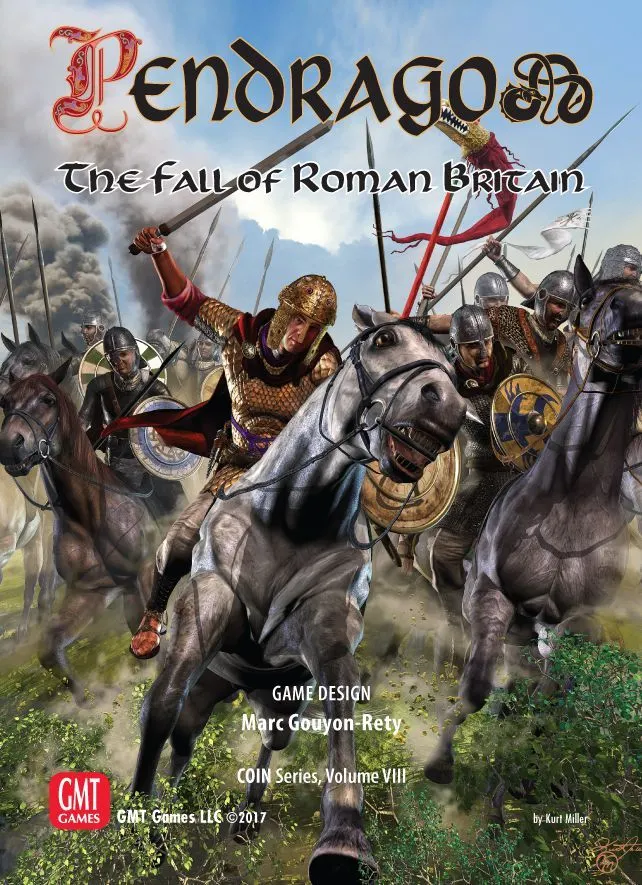
2017
Rules assistance for Pendragon: The Fall of Roman Britain
Plain-language explanations of turns, card effects and disputed situations, with official source references and saved question history.
For 1 player
What would you like to know?
Answers come from the official rulebook, with the page to check.
Pendragon: The Fall of Roman Britain is a board game released in 2017 for 1–4 players, 60–360 minutes per game, and ages 16 and up. It was designed by Morgane Gouyon-Rety and its main mechanics are Variable Player Powers, Income, and Area Movement.





From GMT's website: Volume VIII in GMT’s COIN Series transports us into the 4th and 5th Centuries A.D. and to the embattled Isle of Britannia. Pendragon – The Fall of Roman Britain covers a century of history from the first large-scale raids of Irish, Pict, and Saxon raiders, to the establishment of successor kingdoms, both Celtic and Germanic. This sumptuous volume adapts the celebrated asymmetrical COIN engine to depict the political, military, religious, and economic struggles of Dark Ages Britain. Pendragon leverages the tremendous flexibility of the COIN system, from dual events to dissimilar approaches and victory conditions, to capture the complexity of the period and let the players explore alternative narratives. Unlike earlier volumes, Pendragon is not about counterinsurgency per se, but focuses on the asymmetrical clashes between and among Romano-British authorities and Barbarian powers gnashing over the carcass of the Roman Empire, including: Barbarian Raiders plundering the land and trying to surprise unwary towns and hillforts, then melting into hills or fens. Expansion or decline of the Saxon Shore naval defense system to counter sea-borne raiders. Authentic Late-Roman military doctrine—mighty but hard-to-replace cavalry tracking down raiding parties before they can return their booty home. Accessible, powerful but fickle Foederati: barbarian warbands in Briton employ. Nuanced battle system representing troop qualities and tactics. Fortified strongholds that must be assaulted, besieged, or rebuilt to gain regional political control. Civil wars, coups, religious shifts, and cultural assimilation. Population movements over the generations, due to good administration, barbarian ravages, or climatic changes. Epochal Events ranging from Roman usurpations on the continent to massive reprisals against barbarian homelands. Evolution of rules and victory conditions throughout the game, as the still vivacious Roman Empire may or may not end with Britain fragmented among competing semi-barbarian proto-kingdoms. A deck of 83 cards with gorgeous commissioned original art. Short, medium, and full-length scenarios Support for solitaire, 2-player, 3-player and 4-player experiences. Each faction in Pendragon brings specific capabilities and challenges: The Dux represent the original Roman Army in Britannia: with the most powerful units in the game and a network of strong fortresses ringing the island and tied by efficient roads, you must strive to preserve the stability and prosperity of the provinces and punish any interloper daring to challenge the peace. If you can build up your prestige and maintain order, you may be able to keep the island in the Empire, or at least united in a new post-Roman power. You can rely on the civilian militia to assist you, but—as your peerless cavalry dwindles—you must resort to the traditional Roman offer to barbarians of land for service in your forces as Foederati. As the decay of institutions conspires with the scheming of feckless civilians and the marauding of restless barbarians, you may find that the dream of Empire is dead. If so, with your once proud Army little more than another group of warlords, you still can strive to carve for yourself the most powerful kingdom alongside your new rivals. The Civitates represent the Romanized aristocracy ruling the ancient Celtic tribes from lavish villas and prosperous Roman towns, chafing under the distant authority (and taxes) of Rome, mistrusting the uncultured and semi-Barbarian army, and yearning to settle century-old accounts with their neighbors. When the Barbarian storm comes down upon your island, you may find yourself woefully unprepared to cope—materially or culturally—and presented with a fundamental choice: strive to protect your lands, wealth, and way of life via the despised Army and untrustworthy Foederati, or sacrifice Roman comforts to face down the Barbarian challenge militarily and culturally through a return to Celtic traditions. The Saxons represent various Germanic groups including Angles, Jutes, Frisians, and Franks who harried, settled, and eventually took over swaths of Britain. As outsiders, you face a steep challenge just to come ashore against the might of the Roman army and navy. You will chip away at the Saxon Shore system, ravage the provincial economy to weaken the Britons’ capability to wage war, and see some of your best warriors serve as Foederati (often against yourself), but recognize that the more Saxons living on the island—whoever their paymaster—the more opportunities for advancing your nation. Eventually, you must secure footholds, perhaps in the marshy fens of the eastern seaboard that so resemble your homelands, in order to wield your considerable military potential and challenge the old masters of these rich lands to create England. The Scotti, named for the marauding groups of Irish raiders, also represent those Celts native to the island of Britain who differed from the romanized Civitates by remaining true (or reverting back) to the old ways. Often, the boundary between the two groups was porous... The biggest such group eventually formed the northern nation of the Picts, forebears of modern Scotland. As the Scotti, you see the disintegration of Roman Britain as an opportunity not so much to expand as to seize riches and renown to assert yourself at home. Raid ceaselessly, surprise and plunder poorly protected communities, kidnap for ransom, and show your military prowess against your unfortunate neighbors across the Irish Sea and Forth-Clyde isthmus… Then establish bases strategically along the enemy shores and entreat local hill tribes to reject post-Roman authority. But beware that your very advances will help give rise and limit your ability to grapple new powerhouses on the island! Components: See Wiki below. Players: 1-4 (includes full solitaire system) Map: Area Movement Timescale: about 15 years per campaign between Epoch cards Designer: Marc Gouyon-Rety Developer and Series Creator: Volko Ruhnke
Pendragon: The Fall of Roman Britain supports 1–4 players according to the catalogue. This range comes from the publisher’s listed player count, so the game can be set up for any group size within it. Some setups, rules and scoring details may still vary by player count, so check your edition’s rulebook for the exact configuration.
The listed playing time for Pendragon: The Fall of Roman Britain is 60–360 minutes. This is the publisher’s estimate for a full game. The actual duration depends on the group, the player count and familiarity with the rules: first sessions usually run longer, while experienced groups often finish faster. Setup and teaching time are not included in this estimate.
The catalogue lists Pendragon: The Fall of Roman Britain for ages 16 and up. This is the publisher’s recommendation and reflects reading demands, rule complexity and small components rather than theme alone. Younger players can often join with help from an adult, so check the age guidance on your edition and consider your group’s experience with board games.
Pendragon: The Fall of Roman Britain has a complexity rating of 4.5 out of 5 from BoardGameGeek players, which makes it a heavy game. The rating reflects how much rules knowledge, planning and decision-making a typical game demands. Expect a longer first teach for heavier games, and use a preparation guide before game night.
Pendragon: The Fall of Roman Britain belongs to these categories: Wargame, Medieval, and Political. Its main mechanics are Variable Player Powers, Income, and Area Movement. Categories describe the theme and setting of a game, while mechanics describe what players actually do on their turns. Each mechanic links to a catalogue hub with similar games, which helps when you want something comparable.
The credited designers of Pendragon: The Fall of Roman Britain are: Morgane Gouyon-Rety. These credits come from the published game data and name the people responsible for the game’s design, not its illustrators or publishers. Designer pages on MeepleRules collect other titles by the same designers, which helps when you enjoy a game and want to find similar ones.
The catalogue lists Pendragon: The Fall of Roman Britain as a base game. It can be played on its own with the components in the box and does not require any other title. Expansions, if any exist, add new content or rules on top of it and are listed separately in the catalogue with a link back to this base game.