
- BGG rating
- 5.0
Pro Tennis: Player Cards
- 1–2 players
- 30 min
- 1983

1983
Rules assistance for Pro Tennis
Plain-language explanations of turns, card effects and disputed situations, with official source references and saved question history.
For 1 player
What would you like to know?
Answers come from the official rulebook, with the page to check.
Pro Tennis is a board game released in 1983 for 1 player, 30 minutes per game, and ages 10 and up. It was designed by James Trunzo and Tom Trunzo.





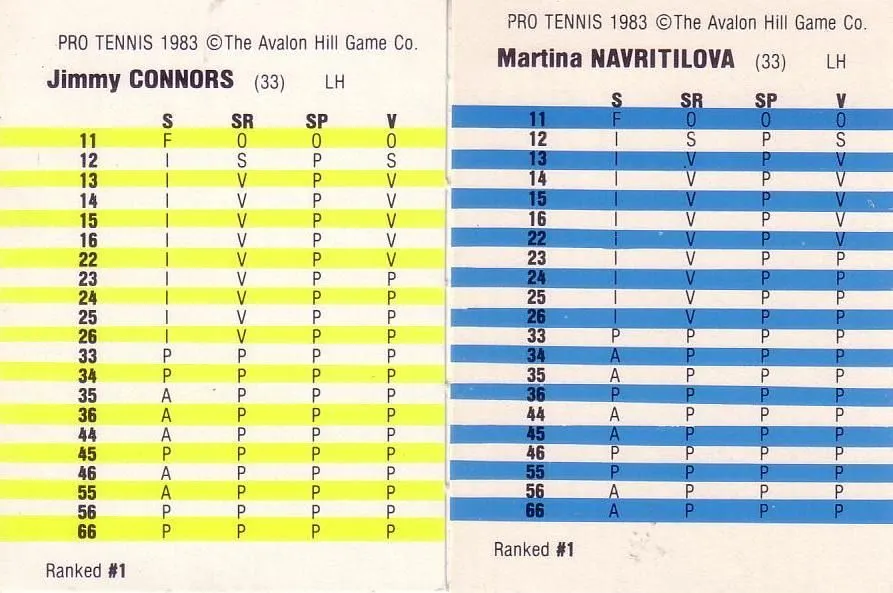
Pro Tennis simulates tennis matches in the early 1980's, the era of Jimmy Connors, John McEnroe, Martina Navritolova and Chris Evert. Included are cards for 50 men and 50 women professionals. Each card has a column for "Serve", "Serve Return", "Volley" and "Special". Play consists of rolling dice (two white dice, plus a red die that isn't added to the others but sometimes changes the outcome) and cross-indexing the number rolled with the proper column. The result will be a point for one of the players or an instruction to roll next in one of the other columns. Once in a while, a player gets to make a choice that varies a column's results, and random events, such as stomach cramps, broken rackets, arguments with the umpire and thunderstorms, are possible. To take an example, Connors is pitted against McEnroe. Connors has the serve. He rolls 1, 5 (white) and 3 (red). The dice roll is 15 (read the dice as digits, low roll first); the red is ignored unless it's a 5 or 6. A 15 in Connors' Serve column is "I", which means that McEnroe can return the serve. He rolls 2, 2 (white) and 1 (red) - a 22, which yields a "V" in his Serve Return column. Connors must now roll against his Volley column. He gets 4, 6 (white) and 5 (red). Ordinarily, a 46 would be a point for him, but the red 5 allows McEnroe to make a clutch return. He rolls the white dice (only). A score equal to or less than his Clutch Value is a V result; anything higher loses the point. McEnroe's Clutch Rating is 33. He rolls a 3 and a 6 - not good enough, and Connors is ahead 15-love. Connors serves again: 4, 6 (white) and 5 (red). An ace for Connors; McEnroe doesn't even get a clutch return. 30-love. The next Connors serve: 2, 2 (white) and 2 (red). Triples generate a random event. (Many players think that random events are too common and limit their appearance to rolls of triple 1's.) Connors rolls the two white dice: 3, 4. He's gotten into an argument with the umpire (realism!) and draws a warning. If he argues again, he'll automatically lose a point. Back to serving: 1, 4 (white) and 2 (red). The result is "I". McEnroe's return: 3, 4 (white) and 1 (red) - a "V". Connors rolls 1, 2 (white) and 4 (red). A 12 on his Volley column is "S", which means that he returned the shot but left his opponent in a good position. McEnroe can roll on the favorable "Special" column. Sure enough. He rolls 3, 5 (white) and 3 (red); a 35 on his Special column wins the point. 30-15. And so it goes. This not a game for anyone who wants to devise winning strategies. Rather, the players watch as the dice play. That is, however, the point of this kind of sports simulation: to project what would happen if real athletes competed in imaginary matches. The game also includes rules for doubles, mixed doubles and matches between men and women.
Pro Tennis supports 1 player according to the catalogue. This is the publisher’s listed player count, so the game is designed for exactly that number of participants. Variants for other group sizes, if any, are described in the rulebook of your edition, so check it before setting up a different configuration.
The listed playing time for Pro Tennis is 30 minutes. This is the publisher’s estimate for a full game. The actual duration depends on the group, the player count and familiarity with the rules: first sessions usually run longer, while experienced groups often finish faster. Setup and teaching time are not included in this estimate.
The catalogue lists Pro Tennis for ages 10 and up. This is the publisher’s recommendation and reflects reading demands, rule complexity and small components rather than theme alone. Younger players can often join with help from an adult, so check the age guidance on your edition and consider your group’s experience with board games.
Pro Tennis has a complexity rating of 1.7 out of 5 from BoardGameGeek players, which makes it a light game. The rating reflects how much rules knowledge, planning and decision-making a typical game demands. Expect a longer first teach for heavier games, and use a preparation guide before game night.
Pro Tennis belongs to these categories: Sports. Categories describe the theme, setting and style of a game rather than its rules. Filter the catalogue by the same category to find similar games when you enjoyed Pro Tennis and want something comparable for your next game night.
The credited designers of Pro Tennis are: James Trunzo and Tom Trunzo. These credits come from the published game data and name the people responsible for the game’s design, not its illustrators or publishers. Designer pages on MeepleRules collect other titles by the same designers, which helps when you enjoy a game and want to find similar ones.
The catalogue lists Pro Tennis as a base game. It can be played on its own with the components in the box and does not require any other title. Expansions, if any exist, add new content or rules on top of it and are listed separately in the catalogue with a link back to this base game.