

- BGG rating
- 6.0
Remember When ...: FLASHBACKS Expansion
- 3–9 players
- 30–60 min
- 2017
2017
Rules assistance for Remember When ...
Plain-language explanations of turns, card effects and disputed situations, with official source references and saved question history.
For 3 players
What would you like to know?
Answers come from the official rulebook, with the page to check.
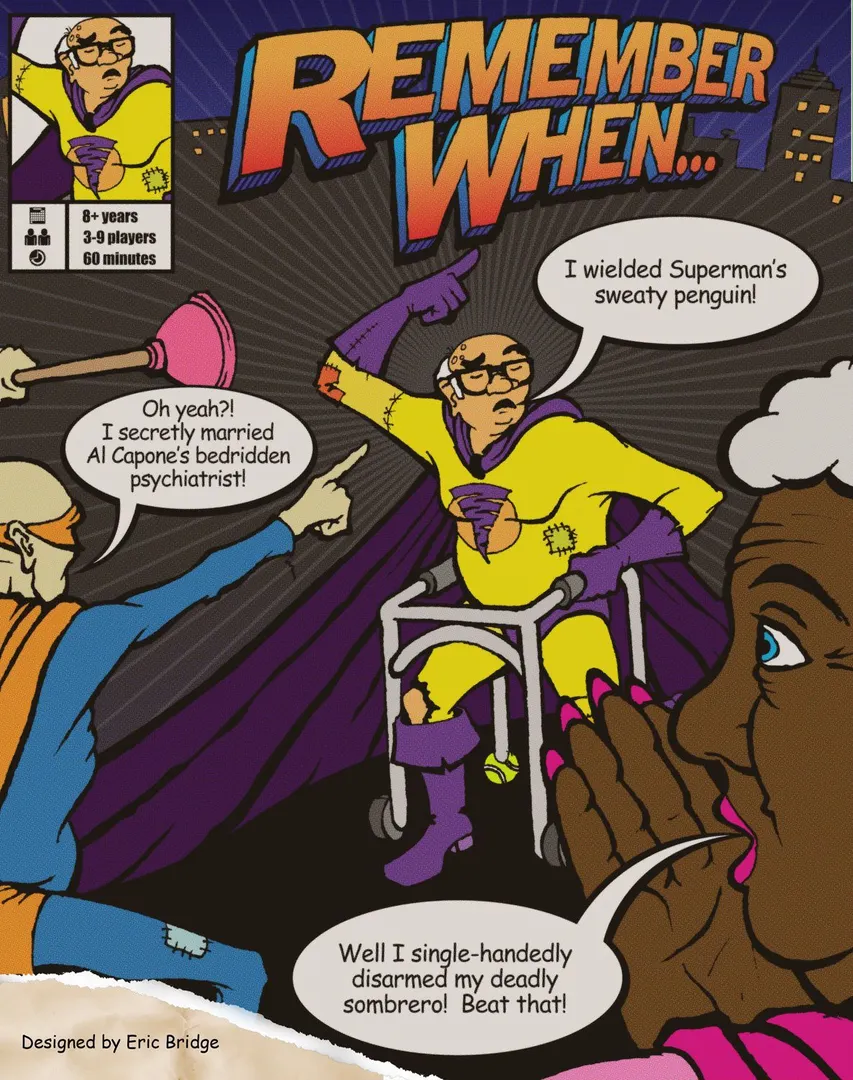
Remember When ... is a board game released in 2017 for 3–9 players, 30–60 minutes per game, and ages 8 and up. It was designed by Eric Bridge and its main mechanics are Simultaneous Action Selection, Storytelling, and Team-Based Game.




As seen on Board Game Arena. Remember When ... is a family party game for 3-9 players, ages 8 and up. Younger readers are also able to play, as the game is very educational for teaching sentence structure and increasing vocabulary, while being fun at the same time! The players represent retired super heroes and reformed super villains who have gotten together, years later, to reminisce about their earlier adventures. However, as always happens at occasions like this, each is trying to outdo their peers by bragging about an even more amazing story of what they once did. But the funny part is that everyone's memories are faulty because they are now going senile, and they're relying on their "friends" to help them fill in the blanks! So while the hero or villain might really have a great story to tell, what comes out of their mouth ends up being VERY different. Each player has two goals - 1) To be the best at helping the other players in remembering correctly, and 2) To come up with their own memory/adventure that their peers agree is the best one of all! Remember When ... comes with hundreds of unique cards, each with 4 words/phrases on it's 4 sides. There are ZERO repeats, meaning there are billions of different combinations! There are also several blank cards for players to create their own. On the Active Player's turn they are creating a memory with 7 or 8 (if using the optional Orange cards) different cards representing a different part of the memory. 1) WHEN they did this, 2) WHERE they did this, 3) HOW they did this (i.e. Adverb), 4) The ACTION that they took (i.e. Verb), 5) The DESCRIPTION of the object of their memory (i.e. Adjective), 6) The OBJECT of their memory (i.e. Noun), and 7) WHY they took this action. For example, "Remember When ..., while looking for my other sock, in the crowded grocery store, I repeatedly kissed the furry caveman because the Great Conjunction was at hand!?" But the Active Player does not create this Sentence/Memory from their own cards. The other players are rapidly trying to assist the Active Player by submitting one card each. The Object and the Action Taken are determined first and read out loud, so the players have some context for their card submissions. Once one card of a type/color (i.e. "Blue") has been submitted then another available color must be submitted. As the players submit their cards to the Active Player, face down, they are trying to guess which of those 4 words/phrases the Active Player will actually choose. If they are correct in their guesses then both they and the Active Player will get points for matching. Once the Active Player has assembled their sentence, scored it for "helping points", then they read the completed sentence aloud (we suggest as dramatically as possible). This is because the other players will be voting on which memory of the evening is the most exciting of all! Also try the game out FOR FREE online at Board Game Arena!
Remember When ... supports 3–9 players according to the catalogue. This range comes from the publisher’s listed player count, so the game can be set up for any group size within it. Some setups, rules and scoring details may still vary by player count, so check your edition’s rulebook for the exact configuration.
The listed playing time for Remember When ... is 30–60 minutes. This is the publisher’s estimate for a full game. The actual duration depends on the group, the player count and familiarity with the rules: first sessions usually run longer, while experienced groups often finish faster. Setup and teaching time are not included in this estimate.
The catalogue lists Remember When ... for ages 8 and up. This is the publisher’s recommendation and reflects reading demands, rule complexity and small components rather than theme alone. Younger players can often join with help from an adult, so check the age guidance on your edition and consider your group’s experience with board games.
Remember When ... has a complexity rating of 1.3 out of 5 from BoardGameGeek players, which makes it a light game. The rating reflects how much rules knowledge, planning and decision-making a typical game demands. Expect a longer first teach for heavier games, and use a preparation guide before game night.
Remember When ... belongs to these categories: Card Game, Humor, and Comic Book / Strip. Its main mechanics are Simultaneous Action Selection, Storytelling, and Team-Based Game. Categories describe the theme and setting of a game, while mechanics describe what players actually do on their turns. Each mechanic links to a catalogue hub with similar games, which helps when you want something comparable.
The credited designers of Remember When ... are: Eric Bridge. These credits come from the published game data and name the people responsible for the game’s design, not its illustrators or publishers. Designer pages on MeepleRules collect other titles by the same designers, which helps when you enjoy a game and want to find similar ones.
The catalogue lists Remember When ... as a base game. It can be played on its own with the components in the box and does not require any other title. Expansions, if any exist, add new content or rules on top of it and are listed separately in the catalogue with a link back to this base game.