

- BGG rank
- BGG #10,321
- BGG rating
- 7.7
1940: The Fall of France – A Panzer Grenadier Game
- 2 players
- 120 min
- Complexity 2.7/5
- 2009
Expansion for Second World War at Sea: Eastern Fleet
2015
Rules assistance for Second World War at Sea: Royal Netherlands Navy
Plain-language explanations of turns, card effects and disputed situations, with official source references and saved question history.
What would you like to know?
Answers come from the official rulebook, with the page to check.
Second World War at Sea: Royal Netherlands Navy is an expansion for Second World War at Sea: Eastern Fleet released in 2015 for 1–2 players, 30 minutes per game, and ages 12 and up. It was designed by Michael Bennighof and James Stear and its main mechanics are Dice Rolling, Secret Unit Deployment, and Hexagon Grid.





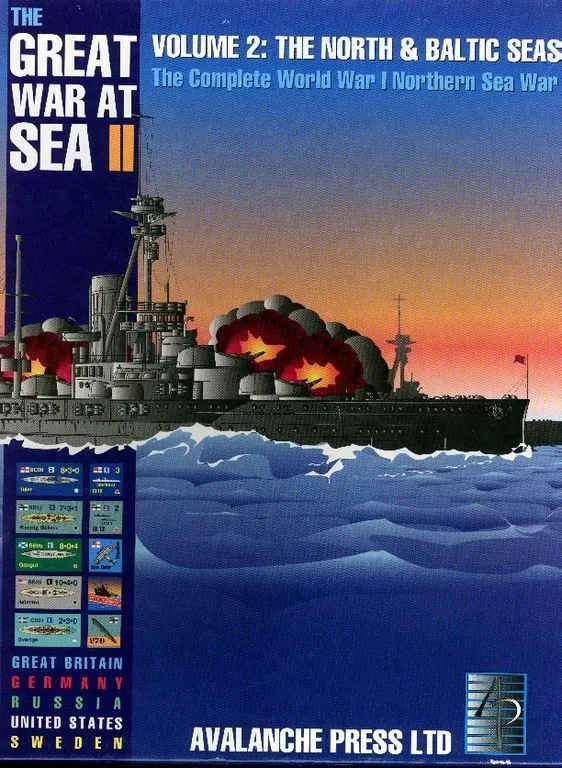


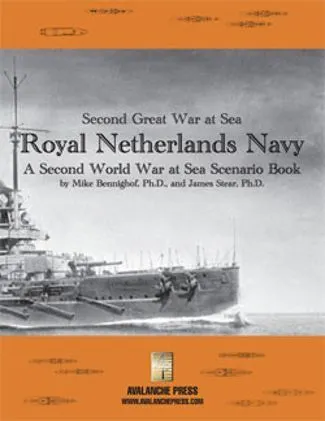
From the Avalanche Press website: Return to the world of the Second Great War, where Wilson’s Peace ended the First Great War on Christmas 1916. Twenty-four years later war returned to Europe, with Russia, France and Italy seeking to overturn the settlement with a war of aggression against the Central Powers of Imperial Germany, Austria-Hungary and the Ottoman Empire. Royal Netherlands Navy is the third book in our alternative history series, The Second Great War. In the first book, The Kaiser’s Navy, we looked at the High Seas Fleet of 1940 and its campaigns in the North Sea and Atlantic. In the second, The Habsburg Fleet, the Imperial and Royal Austro-Hungarian Navy, alongside its Turkish allies, wages war in the Mediterranean Sea. In this volume, the fleet the Dutch admirals hoped to build in our world, but could not get approved, finds itself pressured by the Japanese in the Far East and the British and French in Europe. Defending their rights with armed force, the Dutch find themselves drawn into desperate battles in the North Sea, North Atlantic, South China Sea and the interior waters of the East Indies. In the 1930s, Dutch shipyards stood at the leading edge of naval technology: Dutch submarines first deployed the schnorkel breathing device, for example, and Dutch warships boasted the sophisticated Hazemeyer fire control system that would be enthusiastically copied by the Royal Navy and others. The Netherlands had the industrial and financial means to create a large and modern fleet, and the oil wealth of Borneo and Sumatra provided the motive. Seeing deficits as a more lethal enemy than the Axis, the Dutch government of our reality doomed both the home country and the colonies to defeat and occupation. In the world of Wilson's Peace, things are a little different. There are 210 die-cut and mounted playing pieces from the old, out-of-print Spice Islands booklet, and 90 brand-new laser-cut pieces (scorchless and sootless!) for 300 total: 120 double-sized "long" ship pieces and 180 standard-sized ones representing task forces, aircraft and smaller warships. The Dutch fleet that never was is present, along with French, British, Japanese and German ships, aircraft and airships. Yes, airships! There are also thirty new scenarios based on the battles that might have been waged by the Royal Netherlands Navy in this alternate world, plus more of the story of the Second Great War begun in The Kaiser's Navy and continued in The Habsburg Fleet. This module is not playable by itself, but requires ownership of Strike South and Eastern Fleet to enjoy all of the scenarios.
Second World War at Sea: Royal Netherlands Navy supports 1–2 players according to the catalogue. This range comes from the publisher’s listed player count, so the game can be set up for any group size within it. Some setups, rules and scoring details may still vary by player count, so check your edition’s rulebook for the exact configuration.
The listed playing time for Second World War at Sea: Royal Netherlands Navy is 30 minutes. This is the publisher’s estimate for a full game. The actual duration depends on the group, the player count and familiarity with the rules: first sessions usually run longer, while experienced groups often finish faster. Setup and teaching time are not included in this estimate.
The catalogue lists Second World War at Sea: Royal Netherlands Navy for ages 12 and up. This is the publisher’s recommendation and reflects reading demands, rule complexity and small components rather than theme alone. Younger players can often join with help from an adult, so check the age guidance on your edition and consider your group’s experience with board games.
Second World War at Sea: Royal Netherlands Navy belongs to these categories: Wargame, Nautical, and World War II. Its main mechanics are Dice Rolling, Secret Unit Deployment, and Hexagon Grid. Categories describe the theme and setting of a game, while mechanics describe what players actually do on their turns. Each mechanic links to a catalogue hub with similar games, which helps when you want something comparable.
The credited designers of Second World War at Sea: Royal Netherlands Navy are: Michael Bennighof and James Stear. These credits come from the published game data and name the people responsible for the game’s design, not its illustrators or publishers. Designer pages on MeepleRules collect other titles by the same designers, which helps when you enjoy a game and want to find similar ones.
The catalogue lists Second World War at Sea: Royal Netherlands Navy as an expansion for Second World War at Sea: Eastern Fleet. Expansions add new content, rules or scenarios to the base game and usually cannot be played on their own, so you need Second World War at Sea: Eastern Fleet to use it. Check that your edition of Second World War at Sea: Eastern Fleet is compatible, as some expansions were revised between editions.