

- BGG rank
- BGG #24,446
- BGG rating
- 6.1
Cloak & Dagger
- 2–4 players
- 30–60 min
- Complexity 1.6/5
- 1984
2019
Rules assistance for Secret Night at Davis Manor
Plain-language explanations of turns, card effects and disputed situations, with official source references and saved question history.
For 4 players
What would you like to know?
Answers come from the official rulebook, with the page to check.
Secret Night at Davis Manor is a board game released in 2019 for 4–8 players, 60–120 minutes per game, and ages 12 and up. It was designed by Rafael Prado and its main mechanics are Variable Player Powers, Roll / Spin and Move, and Team-Based Game.






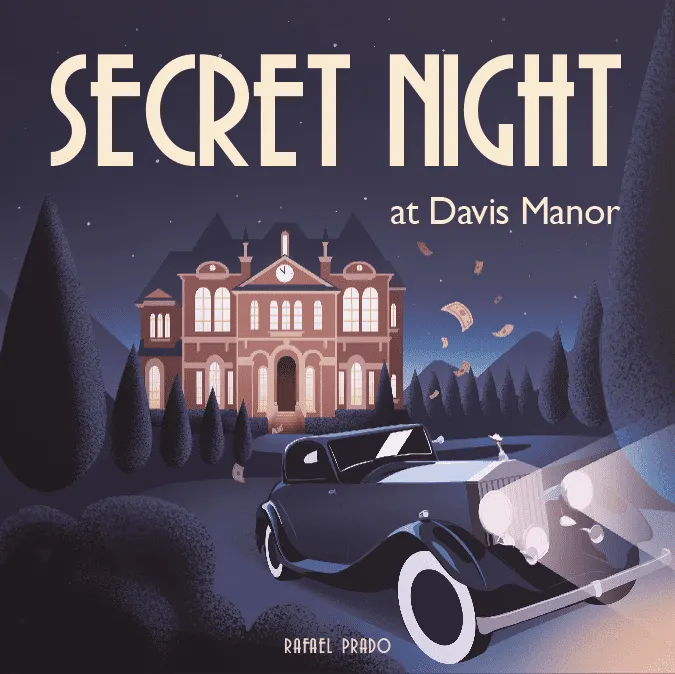
Secret Night at Davis Manor is a team-based board game set in 1928 York, England. It takes place in Davis Manor. Players secretly take on the role of police and thieves, and they must co-operate to achieve their objectives: The thieves have to take the money and escape with it in a vehicle, while the police have to arrest the thieves. Script: England, 1928, following a period of scarcity in the wake of the first world war, Europe is experiencing a period of artistic and economic splendor. In celebration of this new era of prosperity a grand dinner has been organised at the Davis Manor. The greatest Luminaries and elites of the time are set to attend, however all is not what it seems! The police have received warning that a master thief is planning to attend the event and steal the Davis Manor fortune. This thief is rumoured to never act alone, pulling off heists using hidden accomplices. Instead of cancelling the event a daring plan has been hatched! The chief inspector himself will attend the party, along with hidden detective agents. Using their skills, cunning and powers of deduction they will attempt to catch a thief! But be careful.. Not everyone is as they seem in Davis Manor and a lot can happen in the Secret Night. How to play resume: Roles: The Master Thief and the Chief Inspector reveal their roles and keep them shown.The rest of the players will keep their roles hidden. Characters: Each character has a special skill. The mansion: There are 16 rooms in the mansion.They are represented by their names on the perimeter of the Main Board. At the beginning of the game the object cards are shuffled (green circle at the back) and 16 of them are randomly placed face up in each room held by the Main Board. The rest of the object cards are stacked face down as a draw deck. Mechanics: Draw one card, spin the roulette to move the pawn around the board by the number rolled, and perform actions with object cards and/or the Action Square. During their movement, the player can do as many actions as they wants/are able to. The most common action is to perform a search. Being on a green search hex gives you the opportunity to take the card stored in the associated room slot on the edge of the Main Board. Once checked, you should keep one of the cards in your hand (at your choice) in the slot of the room hidden face down. Inventory: The maximum number of cards at the end of your turn is 3, and 1 must always be shown face up next to the player board (even if you only have 1 card in total). Action square: Once per turn, when you are next to another pawn, you may use the Action Square to perform an action: -To Trade cards with another player, either, 1 for 1 , 2 for 2 or 3 for 3. -To Steal a card: The target victim shuffles all his cards (shown and hidden) before he is robbed. The player performing the action then chooses 1 card blindly. -Push: Move a player up to 2 squares. If he encounters an obstacle: (wall, other player) stops. -Whisper a secret: Use it to have a private conversation (whispering to the ear) with another player. This can be useful for plotting strategies or bluffing. In addition to these actions, players may use the object cards. End of the game: The game ends at dawn (9 turns - 6:00 am) or when a team's score counter reaches 10 points. If the game ends in a tie and the Deceiver (the role for games with odd players) is not in play, the first team to score wins.
Secret Night at Davis Manor supports 4–8 players according to the catalogue. This range comes from the publisher’s listed player count, so the game can be set up for any group size within it. Some setups, rules and scoring details may still vary by player count, so check your edition’s rulebook for the exact configuration.
The listed playing time for Secret Night at Davis Manor is 60–120 minutes. This is the publisher’s estimate for a full game. The actual duration depends on the group, the player count and familiarity with the rules: first sessions usually run longer, while experienced groups often finish faster. Setup and teaching time are not included in this estimate.
The catalogue lists Secret Night at Davis Manor for ages 12 and up. This is the publisher’s recommendation and reflects reading demands, rule complexity and small components rather than theme alone. Younger players can often join with help from an adult, so check the age guidance on your edition and consider your group’s experience with board games.
Secret Night at Davis Manor has a complexity rating of 2.7 out of 5 from BoardGameGeek players, which makes it a medium-light game. The rating reflects how much rules knowledge, planning and decision-making a typical game demands. Expect a longer first teach for heavier games, and use a preparation guide before game night.
Secret Night at Davis Manor belongs to these categories: Murder / Mystery and Spies / Secret Agents. Its main mechanics are Variable Player Powers, Roll / Spin and Move, and Team-Based Game. Categories describe the theme and setting of a game, while mechanics describe what players actually do on their turns. Each mechanic links to a catalogue hub with similar games, which helps when you want something comparable.
The credited designers of Secret Night at Davis Manor are: Rafael Prado. These credits come from the published game data and name the people responsible for the game’s design, not its illustrators or publishers. Designer pages on MeepleRules collect other titles by the same designers, which helps when you enjoy a game and want to find similar ones.
The catalogue lists Secret Night at Davis Manor as a base game. It can be played on its own with the components in the box and does not require any other title. Expansions, if any exist, add new content or rules on top of it and are listed separately in the catalogue with a link back to this base game.