
- BGG rating
- 7.4
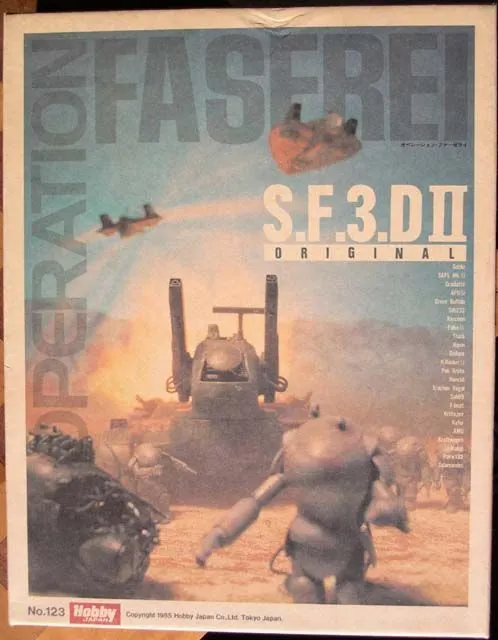
S.F.3.D II Operation Faserei
- 2 players
- 360 min
- Complexity 3.3/5
- 1986
1984
Rules assistance for S.F.3.D. Original
Plain-language explanations of turns, card effects and disputed situations, with official source references and saved question history.
For 2 players
What would you like to know?
Answers come from the official rulebook, with the page to check.
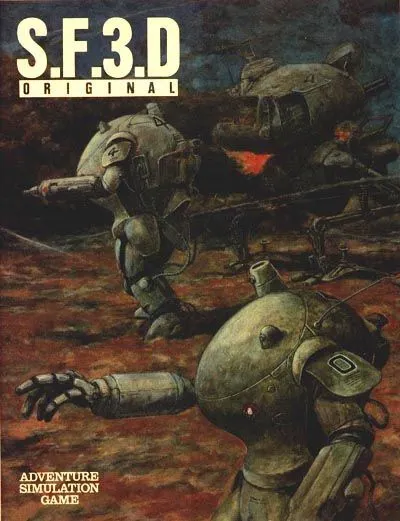
S.F.3.D. Original is a board game released in 1984 for 2 players, 120 minutes per game, and ages 12 and up. It was designed by Yasunori Sekiyama and its main mechanics are Hexagon Grid.




SF3D began as a feature in the May 1982 issue of Hobby Japan under the name, “Wonderful Junk Kit.” Included in that early feature was a scratch-built kit built by Kow Yokoyama of a powersuit pieced together from a Microman action figure, ping pong balls, and salvaged model kit parts. The response to Yokoyama’s design was huge — the era of “realistic” mecha was just taking off, after all — and so a regular feature in Hobby Japan was born. This new series, dubbed SF3D Original, featured story and background details by Hiroshi Ichimura alongside kits created by Yokoyama. Yokoyama’s kits would later be joined by those of other scratch builders, like Makoto Kobayashi, as the workload increased under the demands of a regular column. SF3D ran regularly in Hobby Japan through 1985. SF3D takes place in the distant future, following a cataclysmic World War IV that all but wiped-out life on Earth. Human settlers return to Earth, specifically Australia, and soon find themselves unhappy with their overlords in the Galactic Federation. Crime runs amok and the settlers are unable to restore order themselves, so the Galactic Federation tasks the Strahl Democratic Republic (SDR) with straightening things out down under. The SDR’s methods are heavy-handed and the settlers soon find themselves thrown under the boot of vaguely Germanic totalitarianism. In turn, the unhappy settlers hire mercenary forces to get rid of the SDR and war breaks out in post-apocalyptic Australia. (from the Box:) The storm which is World War IV engulfs the continent of Australia. War sparks ingenuity. Ingenuity birth technology. Technology is escalation. The puppet regime which is called Shuttoral World Government is the enemy. The Australian-led resistance grows in strength with the advent of the HAFS ‘Jerry’, a tow-legged tank with a ground speed of 54 km/hr. War continues… January 11, 2885: New Canberra City falls to Australian forces. The Germans retreat south skirting the desert. February 3, 2885: Shuttoral forces, isolated, make an abortive drive on the township of Gibson. A beachhead rescue saves most ot the force. April 25, 2885: Shuttoral scientists make a secret presentation to Command of the prototype Krachen vogel, armed drone recon. This weapon will be particularly nasty to the Allies because of its similarity to the un-armed Neuspotter. April 26, 2885: Plans begin for a new Shuttoral offensive towards New Canberra City. The directive is “Take, or destroy”. SF3D is a Fast-Moving, Realistic 2-player Game of War, Inspired by the award-winning series of plastic model kits, by Nitto of Japan. This game has been thoroughly playtested in the U.S. Limited, Numbered Edition of 2,040 480 Superb, die-cut doubled-sided oversized counters 4 folding, full-color, semi-geomorphic map boards 20-page Japanese rulebook, numbered 10 Scenario Cards, plus variants 1 Combat Chart Card, 2 Air Commitment Cards 2 six-sided dice (BGG description:) With all of the science fiction wargames that were published in Japan, almost all were based off anime shows, and none used original designs (even the US Battletech just used robots from JPN anime shows at first). This one does use its own story and designs. The game includes 4 mounted maps, and many scenarios that are each given their own scenario cards (ala the US Squad Leader wargame). Includes slightly larger counters than are usually used in Japanese wargames. There was an expansion/sequel to this produced.
S.F.3.D. Original supports 2 players according to the catalogue. This is the publisher’s listed player count, so the game is designed for exactly that number of participants. Variants for other group sizes, if any, are described in the rulebook of your edition, so check it before setting up a different configuration.
The listed playing time for S.F.3.D. Original is 120 minutes. This is the publisher’s estimate for a full game. The actual duration depends on the group, the player count and familiarity with the rules: first sessions usually run longer, while experienced groups often finish faster. Setup and teaching time are not included in this estimate.
The catalogue lists S.F.3.D. Original for ages 12 and up. This is the publisher’s recommendation and reflects reading demands, rule complexity and small components rather than theme alone. Younger players can often join with help from an adult, so check the age guidance on your edition and consider your group’s experience with board games.
S.F.3.D. Original has a complexity rating of 2.3 out of 5 from BoardGameGeek players, which makes it a medium-light game. The rating reflects how much rules knowledge, planning and decision-making a typical game demands. Expect a longer first teach for heavier games, and use a preparation guide before game night.
S.F.3.D. Original belongs to these categories: Wargame and Science Fiction. Its main mechanics are Hexagon Grid. Categories describe the theme and setting of a game, while mechanics describe what players actually do on their turns. Each mechanic links to a catalogue hub with similar games, which helps when you want something comparable.
The credited designers of S.F.3.D. Original are: Yasunori Sekiyama. These credits come from the published game data and name the people responsible for the game’s design, not its illustrators or publishers. Designer pages on MeepleRules collect other titles by the same designers, which helps when you enjoy a game and want to find similar ones.
The catalogue lists S.F.3.D. Original as a base game. It can be played on its own with the components in the box and does not require any other title. Expansions, if any exist, add new content or rules on top of it and are listed separately in the catalogue with a link back to this base game.