

- BGG rank
- BGG #3,201
- BGG rating
- 7.4
Shipyard (Second Edition)
- 1–4 players
- 40–120 min
- Complexity 3.2/5
- 2023
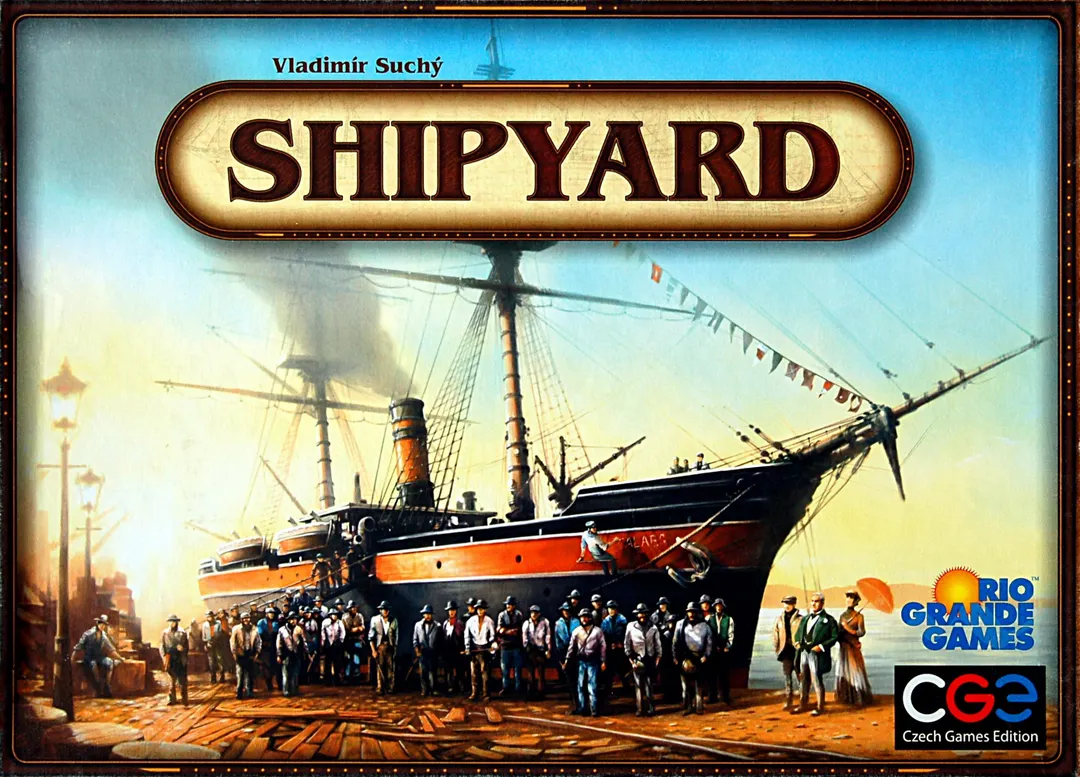
2009
Rules assistance for Shipyard
Plain-language explanations of turns, card effects and disputed situations, with official source references and saved question history.
For 2 players
What would you like to know?
Answers come from the official rulebook, with the page to check.
Shipyard is a board game released in 2009 for 2–4 players, 120 minutes per game, and ages 11 and up. It was designed by Vladimír Suchý and its main mechanics are Set Collection, Tile Placement, and End Game Bonuses.










We’re in 19th century, sea transport is more and more important. Both corporations and naval forces require newer and newer ships. Try to put yourself in the role of their manufacturers. Hire employees, buy accessories, get favour of evaluating committees. Don’t forget to rent a canal and you can heave anchor. Players take turns, beginning with a randomly selected player and continuing around the table clockwise. On their turn, they will choose one of the available actions from the Action Track. The action will get the player something they need to help build their ships. On the player's next turn, they will move that Action Card ahead of all the others and choose a different action. If a player completes a ship on their turn (ships consists of little cards depicting bows, sterns, and (preferably several) middle pieces with several options to add equipment or crew), it is taken out for a shakedown cruise in a canal, during which they may score points for speed, crew, equipment, or safety. As players take their turns, the line of Action Cards will advance around the Action Track. When the lead Action Card reaches the Starting Space again, the countdown marker moves down one space, and play continues. The game ends when the countdown marker reaches the finish space. (It can also end early if the players run out of Ship Cards.) Bonus points are scored for Government Contracts, and the player with the most points wins. The game lasts about 30 minutes per player.
Shipyard supports 2–4 players according to the catalogue. This range comes from the publisher’s listed player count, so the game can be set up for any group size within it. Some setups, rules and scoring details may still vary by player count, so check your edition’s rulebook for the exact configuration.
The listed playing time for Shipyard is 120 minutes. This is the publisher’s estimate for a full game. The actual duration depends on the group, the player count and familiarity with the rules: first sessions usually run longer, while experienced groups often finish faster. Setup and teaching time are not included in this estimate.
The catalogue lists Shipyard for ages 11 and up. This is the publisher’s recommendation and reflects reading demands, rule complexity and small components rather than theme alone. Younger players can often join with help from an adult, so check the age guidance on your edition and consider your group’s experience with board games.
Shipyard has a complexity rating of 3.5 out of 5 from BoardGameGeek players, which makes it a medium-weight game. The rating reflects how much rules knowledge, planning and decision-making a typical game demands. Expect a longer first teach for heavier games, and use a preparation guide before game night.
Shipyard belongs to these categories: Economic, Nautical, and Industry / Manufacturing. Its main mechanics are Set Collection, Tile Placement, and End Game Bonuses. Categories describe the theme and setting of a game, while mechanics describe what players actually do on their turns. Each mechanic links to a catalogue hub with similar games, which helps when you want something comparable.
The credited designers of Shipyard are: Vladimír Suchý. These credits come from the published game data and name the people responsible for the game’s design, not its illustrators or publishers. Designer pages on MeepleRules collect other titles by the same designers, which helps when you enjoy a game and want to find similar ones.
The catalogue lists Shipyard as a base game. It can be played on its own with the components in the box and does not require any other title. Expansions, if any exist, add new content or rules on top of it and are listed separately in the catalogue with a link back to this base game.