

- BGG rank
- BGG #2,056
- BGG rating
- 8.1
Aristeia!
- 2 players
- 60–90 min
- Complexity 3.0/5
- 2017
Rules assistance for Slaughterball: Team Fury Arena – The Jungle
Plain-language explanations of turns, card effects and disputed situations, with official source references and saved question history.
What would you like to know?
Answers come from the official rulebook, with the page to check.
Slaughterball: Team Fury Arena – The Jungle is an expansion for Slaughterball released in 2015 for 2–4 players, 60 minutes per game, and ages 14 and up. It was designed by Erik Kjerland and its main mechanics are Variable Player Powers, Dice Rolling, and Grid Movement.



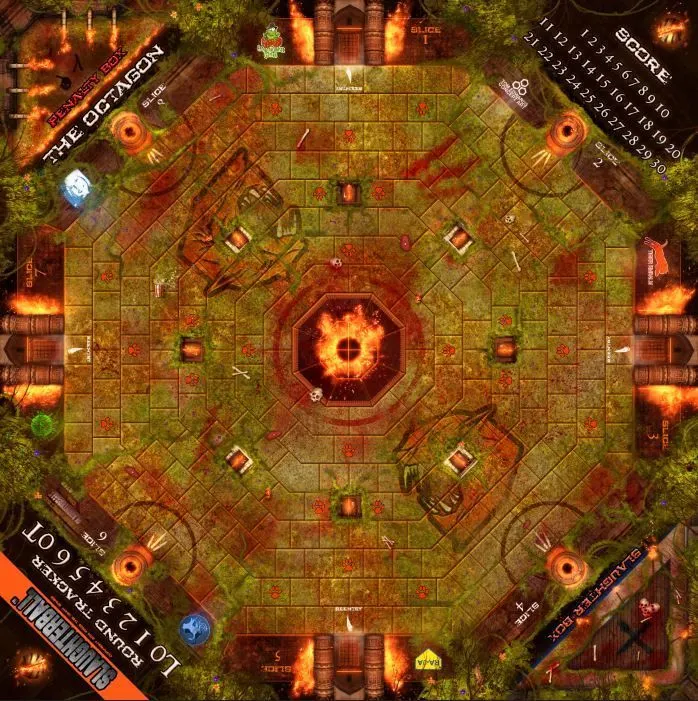
It’s no coincidence that the Fury slaughterdome named the Jungle is lost deep within the vast metropolis that is the Bengali Mahaplex. With over 270 million citizens, the BMP is a huge durocrete jungle, teeming with life and motion. Finding the Fury arena is a task in itself. But, once you find it, you’ll be amazed! The dome boasts ancient Indian architecture, holographic and genetically engineered flora and fauna, and flaming doom! Fury’s owners not only genetically engineered their team, they also genetically engineered plants to impede everyone in the pit. These neovines are attracted to movement, crawling and writhing to tangle those who run by. The Jungle is an arena board for Slaughterball. Special rules: While in the Fury pit, the following rules apply: Entangling vines: The first time an athlete tries to leave an entangling space during a Move action, the athlete must make an Agility test. If the athlete does not get 2 or more knives, he trips and falls down in that space. This ends his movement and no points are scored. Entangling spaces are indicated by the green leaf in the center of a space. Fireblast: Every coach gains this ability while in the Fury pit. At irregular intervals, the meat grinder and the launchers belch forth great gouts of flame! At any time except during an action, any coach can sacrifice an Interrupt card call forth such a conflagration from the meat grinder or any one specified launcher.
Slaughterball: Team Fury Arena – The Jungle supports 2–4 players according to the catalogue. This range comes from the publisher’s listed player count, so the game can be set up for any group size within it. Some setups, rules and scoring details may still vary by player count, so check your edition’s rulebook for the exact configuration.
The listed playing time for Slaughterball: Team Fury Arena – The Jungle is 60 minutes. This is the publisher’s estimate for a full game. The actual duration depends on the group, the player count and familiarity with the rules: first sessions usually run longer, while experienced groups often finish faster. Setup and teaching time are not included in this estimate.
The catalogue lists Slaughterball: Team Fury Arena – The Jungle for ages 14 and up. This is the publisher’s recommendation and reflects reading demands, rule complexity and small components rather than theme alone. Younger players can often join with help from an adult, so check the age guidance on your edition and consider your group’s experience with board games.
Slaughterball: Team Fury Arena – The Jungle belongs to these categories: Miniatures, Science Fiction, and Expansion for Base-game. Its main mechanics are Variable Player Powers, Dice Rolling, and Grid Movement. Categories describe the theme and setting of a game, while mechanics describe what players actually do on their turns. Each mechanic links to a catalogue hub with similar games, which helps when you want something comparable.
The credited designers of Slaughterball: Team Fury Arena – The Jungle are: Erik Kjerland. These credits come from the published game data and name the people responsible for the game’s design, not its illustrators or publishers. Designer pages on MeepleRules collect other titles by the same designers, which helps when you enjoy a game and want to find similar ones.
The catalogue lists Slaughterball: Team Fury Arena – The Jungle as an expansion for Slaughterball. Expansions add new content, rules or scenarios to the base game and usually cannot be played on their own, so you need Slaughterball to use it. Check that your edition of Slaughterball is compatible, as some expansions were revised between editions.