

- BGG rank
- BGG #2,056
- BGG rating
- 8.1
Aristeia!
- 2 players
- 60–90 min
- Complexity 3.0/5
- 2017
Rules assistance for Slaughterball: Team Legion
Plain-language explanations of turns, card effects and disputed situations, with official source references and saved question history.
What would you like to know?
Answers come from the official rulebook, with the page to check.
Slaughterball: Team Legion is an expansion for Slaughterball released in 2015 for 2–4 players, 60 minutes per game, and ages 14 and up. It was designed by Erik Kjerland and its main mechanics are Variable Player Powers, Dice Rolling, and Grid Movement.



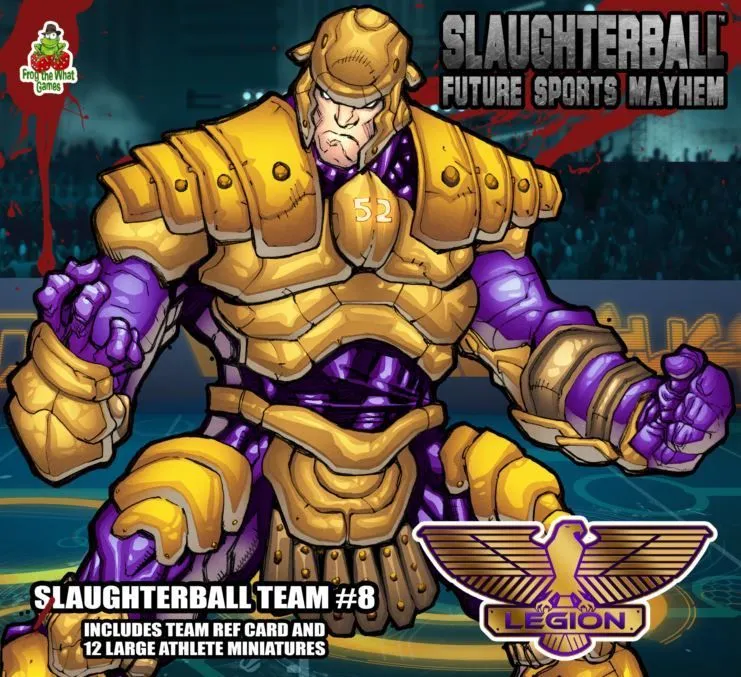
Legion is one of the few teams in the Global Slaughterball League that is completely owned by a regional government. In this case the Metroplex Roma subsidiary SPQR. Current SPQR CEO Tiberius Antonius Caesar-Caesar has dedicated vast sums of tax revenues to develop and market Legion into a juggernaut of popularity and success. Thanks to Caesar-Caesar’s guidance over the past two decades, Legion’s legions of fans have propelled the team to be one of the most financially successful in the league. Legion is a thoroughly disciplined team of well-armored athletes, each with their own skills to contribute to the team. They excel at cooperating with each other to overcome opponents through teamwork. The cleavers are the foundation of this team unity. They are tactical geniuses who grant all teammates a bonus to their tests, plus they can hand out additional Onslaught tokens! It will require an experienced coach to fully understand and lead Legion to victory. You’ll have to familiarize yourself with their impressive list of skills, and stay aware of every team member at all times to make sure you utilize them to their fullest potential. Legion is one of the most complicated teams to lead to victory, so be sure you are up to the task. Even though all Legion athletes have strong skill sets, it is the cleavers’ tactical leadership that propel them to excellence. The value of more onslaught tokens cannot be overemphasized, and you should exploit that ability every turn. Also, do not forget the Leadership bonus that each of your athletes earns from the cleavers, and that you can add up the +1 bonus to tests from each of your cleavers in the pit. To retain the extra tactical choices that they provide, the cleavers should be protected at all times. Do not expose them to attack or you’ll lose them to the Slaughter Box, along with their bonus dice and onslaught tokens. Also, don’t forget the other athletes on the team, who also have great skills and traits. The razor is well-armored, with just a slight reduction in Speed. The slashers can double-team opponents for vicious effect. Even the butcher is better than average with his Awesome Brute skill. And all Legion athletes can stand up adjacent teammates with Help Up. Once you learn how to synergize all these skills, you’re well on your way to invincibility!
Slaughterball: Team Legion supports 2–4 players according to the catalogue. This range comes from the publisher’s listed player count, so the game can be set up for any group size within it. Some setups, rules and scoring details may still vary by player count, so check your edition’s rulebook for the exact configuration.
The listed playing time for Slaughterball: Team Legion is 60 minutes. This is the publisher’s estimate for a full game. The actual duration depends on the group, the player count and familiarity with the rules: first sessions usually run longer, while experienced groups often finish faster. Setup and teaching time are not included in this estimate.
The catalogue lists Slaughterball: Team Legion for ages 14 and up. This is the publisher’s recommendation and reflects reading demands, rule complexity and small components rather than theme alone. Younger players can often join with help from an adult, so check the age guidance on your edition and consider your group’s experience with board games.
Slaughterball: Team Legion belongs to these categories: Miniatures, Science Fiction, and Sports. Its main mechanics are Variable Player Powers, Dice Rolling, and Grid Movement. Categories describe the theme and setting of a game, while mechanics describe what players actually do on their turns. Each mechanic links to a catalogue hub with similar games, which helps when you want something comparable.
The credited designers of Slaughterball: Team Legion are: Erik Kjerland. These credits come from the published game data and name the people responsible for the game’s design, not its illustrators or publishers. Designer pages on MeepleRules collect other titles by the same designers, which helps when you enjoy a game and want to find similar ones.
The catalogue lists Slaughterball: Team Legion as an expansion for Slaughterball. Expansions add new content, rules or scenarios to the base game and usually cannot be played on their own, so you need Slaughterball to use it. Check that your edition of Slaughterball is compatible, as some expansions were revised between editions.