
- BGG rank
- BGG #21,392
- BGG rating
- 6.2
Crazy Rally
- 3–6 players
- 30 min
- Complexity 1.6/5
- 2003
2006
Rules assistance for Snake Lake
Plain-language explanations of turns, card effects and disputed situations, with official source references and saved question history.
For 3 players
What would you like to know?
Answers come from the official rulebook, with the page to check.
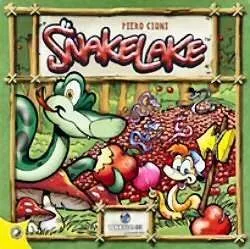
Snake Lake is a board game released in 2006 for 3–6 players, 30 minutes per game, and ages 8 and up. It was designed by Piero Cioni and its main mechanics are Hand Management, Simultaneous Action Selection, and Memory.



From the publisher: "The game is about a group of snakes wandering in the woods trying to eat the apples that fall down from the trees (and avoiding eating the poisonous mushrooms). The snakes' frenzy bring them to run between the trees and players must me able to "pilot" them to the apples, avoiding mushrooms, trees and the other snakes. The game is card driven (the cards are describe the possible movements)." SnakeLake is a cross between the old computer game Snake and the board game Robo Rally, but is much simpler and faster than RR. You have a simple board with a grid and place some apple trees around, then each player chooses a starting point. Each player uses cards to program their next three moves in secret on their own chart, with the 2nd and 3rd move sliding down each turn when the 1st card is used and a new card going in the 3rd slot. The cards simply show forward, left, right (twice each) and one stop card. They also tell you to draw an Event card, which add some randomness. If your snake runs into a tree, or off the board when incomplete, or into another snake's body, you start over again somewhere else, reprogramming your next three snake moves. If you hit another snake's head, they go off and you score a point for each segment of their body. If you get your whole snake on the board and then get your head off the board, you score points for the length of your snake. But the big points come from eating apples which fall from the apple trees. These have 8-12 points on them, and your snake runs over them to eat them and reveal the points scored. Likewise, there are some mushrooms which deduct points if eaten. The apples and mushrooms are placed when an Event card indicates. The other events include removing an apple, sending an opponent's snake to sleep (miss a turn), and make your snake's body longer or shorter. Snake Lake is a light, fast, fun game and will suit children more than adult's. The best strategy seems to be eat an apple then get knocked off the board to start somewhere else, near more apples. Getting your whole snake on and off is hard work, and scores few points in comparison. The components are nicely made, good shiny cards that should wear well. The rules need a little proof-reading but were clear enough. Snake Lake might be better for 3 or 4 players than 6 though, it got very crowded very quickly, even on the large side of the board.
Snake Lake supports 3–6 players according to the catalogue. This range comes from the publisher’s listed player count, so the game can be set up for any group size within it. Some setups, rules and scoring details may still vary by player count, so check your edition’s rulebook for the exact configuration.
The listed playing time for Snake Lake is 30 minutes. This is the publisher’s estimate for a full game. The actual duration depends on the group, the player count and familiarity with the rules: first sessions usually run longer, while experienced groups often finish faster. Setup and teaching time are not included in this estimate.
The catalogue lists Snake Lake for ages 8 and up. This is the publisher’s recommendation and reflects reading demands, rule complexity and small components rather than theme alone. Younger players can often join with help from an adult, so check the age guidance on your edition and consider your group’s experience with board games.
Snake Lake has a complexity rating of 1.4 out of 5 from BoardGameGeek players, which makes it a light game. The rating reflects how much rules knowledge, planning and decision-making a typical game demands. Expect a longer first teach for heavier games, and use a preparation guide before game night.
Snake Lake belongs to these categories: Card Game. Its main mechanics are Hand Management, Simultaneous Action Selection, and Memory. Categories describe the theme and setting of a game, while mechanics describe what players actually do on their turns. Each mechanic links to a catalogue hub with similar games, which helps when you want something comparable.
The credited designers of Snake Lake are: Piero Cioni. These credits come from the published game data and name the people responsible for the game’s design, not its illustrators or publishers. Designer pages on MeepleRules collect other titles by the same designers, which helps when you enjoy a game and want to find similar ones.
The catalogue lists Snake Lake as a base game. It can be played on its own with the components in the box and does not require any other title. Expansions, if any exist, add new content or rules on top of it and are listed separately in the catalogue with a link back to this base game.