
- BGG rating
- 7.3
Solar City: Serce Miasta
- 1–4 players
- 30–60 min
- Complexity 2.5/5
- 2020

2020
Rules assistance for Solar City
Plain-language explanations of turns, card effects and disputed situations, with official source references and saved question history.
What would you like to know?
Answers come from the official rulebook, with the page to check.
Solar City is a board game released in 2020 for 1–4 players, 30–60 minutes per game, and ages 10 and up. It was designed by Marcin Senior Ropka and Viola Kijowska and its main mechanics are Tile Placement and Enclosure.



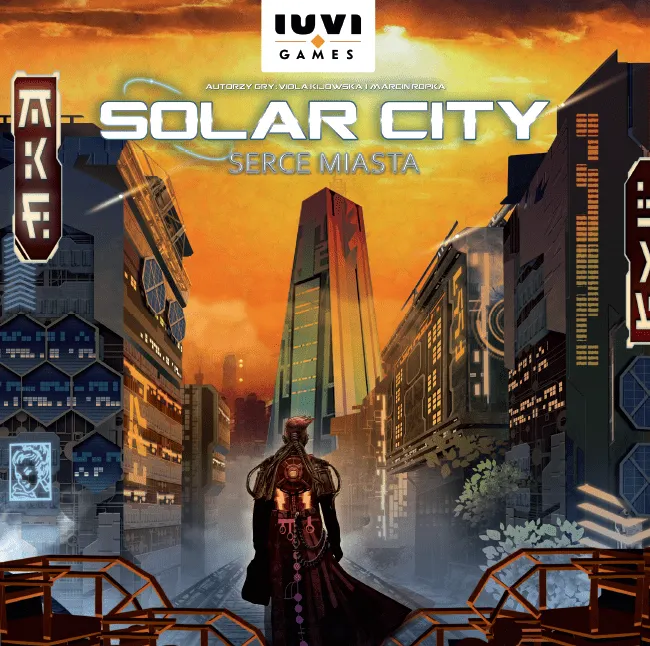
The year is 2035. Humanity is on a brink of extinction and we can’t blame anyone but ourselves. Even despite all the warnings, we were still clogging our sky with smoke and dust driven by short sighted greed. Our planet once green and beautiful, keeps on turning into deathly gray colors. That’s why the world’s brightest minds set into motion this great undertaking. The plan is to transform what we’ve already created, into something that would heal our poisoned world and ensure our survival. It’s in your hands to design the most efficiently working city, that will take us closer to salvation. The game’s theme is strictly linked with the idea of solarpunk. The core concept is set around the state of the environment we live in. Increasing pollution might air and water to become luxury goods. The solution? Conscious urban planning to use city buildings to produce clean energy, oxygen, and water. Various buildings are already being used in the real world in such manner and we can find examples like Bosco Verticale in Milan or Pasona Urban Farm in Tokyo. Solar City is a game where players design the future city. In each turn players choose one of the 3 actions: ● Build a Skyscraper that will bring you profits in the moment of activation ● Build a Public Buildings, that will improve the city structures’ performance. ● Activate the Vertical Farm – cover the Skyscrapers in green, activate the wind turbines, release the water flow, install photovoltaic panels, transforming it into a real factory of bioenergy and oxygen. Each action will activate a part of the city. The player who did that will get the profits from the buildings placed there and, more importantly, will block the possibility of activating this part of the city for the other players. This mechanic force players to adapt their strategy to new situations with each passing minute. The game contains over a dozen different building types. In every game only six of the will be used. Additionally, the game contains random set of Public Buildings. Thanks to that, every Solar City game will be an unique experience. The game takes place over the set number of rounds (depending on the player count) or up until the moment when one player fills their entire board. The winner is the one who contributed more to the positive change in worlds environment (gathered the most Oxygen Points).
Solar City supports 1–4 players according to the catalogue. This range comes from the publisher’s listed player count, so the game can be set up for any group size within it. Some setups, rules and scoring details may still vary by player count, so check your edition’s rulebook for the exact configuration.
The listed playing time for Solar City is 30–60 minutes. This is the publisher’s estimate for a full game. The actual duration depends on the group, the player count and familiarity with the rules: first sessions usually run longer, while experienced groups often finish faster. Setup and teaching time are not included in this estimate.
The catalogue lists Solar City for ages 10 and up. This is the publisher’s recommendation and reflects reading demands, rule complexity and small components rather than theme alone. Younger players can often join with help from an adult, so check the age guidance on your edition and consider your group’s experience with board games.
Solar City has a complexity rating of 2.6 out of 5 from BoardGameGeek players, which makes it a medium-light game. The rating reflects how much rules knowledge, planning and decision-making a typical game demands. Expect a longer first teach for heavier games, and use a preparation guide before game night.
Solar City belongs to these categories: Economic, City Building, and Science Fiction. Its main mechanics are Tile Placement and Enclosure. Categories describe the theme and setting of a game, while mechanics describe what players actually do on their turns. Each mechanic links to a catalogue hub with similar games, which helps when you want something comparable.
The credited designers of Solar City are: Marcin Senior Ropka and Viola Kijowska. These credits come from the published game data and name the people responsible for the game’s design, not its illustrators or publishers. Designer pages on MeepleRules collect other titles by the same designers, which helps when you enjoy a game and want to find similar ones.
The catalogue lists Solar City as a base game. It can be played on its own with the components in the box and does not require any other title. Expansions, if any exist, add new content or rules on top of it and are listed separately in the catalogue with a link back to this base game.
