
- BGG rank
- BGG #3,395
- BGG rating
- 7.4
Talon
- 2–6 players
- 60–90 min
- Complexity 2.6/5
- 2016
Rules assistance for Space Empires: Replicators
Plain-language explanations of turns, card effects and disputed situations, with official source references and saved question history.
What would you like to know?
Answers come from the official rulebook, with the page to check.
Space Empires: Replicators is an expansion for Space Empires 4X released in 2018 for 1–5 players, 180 minutes per game, and ages 12 and up. It was designed by Jim Krohn and its main mechanics are Variable Player Powers, Dice Rolling, and Grid Movement.




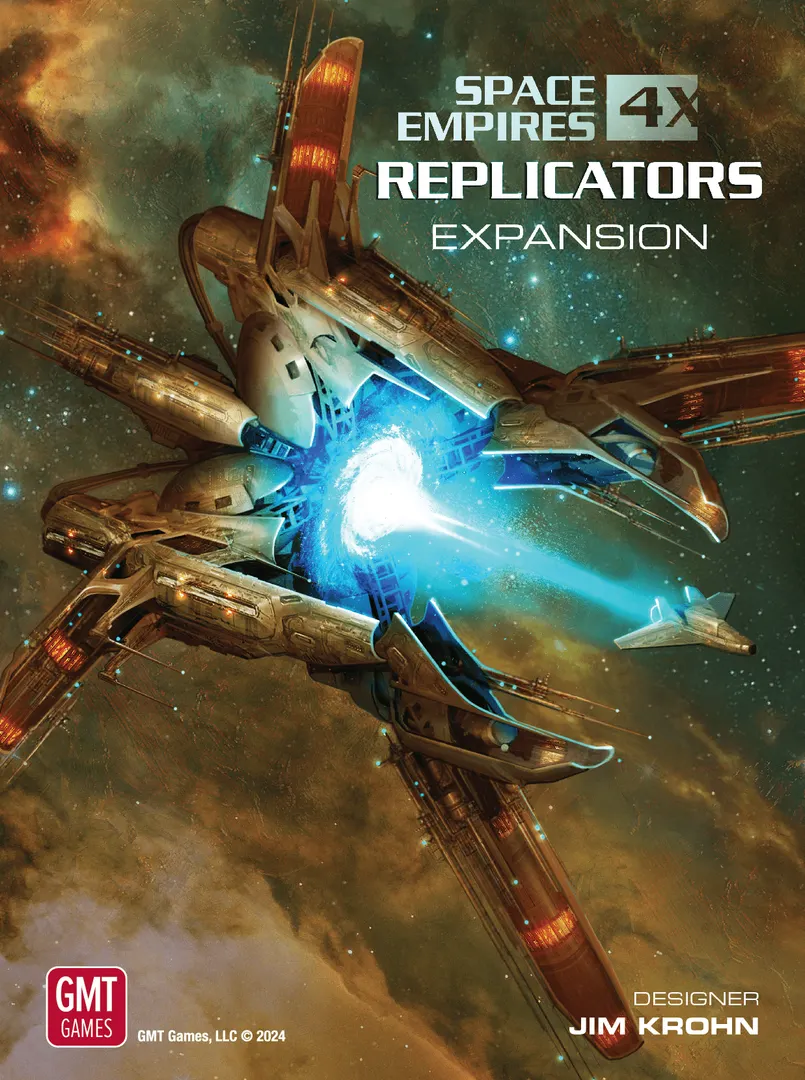
Space Empires: Replicators, the second expansion in the Space Empires series, adds a number of features to the base game, starting with the Replicators. Von-Neumann Machines ("Replicators") are self-replicating machines that behave, research, and reproduce differently from other empires, while having their own Empire Advantages. Replicators can be used by a fifth player, as an opponent in co-op games, or as a teaching empire for new players as the Replicator player doesn't have to fill out a production sheet or track the technology on his ships. Space Empires: Replicators also includes hex-sized terrain tiles for planets, asteroids, nebulae, and other permanent terrain effects. When an exploration marker reveals a terrain effect that stays on the map, the exploration marker is removed and replaced by a tile, giving the map a nice visual effect. (By removing the exploration marker, this also creates more room in the hexes because now the entire hex is the terrain.) For epic games, the backs of some of these tiles can be used to connect two Space Empires Boards. New Deep Space terrain is included in this expansion, with the Galactic Capital (which comes with its own scenario), Regional Map, Gravitational Anomaly, Space Pirates, and the Fold in Space. Each player also is dealt his own (random) resource deck at the start of the game. Everyone starts with a hand of three cards and draws a new one each turn. These cards can be used as an event or turned in for CP. Cards impact battles, exploration, economics — almost every aspect of the game; they can add unpredictable twists and impact your strategy. More powerful resource cards require you to discard an extra card to play them. New Ships are included in Space Empires: Replicators, with these ships requiring a new technology — Advanced Construction — to be researched. There are three levels of Advanced Construction, and it cannot be researched until the Economic Phase after your empire has built a BC or larger ship. Thus, they won't be available until the middle game at the earliest. The ships opened up by Advanced Construction include: Battle Carriers (BV), which are large carriers that can fight well, carry six Fighters, and come equipped with Anti-Sensor Hull (immune to Mines). Fighter 4s can also be researched and built. Advanced Destroyers (DDX) that can mount Attack 2, Defense 2, and come with Heavy Warheads (automatically hit on a 1 or a 2). Advanced Raiders (RX) that can mount Attack 3, Defense 3, and can carry one ground unit! All of the advanced ships can also be equipped with Fast technology (similar to BCs) if Fast 2 is researched. These changes don't impact the early and midgame, but make the DDs and Rs relevant in the late game. Raiders and Fighters are often curve balls that, once the opponent has reacted to them, lose their potency. This gives players another chance to throw a curve later in the game. Some additional counters have been included for all players. The Fleet and Miner counters that were misprinted in the Close Encounters expansion have also been corrected. Additional Empire Advantages have been added.
Space Empires: Replicators supports 1–5 players according to the catalogue. This range comes from the publisher’s listed player count, so the game can be set up for any group size within it. Some setups, rules and scoring details may still vary by player count, so check your edition’s rulebook for the exact configuration.
The listed playing time for Space Empires: Replicators is 180 minutes. This is the publisher’s estimate for a full game. The actual duration depends on the group, the player count and familiarity with the rules: first sessions usually run longer, while experienced groups often finish faster. Setup and teaching time are not included in this estimate.
The catalogue lists Space Empires: Replicators for ages 12 and up. This is the publisher’s recommendation and reflects reading demands, rule complexity and small components rather than theme alone. Younger players can often join with help from an adult, so check the age guidance on your edition and consider your group’s experience with board games.
Space Empires: Replicators has a complexity rating of 3.2 out of 5 from BoardGameGeek players, which makes it a medium-weight game. The rating reflects how much rules knowledge, planning and decision-making a typical game demands. Expect a longer first teach for heavier games, and use a preparation guide before game night.
Space Empires: Replicators belongs to these categories: Wargame, Bluffing, and Science Fiction. Its main mechanics are Variable Player Powers, Dice Rolling, and Grid Movement. Categories describe the theme and setting of a game, while mechanics describe what players actually do on their turns. Each mechanic links to a catalogue hub with similar games, which helps when you want something comparable.
The credited designers of Space Empires: Replicators are: Jim Krohn. These credits come from the published game data and name the people responsible for the game’s design, not its illustrators or publishers. Designer pages on MeepleRules collect other titles by the same designers, which helps when you enjoy a game and want to find similar ones.
The catalogue lists Space Empires: Replicators as an expansion for Space Empires 4X. Expansions add new content, rules or scenarios to the base game and usually cannot be played on their own, so you need Space Empires 4X to use it. Check that your edition of Space Empires 4X is compatible, as some expansions were revised between editions.