

- BGG rank
- BGG #203
- BGG rating
- 7.7
Castle Combo
- 2–5 players
- 10–25 min
- Complexity 1.7/5
- 2024
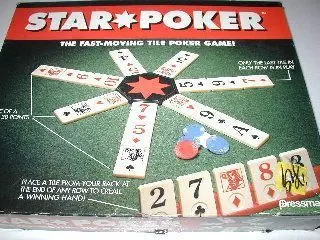
1994
Rules assistance for Star Poker
Plain-language explanations of turns, card effects and disputed situations, with official source references and saved question history.
What would you like to know?
Answers come from the official rulebook, with the page to check.
Star Poker is a board game released in 1994 for 2–7 players, 45 minutes per game, and ages 8 and up. Its main mechanics are Set Collection and Tile Placement.







Object Create poker hands - pairs, straights, flushes, etc. - to score points. After all the tiles have been played, the player with the highest score wins! Contents 54 poker tiles including 2 jokers Scoring chips: Blue = 5 points, Red = 10 points, White = 25 points 7 racks Disk Label Score card Set up Players draw a tile from the "pool;" the one with the highest tile goes first, then play moves in a clockwise direction. Return those tiles to the pool and mix them. Playing On a turn, place a tile on one of the seven sides of the disk. Then take a tile from the pool so that you always have five tiles in your hand. Play continues to the second player who can place a tile after the tile just played, or on any of the other sides of the disk. Then he takes a tile from the pool. Players continue taking their turns until someone scores. Scoring Players score by making various poker hands: 1 Pair, 3 of a Kind, Full House, Straight, etc. (see POKER HANDS). The hands are formed by combining the last or "open" tiles in any of the paths leading from the disk. Blocking When you do not have a tile that you can lay down to score points, you may want to block the other players from scoring. 5 Tile Plays Any time a player scores by creating a 5 of a Kind, Full House, Straight, Flush, Straight Flush, Royal Flush after receiving his points for that round, ALL of those tiles that were used to score are turned face down so that they cannot be used again. Players can play tiles from their hands off of the turned down tiles, as if starting from the beginning (tiles placed before the turned-down tiles cannot be used to form hands). Note: Do not turn the tiles over upon creating 2 pairs and 4 of a Kind. This allows for the creation of a Full House and 5 of a Kind. Jokers A joker can be used as a "Wild Card" to represent a ny tile. (Color does not matter - a red joker can represent a spade or club, etc.) The player that places a joker determines what tile it represents; the joker will remain as that chosen tile for the rest of the game. If another player holds the tile that the joker represents, he can play that tile as well. Points Chart Some of the scoring in Star Poker differs from the scoring in the standard poker game. This is due to the probabilities of creating different hands. 1 Pair = 5 pts. 2 Pairs = 10 pts. 3 of a Kind = 30 pts. 4 of a Kind = 75 pts. 5 of a Kind = 100 pts. Full House = 40 pts. Straight = 50 pts. Flush = 50 pts. Straight Flush = 100 pts. Royal Flush = 100 pts. Blue Chips = 5 pts. Red Chips = 10 pts. White Chips = 25 pts. Ending and Winning the Game Players continue until there are no more tiles to draw from and all tiles in their hands have been placed. In a four player game, once a player draws the tile that leaves two tiles left, the game ends after that player takes his turn. In a five player game, play until there are four tiles left and in a seven player game, play until five tiles are left. The player with the most points wins.
Star Poker supports 2–7 players according to the catalogue. This range comes from the publisher’s listed player count, so the game can be set up for any group size within it. Some setups, rules and scoring details may still vary by player count, so check your edition’s rulebook for the exact configuration.
The listed playing time for Star Poker is 45 minutes. This is the publisher’s estimate for a full game. The actual duration depends on the group, the player count and familiarity with the rules: first sessions usually run longer, while experienced groups often finish faster. Setup and teaching time are not included in this estimate.
The catalogue lists Star Poker for ages 8 and up. This is the publisher’s recommendation and reflects reading demands, rule complexity and small components rather than theme alone. Younger players can often join with help from an adult, so check the age guidance on your edition and consider your group’s experience with board games.
Star Poker has a complexity rating of 1.4 out of 5 from BoardGameGeek players, which makes it a light game. The rating reflects how much rules knowledge, planning and decision-making a typical game demands. Expect a longer first teach for heavier games, and use a preparation guide before game night.
Star Poker belongs to these categories: Card Game. Its main mechanics are Set Collection and Tile Placement. Categories describe the theme and setting of a game, while mechanics describe what players actually do on their turns. Each mechanic links to a catalogue hub with similar games, which helps when you want something comparable.
The catalogue lists Star Poker as a base game. It can be played on its own with the components in the box and does not require any other title. Expansions, if any exist, add new content or rules on top of it and are listed separately in the catalogue with a link back to this base game.