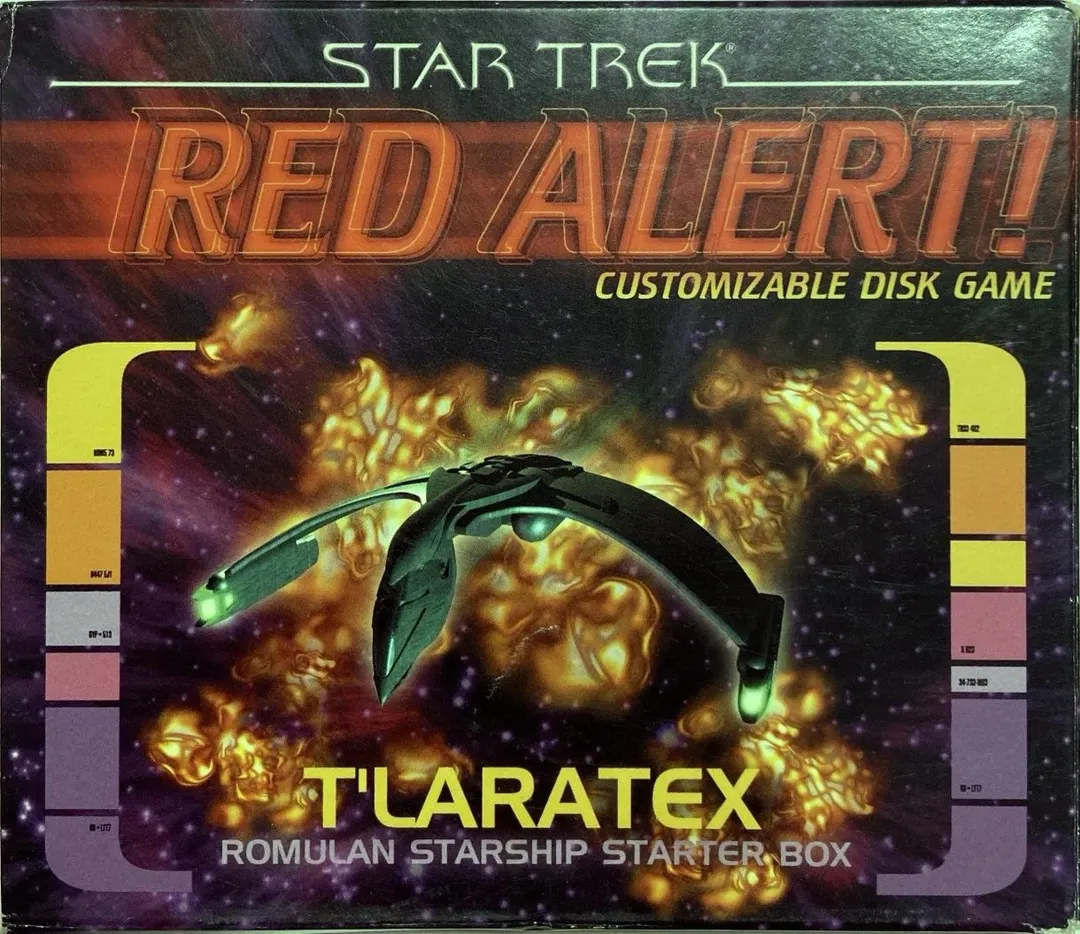
Rules assistance for Star Trek Red Alert! T'laratex Romulan Starship Starter Box
Plain-language explanations of turns, card effects and disputed situations, with official source references and saved question history.
- 2–99 players

Rules assistant for Star Trek Red Alert! T'laratex Romulan Starship Starter Box
What would you like to know?
Answers come from the official rulebook, with the page to check.
Star Trek Red Alert! T'laratex Romulan Starship Starter Box is an expansion for Star Trek Red Alert! released in 2000 for 2–99 players. It was designed by Christian T. Petersen, Darrell Hardy, Matthew Colville, and Christian Moore and its main mechanics are Variable Player Powers, Variable Set-up, and Scenario / Mission / Campaign Game.
About the game
Star Trek: Red Alert is a game of fierce combat between Federation, Klingon, Romulan, Cardassian, And Ferengi ships and crews! Commission your ship, add crew and tech, and face off against alien opponents. This starter box contains the rules and basic disks for the Romulan ship T'laratex, along with a selection of random disks for customizing your vessel. Add more ships, crew and tech--including famous Star Trek vessels and characters--to your fleet with additional boxes and booster packs! —description from the back of the box This game uses cardboard disks as miniatures for spacecraft, and "terrain" on a tabletop without any grid for movement regulation. There are resource allocation for the use of crew, energy, shields, and other facets. Conflict resolution is dice less but damage is randomized through the use of drawn cardboard chits. Starter boxes include the vessel on the cover, control sheets, and random other terrain, scenarios, and resources. —user summary
Questions and answers
Star Trek Red Alert! T'laratex Romulan Starship Starter Box supports 2–99 players according to the catalogue. This range comes from the publisher’s listed player count, so the game can be set up for any group size within it. Some setups, rules and scoring details may still vary by player count, so check your edition’s rulebook for the exact configuration.
Star Trek Red Alert! T'laratex Romulan Starship Starter Box belongs to these categories: Fighting, Miniatures, and Science Fiction. Its main mechanics are Variable Player Powers, Variable Set-up, and Scenario / Mission / Campaign Game. Categories describe the theme and setting of a game, while mechanics describe what players actually do on their turns. Each mechanic links to a catalogue hub with similar games, which helps when you want something comparable.
The credited designers of Star Trek Red Alert! T'laratex Romulan Starship Starter Box are: Christian T. Petersen, Darrell Hardy, Matthew Colville, and Christian Moore. These credits come from the published game data and name the people responsible for the game’s design, not its illustrators or publishers. Designer pages on MeepleRules collect other titles by the same designers, which helps when you enjoy a game and want to find similar ones.
The catalogue lists Star Trek Red Alert! T'laratex Romulan Starship Starter Box as an expansion for Star Trek Red Alert!. Expansions add new content, rules or scenarios to the base game and usually cannot be played on their own, so you need Star Trek Red Alert! to use it. Check that your edition of Star Trek Red Alert! is compatible, as some expansions were revised between editions.