- BGG rating
- 8.4
Terraforming Mars: Hellas & Elysium
1–5 players90–120 min2017
Complexity 2.8/5
2016
Rules assistance for Terraforming Mars
Plain-language explanations of turns, card effects and disputed situations, with official source references and saved question history.
What would you like to know?
Answers come from the official rulebook, with the page to check.
Highest total VP wins; ties go to the player with most M€.
About 10 min · 8 steps
Step 1 of 8
Take one or two actions in any combination; the same action may be taken twice.
No. A blue-card action can be used once per generation; its ongoing effects remain active.
You must meet its requirements to play it. Requirements do not need to remain met when using the card later.
Spend 8 plants to place greenery. Spend 8 heat to raise temperature.
If possible, place it next to one of your tiles. If you have no tile or no available adjacent space, use any available space.
No. A later tile placed next to an ocean gains a 2 M€ bonus, regardless of ownership.
After the generation when all three goals are reached, players get one final plant-to-greenery opportunity before scoring.
Terraforming Mars is a board game released in 2016 for 1–5 players, 120 minutes per game, and ages 12 and up. It was designed by Jacob Fryxelius and its main mechanics are Variable Player Powers, Hand Management, and Take That. MeepleRules offers a rules assistant for Terraforming Mars that explains turns, card effects and disputed situations in plain language.
1–5 players90–120 min2017

1–5 players90–120 min2017
1–5 players120 min2018

1–5 players90–120 min2018
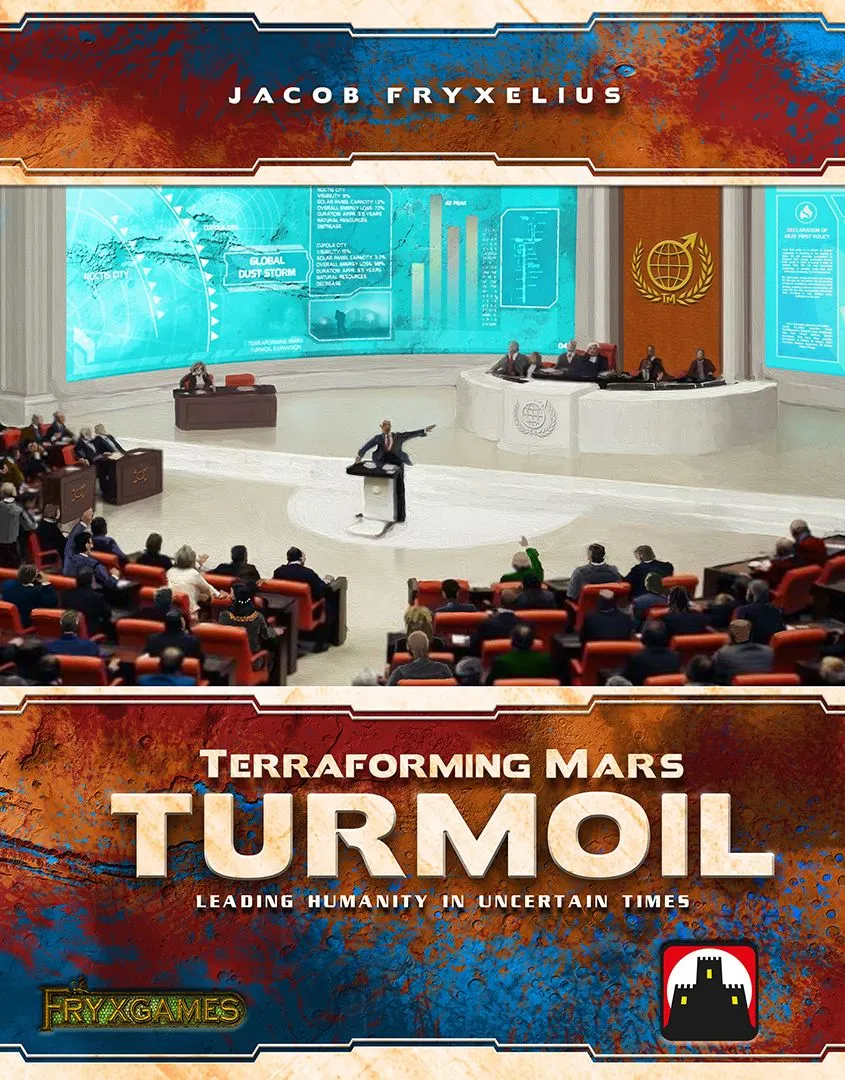
1–5 players150 min2019
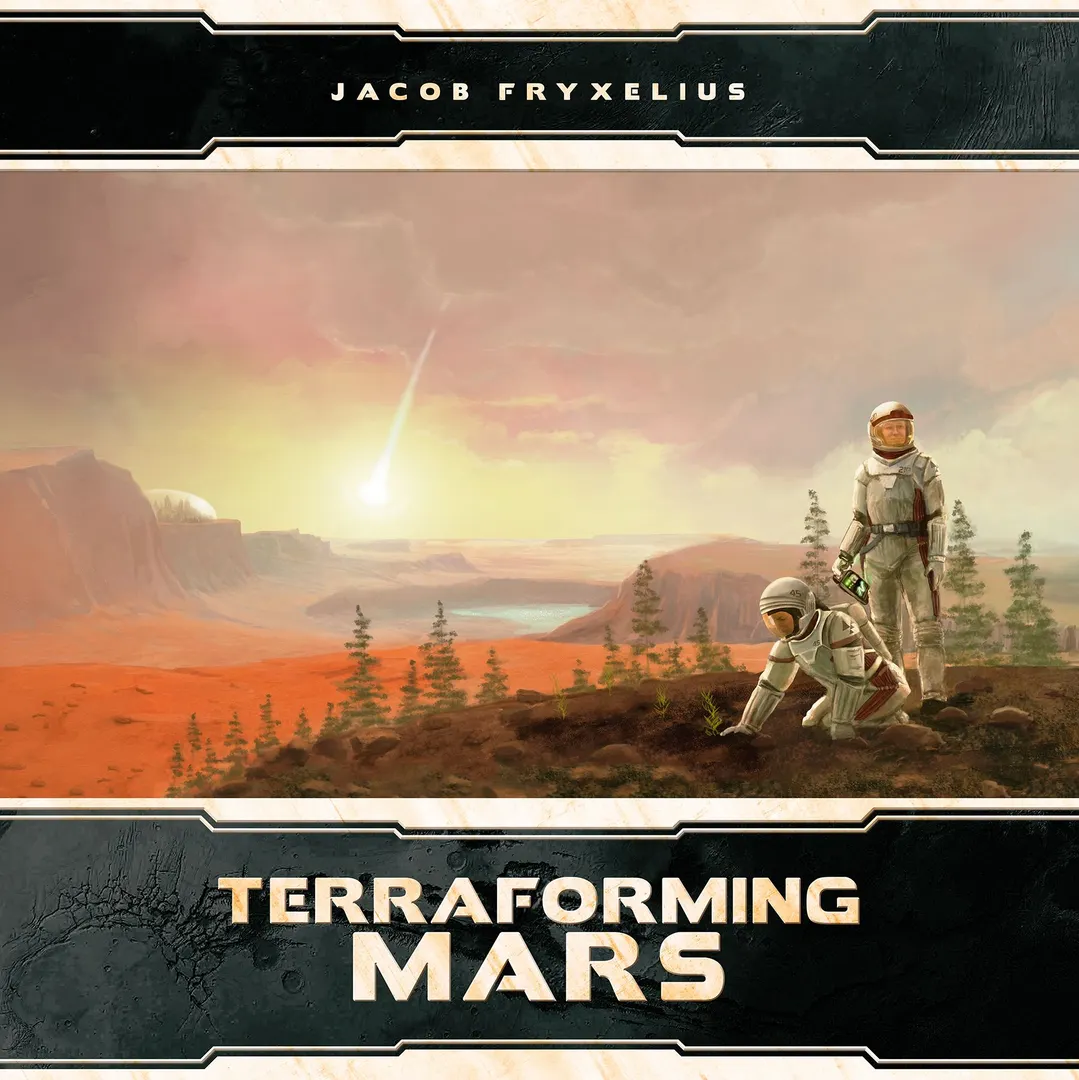
1–5 players120 min2021
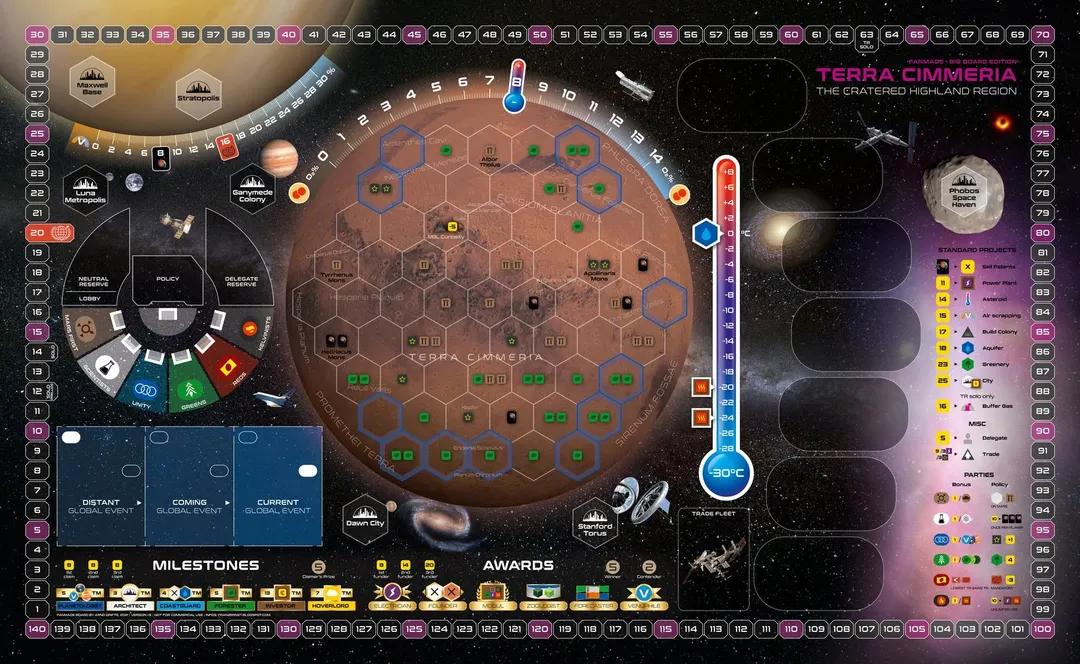
1–5 players2022
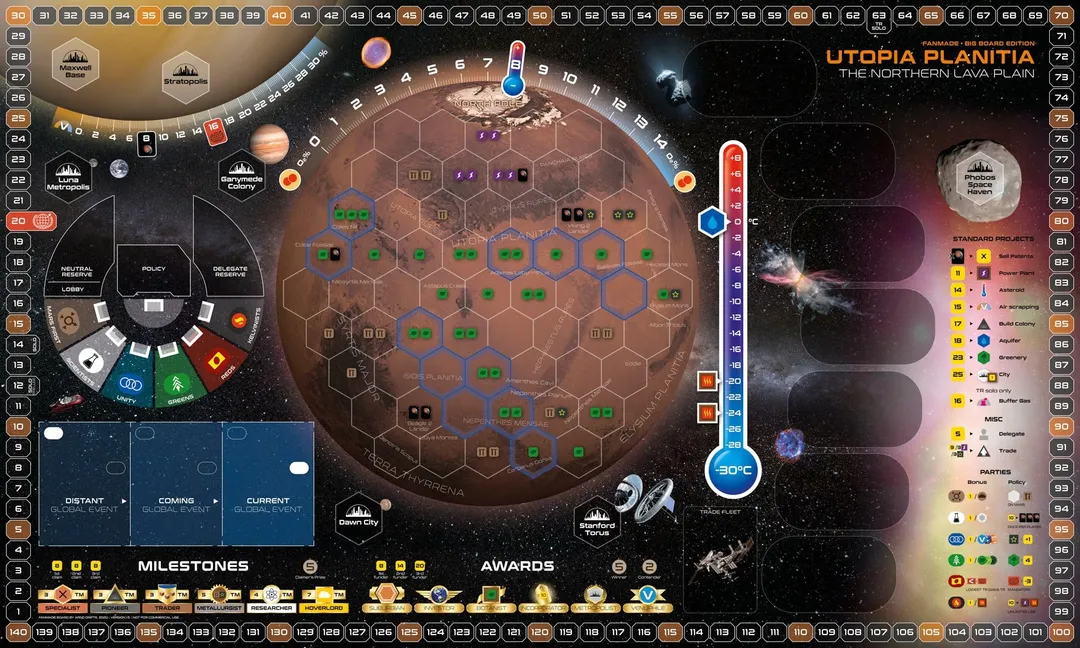
1–5 players2022
1–5 players2022

4–5 players2024
2–5 players120 min2024

1 player2024
1–5 players90–120 min2019

1–4 players90–150 min2021
1–4 players60–150 min2017
2–4 players45–75 min2007
1–4 players45–90 min2014

2–4 players120 min2020

1–4 players90–180 min2022

1–4 players90–120 min2027

1–5 players60–120 min2016
In the 2400s, mankind begins to terraform the planet Mars. Giant corporations, sponsored by the World Government on Earth, initiate huge projects to raise the temperature, the oxygen level, and the ocean coverage until the environment is habitable. In Terraforming Mars, you play one of those corporations and work together in the terraforming process, but compete for getting victory points that are awarded not only for your contribution to the terraforming, but also for advancing human infrastructure throughout the solar system, and doing other commendable things. As a player, you acquire unique project cards (from over two hundred different ones) by buying them to your hand. The cards can give you immediate bonuses, as well as increasing your production of different resources. Many cards also have requirements and they become playable when the temperature, oxygen, or ocean coverage increases enough. Buying cards is costly, so there is a balance between buying cards and actually playing them. Standard Projects are always available to complement your hand of cards. Your basic income, as well as your basic score, are based on your Terraform Rating. However, your income is boosted by your production, and VPs are also gained from many other sources. You keep track of your production and resources on your player board. The game uses six types of resources: MegaCredits, Steel, Titanium, Plants, Energy, and Heat. On the game board, you compete for the best places for your city tiles, ocean tiles, and greenery tiles. You also compete for different Milestones and Awards worth many VPs. Each round is called a generation and consists of the following phases: 1) Player order shifts clockwise. 2) Research phase: All players buy cards from four privately drawn. 3) Action phase: Players take turns doing 1-2 actions from these options: Playing a card, claiming a Milestone, funding an Award, using a Standard project, converting plant into greenery tiles (and raising oxygen), converting heat into a temperature raise, and using the action of a card in play. The turn continues around the table (sometimes several laps) until all players have passed. 4) Production phase: Players get resources according to their terraform rating and production parameters. When the three global parameters (temperature, oxygen, ocean) have all reached their required levels, the terraforming is complete, and the game ends after that generation. Combine your Terraform Rating and other VPs to determine the winning corporation!
Use the rules assistant for Terraforming Mars to describe a turn, card effect or disputed situation. Get a plain-language explanation with official source references, then return to the question in your saved history. Select your edition when available so the sources match your game.
Ask about the rulesTerraforming Mars supports 1–5 players according to the catalogue. This range comes from the publisher’s listed player count, so the game can be set up for any group size within it. Some setups, rules and scoring details may still vary by player count, so check your edition’s rulebook for the exact configuration.
The listed playing time for Terraforming Mars is 120 minutes. This is the publisher’s estimate for a full game. The actual duration depends on the group, the player count and familiarity with the rules: first sessions usually run longer, while experienced groups often finish faster. Setup and teaching time are not included in this estimate.
The catalogue lists Terraforming Mars for ages 12 and up. This is the publisher’s recommendation and reflects reading demands, rule complexity and small components rather than theme alone. Younger players can often join with help from an adult, so check the age guidance on your edition and consider your group’s experience with board games.
Terraforming Mars has a complexity rating of 3.3 out of 5 from BoardGameGeek players, which makes it a medium-weight game. The rating reflects how much rules knowledge, planning and decision-making a typical game demands. Expect a longer first teach for heavier games, and use a preparation guide before game night.
Terraforming Mars belongs to these categories: Economic, Territory Building, and Science Fiction. Its main mechanics are Variable Player Powers, Hand Management, and Take That. Categories describe the theme and setting of a game, while mechanics describe what players actually do on their turns. Each mechanic links to a catalogue hub with similar games, which helps when you want something comparable.
The credited designers of Terraforming Mars are: Jacob Fryxelius. These credits come from the published game data and name the people responsible for the game’s design, not its illustrators or publishers. Designer pages on MeepleRules collect other titles by the same designers, which helps when you enjoy a game and want to find similar ones.
The catalogue lists Terraforming Mars as a base game. It can be played on its own with the components in the box and does not require any other title. Expansions, if any exist, add new content or rules on top of it and are listed separately in the catalogue with a link back to this base game.