

- BGG rank
- BGG #1,120
- BGG rating
- 7.2
Akrotiri
- 2 players
- 45 min
- Complexity 2.6/5
- 2014
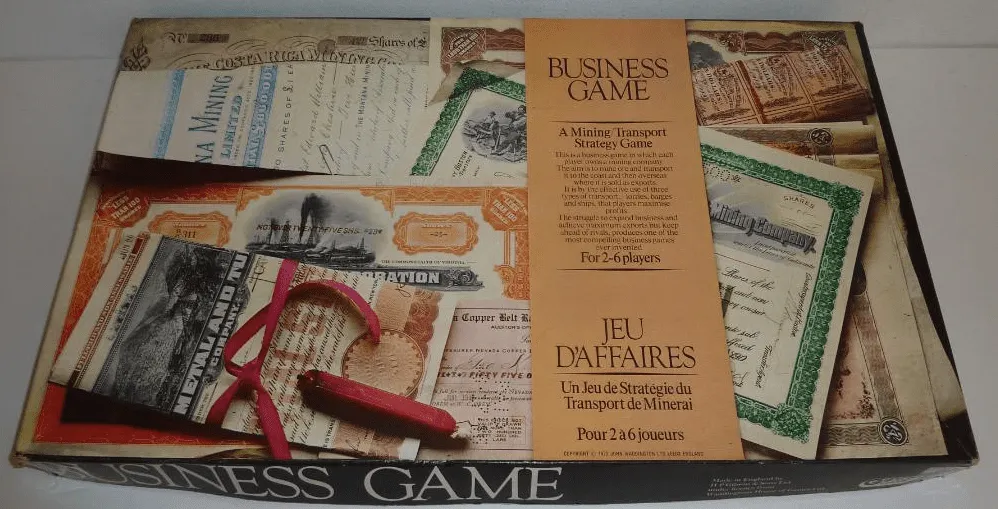
1965
Rules assistance for The Business Game
Plain-language explanations of turns, card effects and disputed situations, with official source references and saved question history.
For 2 players
What would you like to know?
Answers come from the official rulebook, with the page to check.
The Business Game is a board game released in 1965 for 2–6 players, 90 minutes per game, and ages 8 and up. Its main mechanics are Roll / Spin and Move, Income, and Point to Point Movement.
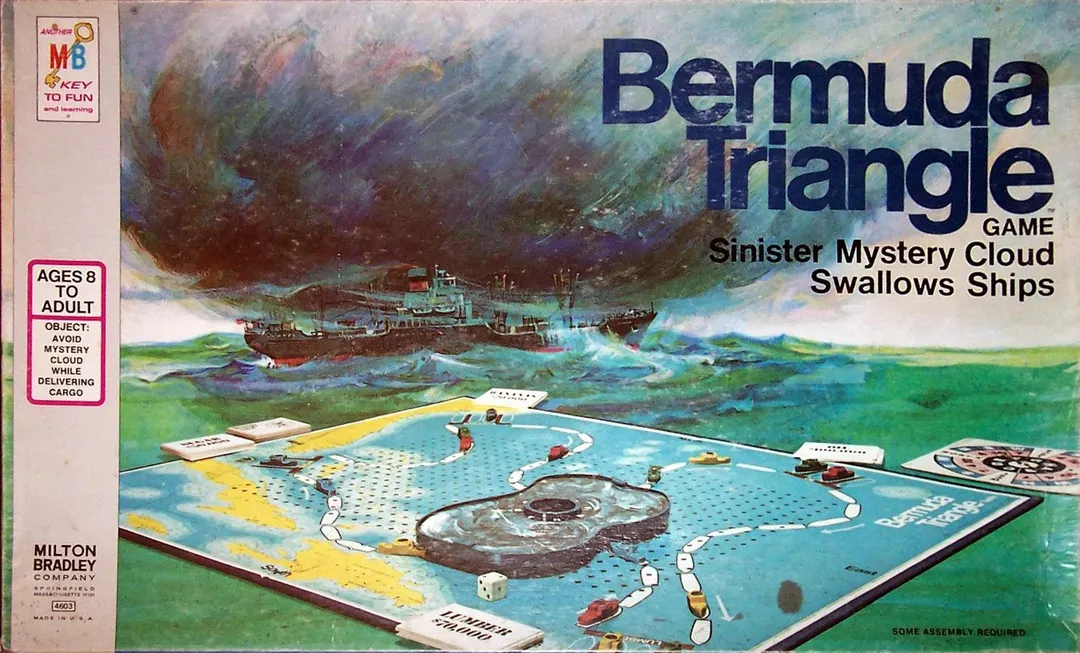


Board of two joined leaves, 12 mine derricks (2 of each of 6 colours), 6 lorries [trucks], 5 barges, 2 ships, 90 pyramids (15 of each of 6 colours), 24 cubes (4 of each of 6 colours), 26 production cards, 6 Canal Company Title Deeds, 2 production debit cards, 1 die, sterling and dollar currency. The players are operating a mine and trying to get the ore to market, but must compete with each other for the limited transportation resources. The ore has to be transported initially by lorries and also later by barges to the coastal warehouse. All transport has to be hired and there is always less transport available than required, favouring those who are prepared to take a risk on achieving a quick journey without mishap. For example there are only 5 barges (always one less than the numbers of players) to encourage competition and load sharing. You can also force other players to pay you for taking their ore to make up a barge load as all barges have to travel fully laden. Much depends on how long a journey takes. New ore can only be obtained by throwing a 1 or a six which also triggers the playing of a production card which can be favourable or not. From the coastal warehouse, barges and ships are used to transport ore out to sea to foreign ports to sell to gradually earn the Million Dollars needed to win the game. The second set of money (dollars) is thus actually a victory point counting device and not actual currency (i.e. it cannot be spent). It works well with any number of players (when playing with a smaller complement, each player operates multiple mines) except five, as the competition factor on one side of the board is uneven with the other.
The Business Game supports 2–6 players according to the catalogue. This range comes from the publisher’s listed player count, so the game can be set up for any group size within it. Some setups, rules and scoring details may still vary by player count, so check your edition’s rulebook for the exact configuration.
The listed playing time for The Business Game is 90 minutes. This is the publisher’s estimate for a full game. The actual duration depends on the group, the player count and familiarity with the rules: first sessions usually run longer, while experienced groups often finish faster. Setup and teaching time are not included in this estimate.
The catalogue lists The Business Game for ages 8 and up. This is the publisher’s recommendation and reflects reading demands, rule complexity and small components rather than theme alone. Younger players can often join with help from an adult, so check the age guidance on your edition and consider your group’s experience with board games.
The Business Game has a complexity rating of 2.1 out of 5 from BoardGameGeek players, which makes it a medium-light game. The rating reflects how much rules knowledge, planning and decision-making a typical game demands. Expect a longer first teach for heavier games, and use a preparation guide before game night.
The Business Game belongs to these categories: Economic and Transportation. Its main mechanics are Roll / Spin and Move, Income, and Point to Point Movement. Categories describe the theme and setting of a game, while mechanics describe what players actually do on their turns. Each mechanic links to a catalogue hub with similar games, which helps when you want something comparable.
The catalogue lists The Business Game as a base game. It can be played on its own with the components in the box and does not require any other title. Expansions, if any exist, add new content or rules on top of it and are listed separately in the catalogue with a link back to this base game.