- BGG rank
- BGG #16,672
- BGG rating
- 7.3
The Fate of Reiters: Five Battles of the French Wars of Religion 1562-1598
2019
Rules assistance for The Fate of Reiters: Five Battles of the French Wars of Religion 1562-1598
Plain-language explanations of turns, card effects and disputed situations, with official source references and saved question history.
- 2 players
- 30–120 min
- 15+
- Complexity 2.6/5

For 2 players
Rules assistant for The Fate of Reiters: Five Battles of the French Wars of Religion 1562-1598
What would you like to know?
Answers come from the official rulebook, with the page to check.
The Fate of Reiters: Five Battles of the French Wars of Religion 1562-1598 is a board game released in 2019 for 2 players, 30–120 minutes per game, and ages 15 and up. It was designed by Philippe Hardy and its main mechanics are Area Movement, Dice Rolling, and Simulation.
About the game
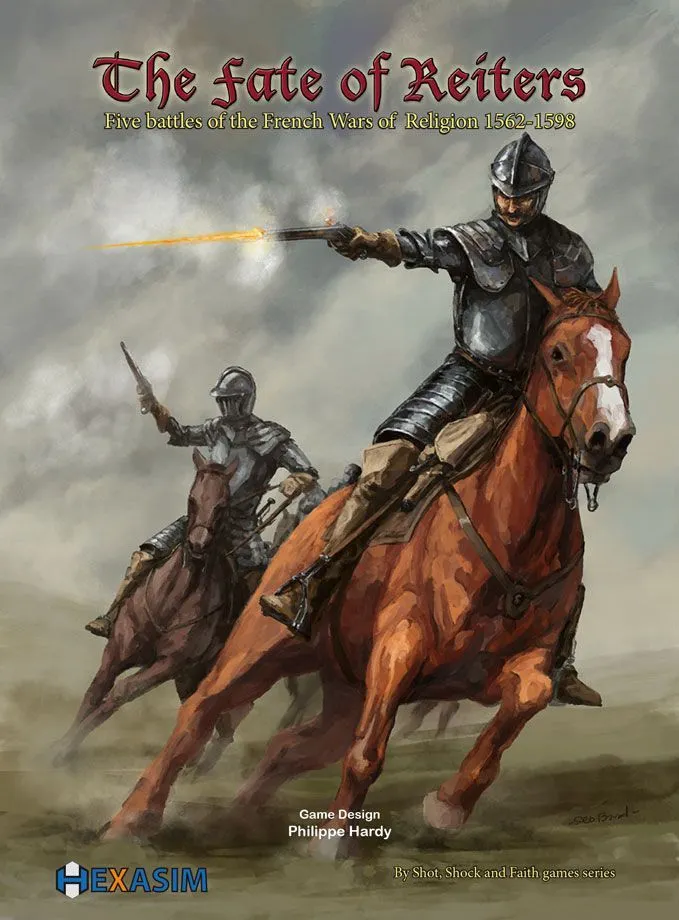
The Fate of Reiters: Five Battles of the French Wars of Religion 1562-1598 is a new game of the series Par le Feu, le Fer et la Foi (in English: "By Shot, Shock and Faith") and allows the simulation of the Religious Wars that occurred in France from 1562 to 1598. This civil war opposes, in a first conflict phase, Protestants - otherwise known as Huguenots - to Catholics, then Royalists to Holy League members after the accession of Henry IV to the throne in 1589. The art of war during this period of the Renaissance is rapidly changing. The great feudal landlords, steeped in morals, fight alongside mercenaries motivated by sole cupidity. The diversity of the weapons that are used offers great tactical possibilities, based on impact and fire. Gendarmes, cuirassiers, reiters, harquebusiers, lansquenets and Swiss mercenaries confront each other in a merciless fight. The Fate of Reiters is a Grand-Tactical board-wargame which, for the first time, allows the simulation of five battles of that era: COGNAT : January 6th, 1568 DORMANS : October 10th, 1575 AUNEAU : November 24th, 1587 VIMORY : October 26th, 1587 METRIEUX (aka VIRE-CULS) December 10th, 1587 This is a classic wargame « I go, You go » ststem, of average complexity, including, during the active player's phase, a sequence of reaction from the passive player, such as fire, counter-charge or tactical backstep. The maps are with areas from 300 to 500 meters by side. A color code allows to easily determine the costs of movements and the line of sight. The scale of the game is one unit for 100 to 500 soldiers or one or two guns. One game turn represent a duration of 20 to 30 minutes. A corps represents either a vanguard or a rearguard, or the main body called "battle". The combats allow to simulate charges « in wall », the merciless shocks between pikemen, the artillery fire and highlight, by a support system, the combination of iron -shock- and fire -shooting. The optional rules- caracoles, orders, lost children, looting- add even more realism to the era's battles. The rules and the five battles offered are based on a thorough bibliography and researches made into books written by contemporary authors, specifically François de la Noue for the Protestants and Blaise de Montluc for the Catholics, and also on precise topographical plans of each battlefield that is still accessible... Are you ready to put on the Henri de Guise, Duke of Lorraine and fight your enemies the famous German mercenaries ? The Fate of Reiters is the second opus of Par le Feu, le Fer et le Foi (By Shot, Shock and Faith). This new HEXASIM wargame offers you this option with an innovating and elegant game. —description from the publisher
Categories
Mechanics
Designers
Publishers
- Hexasim
Questions and answers
The Fate of Reiters: Five Battles of the French Wars of Religion 1562-1598 supports 2 players according to the catalogue. This is the publisher’s listed player count, so the game is designed for exactly that number of participants. Variants for other group sizes, if any, are described in the rulebook of your edition, so check it before setting up a different configuration.
The listed playing time for The Fate of Reiters: Five Battles of the French Wars of Religion 1562-1598 is 30–120 minutes. This is the publisher’s estimate for a full game. The actual duration depends on the group, the player count and familiarity with the rules: first sessions usually run longer, while experienced groups often finish faster. Setup and teaching time are not included in this estimate.
The catalogue lists The Fate of Reiters: Five Battles of the French Wars of Religion 1562-1598 for ages 15 and up. This is the publisher’s recommendation and reflects reading demands, rule complexity and small components rather than theme alone. Younger players can often join with help from an adult, so check the age guidance on your edition and consider your group’s experience with board games.
The Fate of Reiters: Five Battles of the French Wars of Religion 1562-1598 has a complexity rating of 2.6 out of 5 from BoardGameGeek players, which makes it a medium-light game. The rating reflects how much rules knowledge, planning and decision-making a typical game demands. Expect a longer first teach for heavier games, and use a preparation guide before game night.
The Fate of Reiters: Five Battles of the French Wars of Religion 1562-1598 belongs to these categories: Wargame, Renaissance, and Civil War. Its main mechanics are Area Movement, Dice Rolling, and Simulation. Categories describe the theme and setting of a game, while mechanics describe what players actually do on their turns. Each mechanic links to a catalogue hub with similar games, which helps when you want something comparable.
The credited designers of The Fate of Reiters: Five Battles of the French Wars of Religion 1562-1598 are: Philippe Hardy. These credits come from the published game data and name the people responsible for the game’s design, not its illustrators or publishers. Designer pages on MeepleRules collect other titles by the same designers, which helps when you enjoy a game and want to find similar ones.
The catalogue lists The Fate of Reiters: Five Battles of the French Wars of Religion 1562-1598 as a base game. It can be played on its own with the components in the box and does not require any other title. Expansions, if any exist, add new content or rules on top of it and are listed separately in the catalogue with a link back to this base game.