- BGG rating
- 7.4
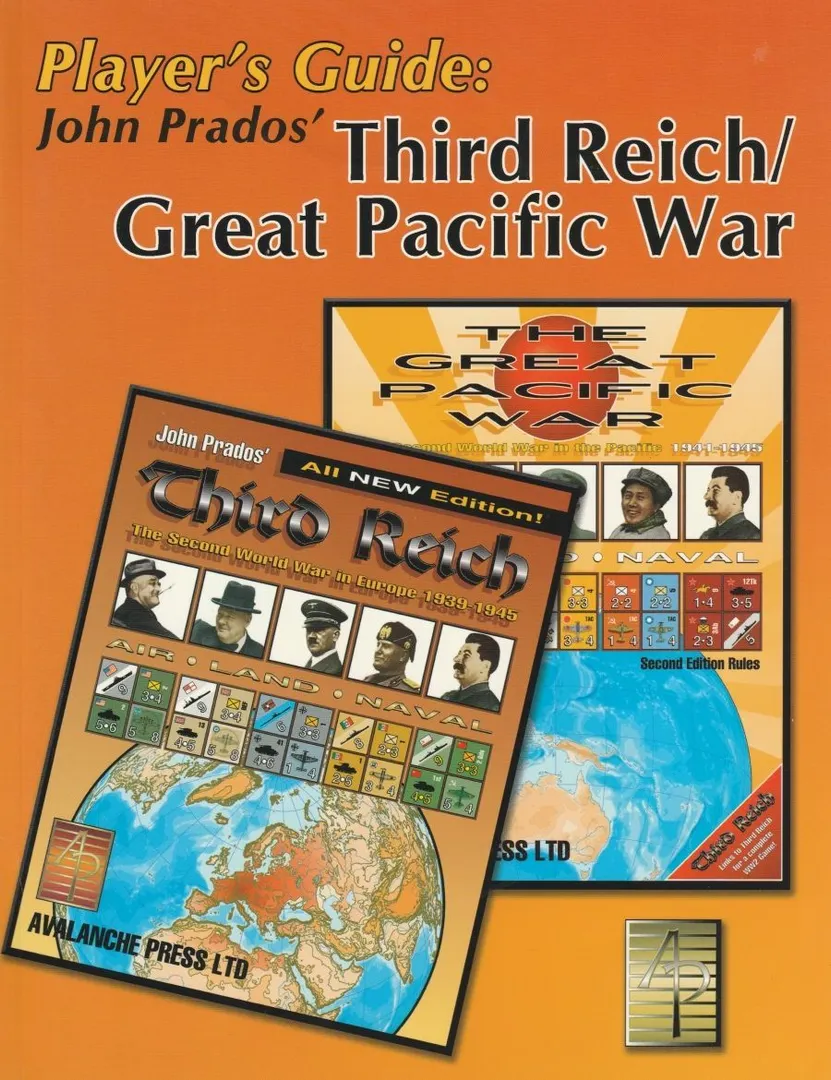
Third Reich/Great Pacific War Player's Guide
- 2–5 players
- 360 min
- Complexity 3.4/5
- 2004
2003
Rules assistance for The Great Pacific War: The Second World War in the Pacific 1937-1945
Plain-language explanations of turns, card effects and disputed situations, with official source references and saved question history.
For 2 players
What would you like to know?
Answers come from the official rulebook, with the page to check.
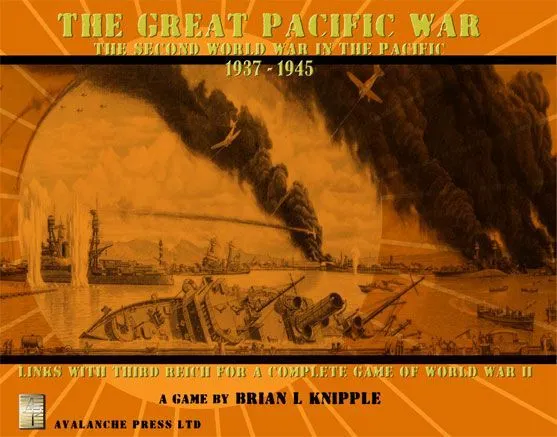
The Great Pacific War: The Second World War in the Pacific 1937-1945 is a board game released in 2003 for 2–5 players, 240–480 minutes per game, and ages 12 and up. It was designed by Brian L. Knipple and its main mechanics are Dice Rolling, Grid Movement, and Hexagon Grid.
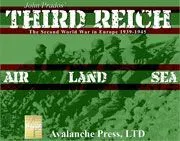



Description from the publisher: Great Pacific War is Avalanche Press' strategic-level game of the War in the Pacific. The game covers the entire war from December 1941 through 1946 and includes the forces of all participants. Players are placed in the positions of the commanders of the Japanese, British, Soviet and American forces in World War Two. The system is the same one used in Avalanche Press' game, Third Reich. In addition to five scenarios covering all or part of the War in the Pacific, Great Pacific War includes rules to link it and Third Reich to play the Second World War, a simulation of the entire conflict with up to seven players. Included in the game are five scenarios for the Great Pacific War and three scenarios for the linked Second World War. One of the Great Pacific War scenarios covers a possible 1931 conflict between Japan and America as postulated by the British journalist Hector Bywater in his book of the same title. The facts: Game scale is 60 miles per hex covering the battlefield on three 34" x 22" maps. Units are represented at corps, fleet and air army level. Each turn represents three months of actual time. The game system is built around players drawing impulse "chits" to determine how they can activate their forces. The emphasis is on the interaction of military, political and economic factors (as in Third Reich). The game system from our Third Reich game allows players to control the military, political and economic destinies of their nations in a struggle to dominate the world. Land, air and sea forces battle across almost a third of the earth's surface as the two mightiest navies fight for control of the Pacific. Players manage their economies and build and operate their military forces within the capabilities of their nations' abilities. In Great Pacific War the Japanese player must decide initially whether war with America or the Soviet Union will be his or her strategy. JapanÍs lack of resources make a war with one or the other a necessity. Also possible is a war with Britain and her ally, The Netherlands, who together control the riches of India, Java and Borneo. This strategy has many risks, the greatest being that America will enter the war on Britain's side. Coloring all is the massive Japanese investment in China and the importance of those conquered territories to the Japanese economy. The American player must move a nation unprepared for war to a position of strength, while attempting to support the Nationalist Chinese in their conflict with the Japanese. In the linked game players have also to consider the effects of their actions on the global conflict. A Soviet player desperately defending Moscow in 1941 can little afford a Japanese attack on Vladivostok. Likewise a British player fighting Germany with only a seemingly soon-to-be-defeated Soviet Union as an ally, will not welcome a Japanese attack on his eastern possessions unless it brings America into the war. Historically Japan went to war to obtain the resources denied her by the Allies embargo of steel and oil and because German successes appeared to offer Japan the opportunity to join a victory almost already won. The question is whether you and your allies can do any better than your historical counterparts. Components: 3 34” x 22” maps 2 countersheets consisting of 560 counters 1 rulebook...separated into 2 booklets 2 scenario booklets 1 "Policial Maker Explanations" booklet 1 Off-Map Movement and Sea Zones Chart 11" x 17" 1 Chart with US Entry/Russian Winter Table/Mud Table 1 Chart with Sequence of Play/Alliance & Individual Victory Tables/Construction and Repair Costs 1 Terrain Effects Chart 1 Turn Impulse Track 1 Production Costs 9 Force Pool Charts(Netherlands,Britain,Soviet Union,Nationalist China,Communist China,United States(x2),Japan(x2)) Note: The maps are not mounted like those in JP's Third Reich were. This solves the problem of the maps not adjoining properly (as in Third Reich), but will upset those that like hard mounted maps. The game marries up with JP's Third Reich, but don't expect the maps to do so. When played together, action will be on separate maps to create a monster game of the entire Second World War.
The Great Pacific War: The Second World War in the Pacific 1937-1945 supports 2–5 players according to the catalogue. This range comes from the publisher’s listed player count, so the game can be set up for any group size within it. Some setups, rules and scoring details may still vary by player count, so check your edition’s rulebook for the exact configuration.
The listed playing time for The Great Pacific War: The Second World War in the Pacific 1937-1945 is 240–480 minutes. This is the publisher’s estimate for a full game. The actual duration depends on the group, the player count and familiarity with the rules: first sessions usually run longer, while experienced groups often finish faster. Setup and teaching time are not included in this estimate.
The catalogue lists The Great Pacific War: The Second World War in the Pacific 1937-1945 for ages 12 and up. This is the publisher’s recommendation and reflects reading demands, rule complexity and small components rather than theme alone. Younger players can often join with help from an adult, so check the age guidance on your edition and consider your group’s experience with board games.
The Great Pacific War: The Second World War in the Pacific 1937-1945 has a complexity rating of 4.0 out of 5 from BoardGameGeek players, which makes it a heavy game. The rating reflects how much rules knowledge, planning and decision-making a typical game demands. Expect a longer first teach for heavier games, and use a preparation guide before game night.
The Great Pacific War: The Second World War in the Pacific 1937-1945 belongs to these categories: Wargame and World War II. Its main mechanics are Dice Rolling, Grid Movement, and Hexagon Grid. Categories describe the theme and setting of a game, while mechanics describe what players actually do on their turns. Each mechanic links to a catalogue hub with similar games, which helps when you want something comparable.
The credited designers of The Great Pacific War: The Second World War in the Pacific 1937-1945 are: Brian L. Knipple. These credits come from the published game data and name the people responsible for the game’s design, not its illustrators or publishers. Designer pages on MeepleRules collect other titles by the same designers, which helps when you enjoy a game and want to find similar ones.
The catalogue lists The Great Pacific War: The Second World War in the Pacific 1937-1945 as a base game. It can be played on its own with the components in the box and does not require any other title. Expansions, if any exist, add new content or rules on top of it and are listed separately in the catalogue with a link back to this base game.