

- BGG rank
- BGG #22,334
- BGG rating
- 6.6
Rabbit Rummage
- 2–6 players
- 5–15 min
- Complexity 1.0/5
- 2020
2010
Rules assistance for Three Little Pigs
Plain-language explanations of turns, card effects and disputed situations, with official source references and saved question history.
What would you like to know?
Answers come from the official rulebook, with the page to check.
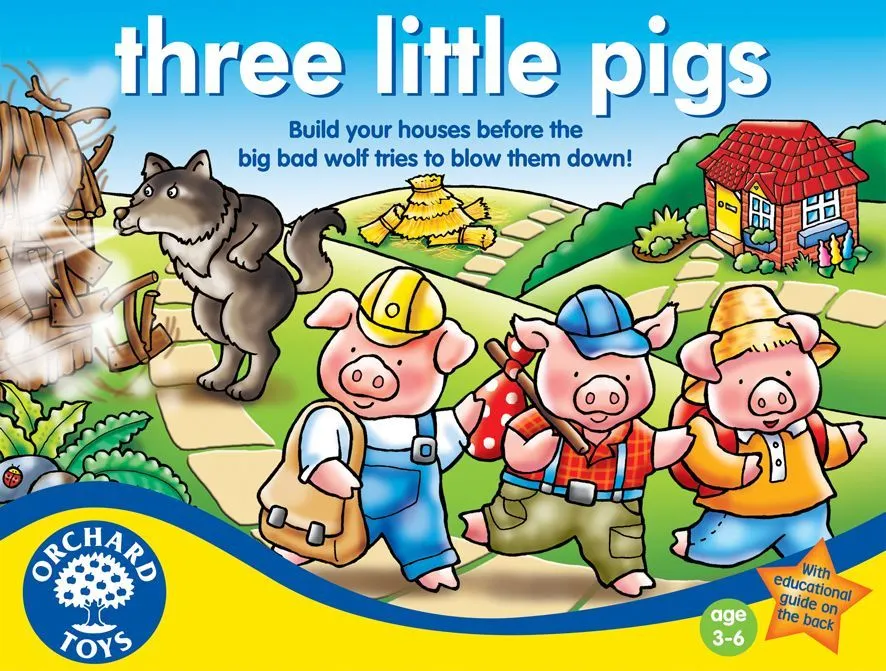
Three Little Pigs is a board game released in 2010 for 2–4 players and ages 3 and up. Its main mechanics are Set Collection and Roll / Spin and Move.




Contents: 1 dice, 1 jigged playing board, 1 wolf spinner, 4 playing piece cards, each showing 3 pigs, 4 coloured card stands, 4 sets of slot-together houses, one of straw, one of sticks and one of brick The object is to build a straw, stick and brick house in front of you before moving your pigs to the safety of the middle of the playing board. Players throw the die to move round the board. If the player lands on a brick, stick or straw square they take a house piece of that type from the pile on the table. If they have already completed that particular house, they do not take a house piece and play passes to the next player. Players are aiming to collect both pieces of each house, which are slotted together in front of them. If the player lands on a wolf square, they spin the wolf spinner. If the spinner points to a stick or straw house, the player may take one of those pieces from another player saying "I’ll huff and I’ll puff, and I will blow your house down!" If they do not need the house piece, because they have already completed that house, they take the piece and return it to the relevant pile on the table. If the spinner points to the brick house, the wolf cannot blow it down, so the player cannot take another player’s house piece. When a player has assembled all three houses, they have to continue to play in order to reach the safety of the middle of the playing board (throwing the exact number, or more to move there). Other players can still take pieces of their completed straw and stick houses. If this happens, then the player who loses a piece/s of their house, must replace it/them before, again, attempting to go to the middle of the playing board. The winner is the first player to reach the safety of the middle of the playing board, having assembled their three houses.
Three Little Pigs supports 2–4 players according to the catalogue. This range comes from the publisher’s listed player count, so the game can be set up for any group size within it. Some setups, rules and scoring details may still vary by player count, so check your edition’s rulebook for the exact configuration.
The catalogue lists Three Little Pigs for ages 3 and up. This is the publisher’s recommendation and reflects reading demands, rule complexity and small components rather than theme alone. Younger players can often join with help from an adult, so check the age guidance on your edition and consider your group’s experience with board games.
Three Little Pigs has a complexity rating of 1.0 out of 5 from BoardGameGeek players, which makes it a light game. The rating reflects how much rules knowledge, planning and decision-making a typical game demands. Expect a longer first teach for heavier games, and use a preparation guide before game night.
Three Little Pigs belongs to these categories: Animals and Children's Game. Its main mechanics are Set Collection and Roll / Spin and Move. Categories describe the theme and setting of a game, while mechanics describe what players actually do on their turns. Each mechanic links to a catalogue hub with similar games, which helps when you want something comparable.
The catalogue lists Three Little Pigs as a base game. It can be played on its own with the components in the box and does not require any other title. Expansions, if any exist, add new content or rules on top of it and are listed separately in the catalogue with a link back to this base game.