

- BGG rank
- BGG #161
- BGG rating
- 8.3
ISS Vanguard
- 1–4 players
- 90–120 min
- Complexity 3.7/5
- 2022
2023
Rules assistance for Utopia
Plain-language explanations of turns, card effects and disputed situations, with official source references and saved question history.
For 1 player
What would you like to know?
Answers come from the official rulebook, with the page to check.
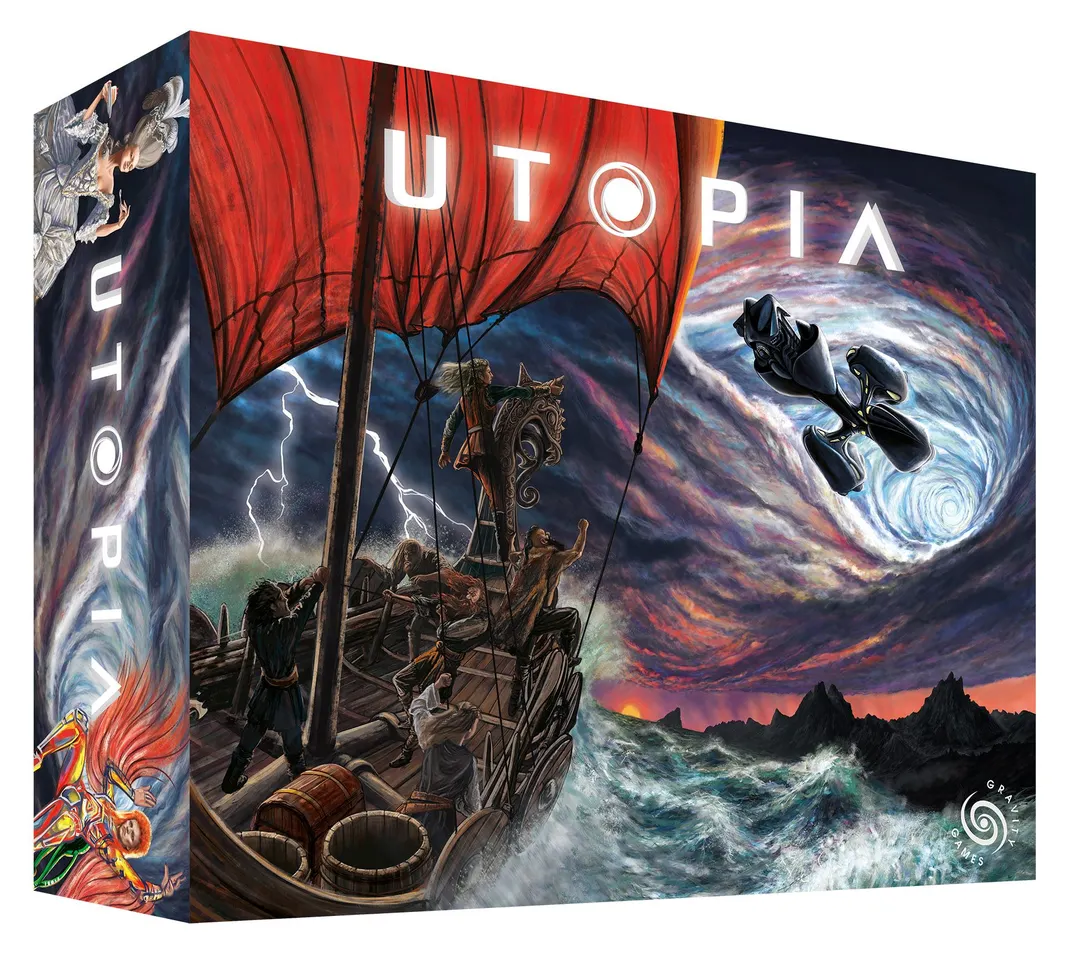
Utopia is a board game released in 2023 for 1–4 players, 90–120 minutes per game, and ages 14 and up. It was designed by James Henchman-Price and its main mechanics are Cooperative Game, Solo / Solitaire Game, and Open Drafting.

You control a shadowy 24th century faction, hell-bent on reordering history to set off a chain reaction which will bring about your utopian vision for the world. At your disposal is a fleet of chronoships, capable of traversing all four dimensions of space and time. You will hunt through all of history to hire the brightest minds to your cause, and each will be given command of one of your precious chronoships. However, you are not the only one with a grand vision for the future and must watch out for rivals, who will attempt to meddle with your plans! The aim of this worker placement game is to be the first to complete three Butterfly Effect Missions. These are iconic moments in history, from the rise of the Roman Empire to the Industrial Revolution, from the Second World War to the colonisation of Mars. Each Butterfly Effect Mission will require knowledge to be collected or technology to be developed. In Utopia, each player will start by drafting two crew-members to activate their first two Chronoships. These crew-members will be famous people from history or the future and each will have different primary and secondary abilities. Primary abilities enhance the collection of one of five types of knowledge: Military, Exploration, Science, Politics or Culture. Secondary abilities come in 13 varieties which will help the player to compete with their rivals, ranging from Merchants to Medics, from Spies to Superstars. It is possible to control an additional three Chronoships by recruiting new crew-members to command them. Chronoships travel through wormholes to visit different locations in space and time, known as Time Zones (TZs). There are 12 TZs in total, TZ1 represents the ancient past, whereas TZ12 represents the distant future. New Alternate TZs will also spawn throughout the game, the “Butterfly Effect” of players meddling with the space-time continuum. -description from designer
Utopia supports 1–4 players according to the catalogue. This range comes from the publisher’s listed player count, so the game can be set up for any group size within it. Some setups, rules and scoring details may still vary by player count, so check your edition’s rulebook for the exact configuration.
The listed playing time for Utopia is 90–120 minutes. This is the publisher’s estimate for a full game. The actual duration depends on the group, the player count and familiarity with the rules: first sessions usually run longer, while experienced groups often finish faster. Setup and teaching time are not included in this estimate.
The catalogue lists Utopia for ages 14 and up. This is the publisher’s recommendation and reflects reading demands, rule complexity and small components rather than theme alone. Younger players can often join with help from an adult, so check the age guidance on your edition and consider your group’s experience with board games.
Utopia has a complexity rating of 3.0 out of 5 from BoardGameGeek players, which makes it a medium-weight game. The rating reflects how much rules knowledge, planning and decision-making a typical game demands. Expect a longer first teach for heavier games, and use a preparation guide before game night.
Utopia belongs to these categories: Science Fiction. Its main mechanics are Cooperative Game, Solo / Solitaire Game, and Open Drafting. Categories describe the theme and setting of a game, while mechanics describe what players actually do on their turns. Each mechanic links to a catalogue hub with similar games, which helps when you want something comparable.
The credited designers of Utopia are: James Henchman-Price. These credits come from the published game data and name the people responsible for the game’s design, not its illustrators or publishers. Designer pages on MeepleRules collect other titles by the same designers, which helps when you enjoy a game and want to find similar ones.
The catalogue lists Utopia as a base game. It can be played on its own with the components in the box and does not require any other title. Expansions, if any exist, add new content or rules on top of it and are listed separately in the catalogue with a link back to this base game.