
- BGG rank
- BGG #16,367
- BGG rating
- 7.9
Ayu
- 2 players
- 45 min
- Complexity 2.5/5
- 2011
2013
Rules assistance for Veletas
Plain-language explanations of turns, card effects and disputed situations, with official source references and saved question history.
For 2 players
What would you like to know?
Answers come from the official rulebook, with the page to check.
Veletas is a board game released in 2013 for 2 players, 45 minutes per game, and ages 5 and up. It was designed by Luis Bolaños Mures and its main mechanics are Square Grid, Grid Movement, and Enclosure.
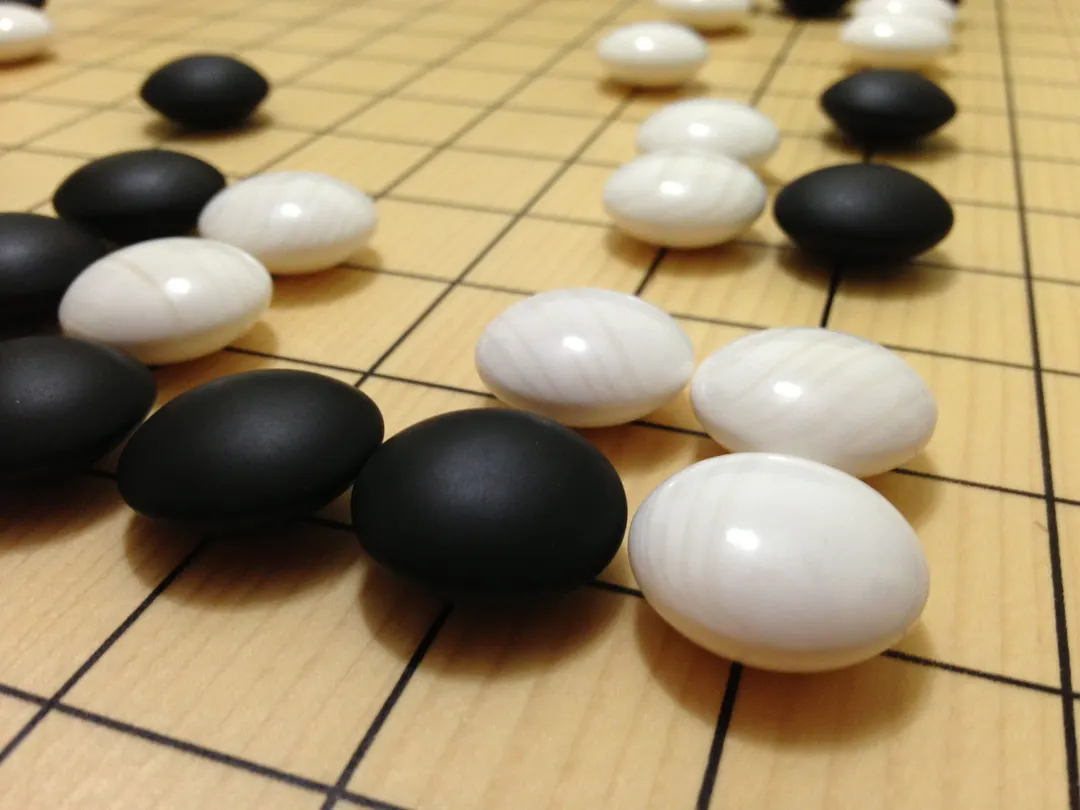


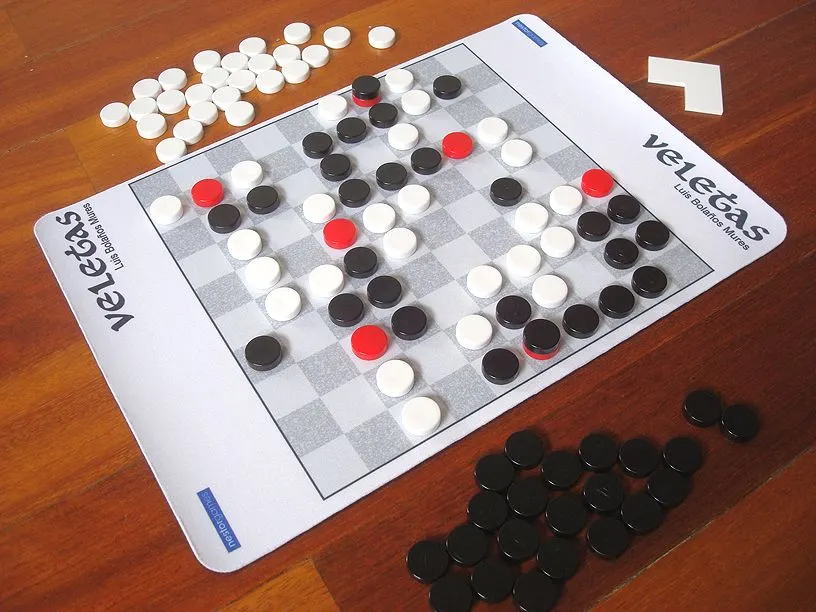
Veletas is a drawless territory game for two players: Black and White. It is played on the spaces (squares) of a 10x10 checkered square board, which is initially empty. Apart from the board, the necessary material comprises seven shooters and a sufficient number of black and white stones. Both players control a number of neutral red pieces and shoot stones of their own colour from them. In order to win, a player must claim a majority of neutral pieces by having them surrounded by larger groups of their own pieces than their opponent's. This game won (along with Four) the BoardGameGeek Best Combinatorial 2-Player Game of 2013 Award. Definitions A group is a set of one or more like-colored, orthogonally adjacent stones. The size of a group is the number of stones in it. Stones on top of shooters are not part of any groups. A trapped shooter is a shooter that cannot make any legal move in the current position. Play The first player begins by placing three shooters and one black stone on empty squares of the board. The second player then chooses which player will be Black and which will be White. Next, White places the remaining four shooters and one white stone on empty squares of the board. In both cases, no shooters can be placed on the perimeter of the board. This restriction does not apply to the rest of the game. From then on, the players take turns, starting with Black. On your turn, you may (but are not obliged to) move a shooter to an empty square in a straight orthogonal or diagonal line, without jumping over any stones. Then, you must place a stone of your color on an empty square that is a straight orthogonal or diagonal line away from the square onto which the shooter was moved (or from any shooter, if none was moved), with no stones in between along that line. This is called shooting. Claimed shooters (see below) cannot move or shoot. Note shooters can move and shoot over claimed or unclaimed shooters. After shooting, if there are any trapped shooters on the board that have not been claimed before, each one of them is claimed by the player who owns the biggest group orthogonally adjacent to it. If there is no such group or the biggest such groups of each color are the same size, the shooter is claimed by the opponent. Claiming a shooter is indicated by placing a stone of the corresponding color on top of it. Claimed shooters remain unchanged for the rest of the game. The game ends when a player has claimed the majority of shooters, i.e. at least four of them. That player wins. Draws are not possible. Smaller versions For shorter but still reasonable games, the following variants are suggested: 7x7 board with three shooters. The first player places one shooter, and White places the other two. Whoever claims two shooters wins. 9x9 board with five shooters. The first player places two shooters, and White places the other three. Whoever claims three shooters wins. Online Play Board Game Arena (real time, turn-based) Boardspace.net (real time, AI option) igGameCenter (real time) AbstractPlay (turn-based) Mobile Apps Boardspace.net local multiplayer or online, IOS Boardspace.net local multiplayer or online, Android
Veletas supports 2 players according to the catalogue. This is the publisher’s listed player count, so the game is designed for exactly that number of participants. Variants for other group sizes, if any, are described in the rulebook of your edition, so check it before setting up a different configuration.
The listed playing time for Veletas is 45 minutes. This is the publisher’s estimate for a full game. The actual duration depends on the group, the player count and familiarity with the rules: first sessions usually run longer, while experienced groups often finish faster. Setup and teaching time are not included in this estimate.
The catalogue lists Veletas for ages 5 and up. This is the publisher’s recommendation and reflects reading demands, rule complexity and small components rather than theme alone. Younger players can often join with help from an adult, so check the age guidance on your edition and consider your group’s experience with board games.
Veletas has a complexity rating of 2.0 out of 5 from BoardGameGeek players, which makes it a medium-light game. The rating reflects how much rules knowledge, planning and decision-making a typical game demands. Expect a longer first teach for heavier games, and use a preparation guide before game night.
Veletas belongs to these categories: Territory Building, Print & Play, and Abstract Strategy. Its main mechanics are Square Grid, Grid Movement, and Enclosure. Categories describe the theme and setting of a game, while mechanics describe what players actually do on their turns. Each mechanic links to a catalogue hub with similar games, which helps when you want something comparable.
The credited designers of Veletas are: Luis Bolaños Mures. These credits come from the published game data and name the people responsible for the game’s design, not its illustrators or publishers. Designer pages on MeepleRules collect other titles by the same designers, which helps when you enjoy a game and want to find similar ones.
The catalogue lists Veletas as a base game. It can be played on its own with the components in the box and does not require any other title. Expansions, if any exist, add new content or rules on top of it and are listed separately in the catalogue with a link back to this base game.